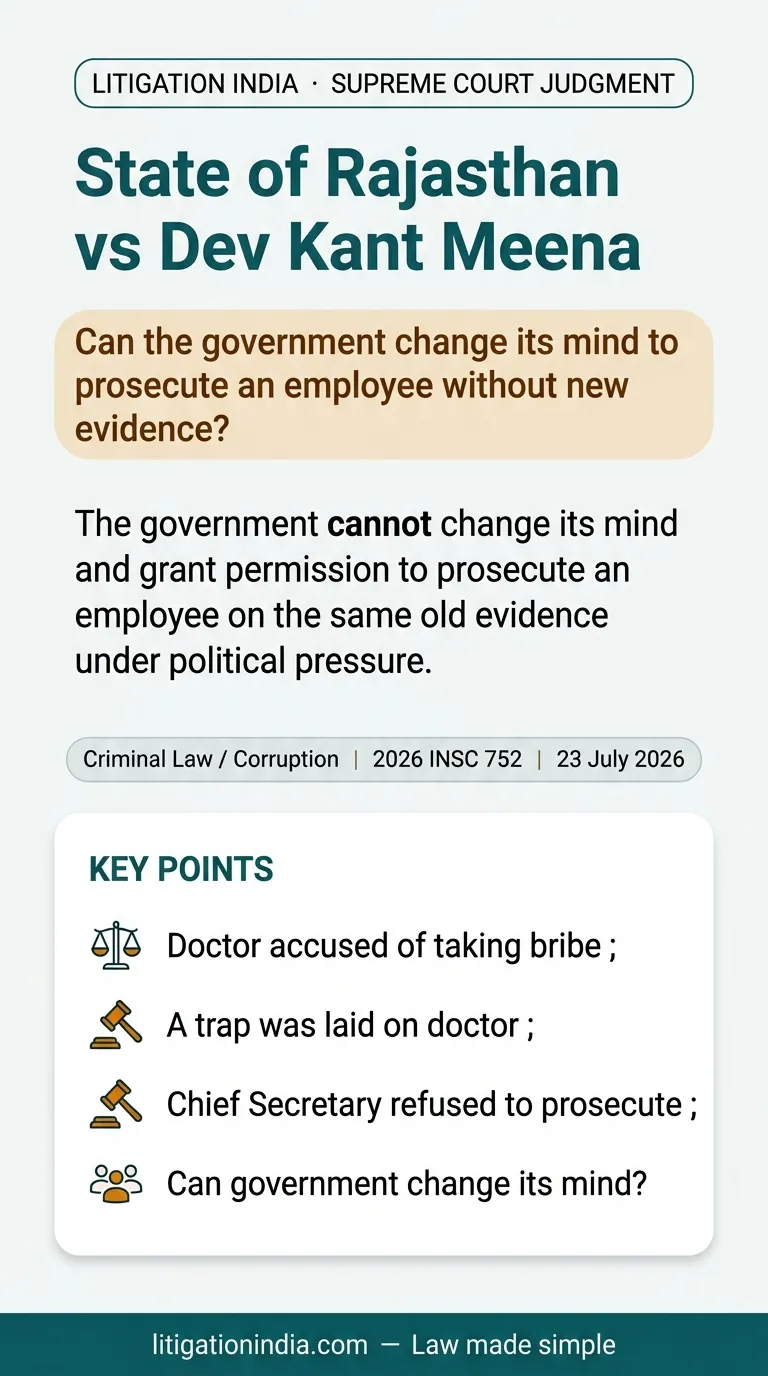
State of Rajasthan vs Dev Kant Meena
The big legal question
Can the government change its mind to prosecute an employee without new evidence?
“The government cannot change its mind and grant permission to prosecute an employee on the same old evidence under political pressure.”
Story Slides
In short
This case is about a government doctor, Dev Kant Meena, who was accused of taking a bribe of Rs. 2,000 for knee surgery. Initially, the higher government authorities investigated the matter and refused to give 'sanction'—which is the official permission needed to put a government officer on trial. They found the bribe claims doubtful and suspected a political setup. However, the Chief Minister’s office pressured them to review this decision. Without any new evidence, the government changed its mind and granted the permission to prosecute him. The doctor challenged this in the High Court, which cancelled the permission. The State of Rajasthan then dragged the case to the Supreme Court. The Supreme Court strictly rejected the government's appeal. It held that once the government decides not to prosecute an employee, it cannot change its decision on the same old files just because of political pressure. A review is only allowed if the police find brand new evidence. The Court criticized the political interference, protected the doctor, and ordered the state government to pay a penalty of Rs. 50,000 for making him fight an unnecessary legal battle.
Background
A government doctor was accused of demanding a bribe for surgery, and police claimed they recovered marked money from his locked drawer. The government department initially refused to permit his prosecution, finding the allegations highly suspicious and politically motivated. Later, under pressure from the Chief Minister's office, the government reversed its decision and granted the permission using the exact same files.
The Decision
The Supreme Court dismissed the government's appeal and upheld the High Court's order cancelling the prosecution permission. It ruled that the government cannot review or change its decision to decline prosecution unless there is genuine new evidence. The Court also ordered the State of Rajasthan to pay Rs. 50,000 to the doctor as compensation for unnecessary harassment.
Why it matters for you
This judgment is a shield for honest public servants against political vendetta and unfair prosecution. It ensures that once a government department clears an employee of false charges, political bosses cannot force a reopen without new proof. It protects government workers from being dragged into courts repeatedly for the same old issue.
AI-assisted summary, reviewed and verified by our editorial team.
Need help with your case?
Facing a similar legal challenge in the Supreme Court or High Court? Connect with our pro bono volunteer advocates today.
Related Supreme Court services