
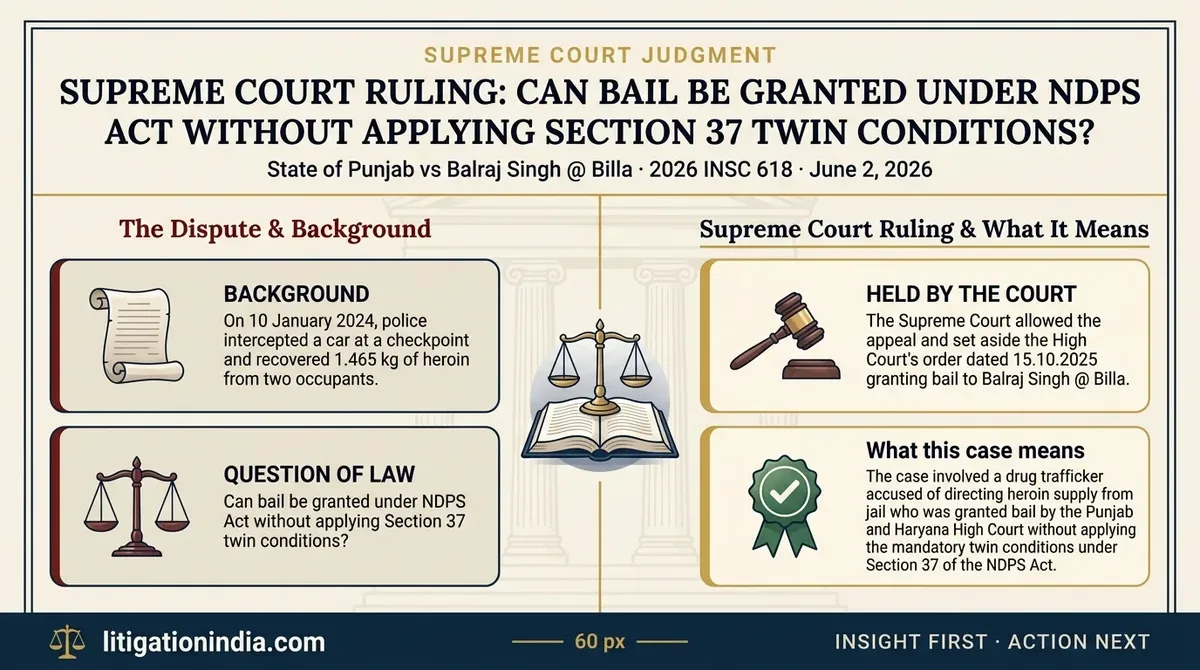
Full text of the judgment
Text extracted from State of Punjab vs Balraj Singh @ Billa. For the authoritative version refer to the Supreme Court of India's official website.
2026 INSC 618 Crl. A. @ SLP (Crl.) 896/2026
Page 1 of 13 REPORTABLE
IN THE SUPREME COURT OF INDIA CRIMINAL APPELLATE JURISDICTION
CRIMINAL APPEAL NO. ____ OF 2026 (@ Special Leave Petition (Crl.) No. 896 of 2026)
STATE OF PUNJAB
… APPELLANT(S)
BALRAJ SINGH @ BILLA … RESPONDENT(S)
J U D G M E N T
SANJAY KAROL, J.
Leave granted. 2. The present appeal has been filed against impugned judgment and order dated 15.10.2025 in CRM-M No. 46383 of 2025 (O&M) Digitally signed by SOURAV PAL Date: 2026.06.02 17:28:23 IST Reason: Signature Not Verified
Crl. A. @ SLP (Crl.) 896/2026
Page 2 of 13 passed by the High Court of Punjab and Haryana at Chandigarh, whereby the respondent herein came to be released on regular bail in connection with FIR No. 06 dated 10.01.2024 registered under Section 21(c)/29/61 and 85 of the Narcotic Drugs and Psychotropic Substances Act, 19851.
Brief Facts
3. The case set up in the subject FIR against the accused persons is that on 10.01.2024, the police had set-up a check point at the bridge on Canal Road, Village Veeram, and were conducting a check of the vehicles passing. Upon seeing the police party, a car (Mahindra XUV 300) bearing registration No. UP-15-DD-6521 attempted to flee, however the car got switched off and stopped on the katcha side of the road. Upon enquiry, the driver of the vehicle identified himself as Gurjit Singh @ Geetu and the other occupant stated his name as Sukhwinder Singh @ Gora. Since no satisfactory response was received qua the papers of the the car, the police suspected presence of intoxicant material in their possession.
4. Consequently, notice was issued to them under Section 50 of the NDPS Act and the Deputy Superintendent of Police, arrived at
1 Hereinafter ‘NDPS Act’.
Crl. A. @ SLP (Crl.) 896/2026
Page 3 of 13 the stop to conduct search. He prepared consent memos for the search and signature of both these persons was taken. Upon search, a total of 1. 465 Kg., of heroin was recovered from their possession. The said contraband was weighed, sealed and seized vide recovery memos. This was after compliance of the statutory provisions mandated under Section 50 of the NDPS Act. The FSL report confirmed that the recovered substance is diacetylmorphine/heroin.
5. The case against the respondent herein, Balraj Singh @ Billa, is that the co-accused persons have made a disclosure on 11.01.2024 that the respondent had directed them to collect the heroin from the canal area and keep it for further supply on his instructions, while lodged in Central Jail, Goindwal Sahib. Pursuant thereto, he came to be arrayed as an accused vide DDR dated 11.01.2024. It was further found during investigation that the respondent is operating a drug trafficking network from inside jail using illegal mobile phones.
6. The respondent preferred an application seeking regular bail before Ld. Judge Special Court Tarn Taran, which came to be numbered as B.A. 1868/2025. The same came to be rejected vide order dated 03.07.2025. An appeal was preferred by the respondent
Crl. A. @ SLP (Crl.) 896/2026
Page 4 of 13 before the High Court of Punjab and Haryana at Chandigarh which came to be numbered as CRM-M-46383-2025 (O&M).
7. The High Court vide the impugned order dated 15.10.2025 granted regular bail to the respondent. On the aspect of criminal antecedents, the Court observed that antecedents alone cannot be the basis for refusal of prayer of bail. The Court relied upon the period of custody and the likelihood of the trial taking a considerable time to release the respondent on bail.
8. It is a matter of record that in relation to the very same FIR, all three accused persons had preferred applications for bail under Section 483 of the Bhartiya Nagrik Suraksha Sanhita, 2023. These applications were allowed and all three accused persons were granted bail vide separate orders. Here we may observe that in relation to the other two accused persons, this Court vide orders dated 24.04.2026 in Crl. Appeal @ SLP (Crl.) No. 5075 of 2026 and Crl. Appeal @ SLP (Crl) No. 5020 of 2026 has already set aside the order granting bail by the High Court, hence we need not elaborately deal with the legal issues therein.
9. In the instant case after hearing the learned counsel for the parties this Court vide the interim order dated 07.04.2026 had
Crl. A. @ SLP (Crl.) 896/2026
Page 5 of 13 directed the instant respondent Balraj Singh @ Billa to surrender. It is a matter of record that the present respondent has thus surrendered, as is evident from the affidavit of Mr. Surendra Lamba, dated 09.04.2026.
Submissions 10. The appellant, State of Punjab, has submitted that vide the impugned order the respondent has been erroneously granted bail. We have heard Mr. Shadan Farasat, learned senior counsel and Mr. Rajat Bhardwaj, learned Additional Advocate General. The substantial grounds of challenge are as follows: (a) The bar under Section 37 of the NDPS Act has been ignored by the High Court, in violation of the ratio laid down in State of Meghalaya v. Lalrintluanga Sailo & Anr.2 and Union of India v. Ajay Kumar Singh3; (b) The present case involves commercial quantity, therefore, the respondent ought not to have been released on bail; and (c) Respondent has 3 antecedents of similar nature, which has been ignored by the High Court.
2 2024 SCC OnLine SC 1751. 3 2023 SCC OnLine SC 346.
Crl. A. @ SLP (Crl.) 896/2026
Page 6 of 13 11. The respondent has submitted that the High Court has rightly released him on regular bail. He has no connection with the subject FIR and has been falsely implicated in the matter. Pertinently, no reference has been made to him in the FIR and no recovery was effected from him. The respondent has been incarcerated for 1 year 7 months and investigation stood completed. Only 2 out of 24 prosecution witnesses were examined, therefore the trial is not likely to conclude soon.
Our View 12. At the outset, it has been reiterated by this Court that on many occasions, an appeal against grant of bail and an application for cancellation of bail stand on a different footing [See: Ashok Dhankad v. State NCT of Delhi4]. Coming to the case at hand, in our view, the issue which arises for our consideration is whether the order granting bail of the High Court is in consonance with the settled principles of law concerning Section 37 of the NDPS Act?
13. For ready reference, Section 37 of the NDPS Act reads as follows: “37. Offences to be cognizable and non-bailable. –
4 2025 SCC OnLine SC 1690.
Crl. A. @ SLP (Crl.) 896/2026
Page 7 of 13 (1) Notwithstanding anything contained in the Code of Criminal Procedure, 1973 (2 of 1974), — (a) every offence punishable under this Act shall be cognizable; (b) no person accused of an offence punishable for [offences under Section 19 or Section 24 or Section 27-A and also for offences involving commercial quantity] shall be released on bail or on his own bond unless— (i) the Public Prosecutor has been given an opportunity to oppose the application for such release, and (ii) where the Public Prosecutor oppose the application, the court is satisfied that there are reasonable grounds for believing that he is not guilty of such offence and that he is not likely to commit any offence while on bail. (2) The limitations on granting of bail specified in clause (b) of sub-section (1) are in addition to the limitations under the Code of Criminal Procedure, 1973 (2 of 1974)4, or any other law for the time being in force on granting of bail.]”
(emphasis supplied)
14. As rightly submitted by the appellant State, this Court, in Lalrintluanga Sailo (Supra) while setting aside the bail granted by the High Court therein had held that consideration on the twin conditions under Section 37 of the NDPS Act is essential by the concerned Court. It was observed: “5. There cannot be any doubt with respect to the position that in cases involving commercial quantity of narcotic drugs or psychotropic substances, while considering the application of bail, the court is bound to ensure the satisfaction of conditions
Crl. A. @ SLP (Crl.) 896/2026
Page 8 of 13 under Section 37(1)(b)(ii) of the NDPS Act. The said provision reads thus:
“37. (1)(b)(ii) where the Public Prosecutor opposes the application, the court is satisfied that there are reasonable grounds for believing that he is not guilty of such offence and that he is not likely to commit any offence while on bail.”
7. In the decision in Collector of Customs v. Ahmadalieva Nodira [Collector of Customs v. Ahmadalieva Nodira, (2004) 3 SCC 549 : 2004 SCC (Cri) 834] , the three-Judge Bench of this Court considered the provisions under Section 37(1)(b) as also Section 37(1)(b)(ii) of the NDPS Act, with regard to the expression “reasonable grounds” used therein. This Court held that it means something more than the prima facie grounds and that it contemplates substantial and probable causes for believing that the accused is not guilty of the alleged offence. Furthermore, it was held that the reasonable belief contemplated in the provision would require existence of such facts and circumstances as are sufficient in themselves to justify satisfaction that the accused is not guilty of the alleged offence.
10. Thus, the provisions under Section 37(1)(b)(ii) of the NDPS Act and the decisions referred supra revealing the consistent view of this Court that while considering the application for bail made by an accused involved in an offence under the NDPS Act a liberal approach ignoring the mandate under Section 37 of the NDPS Act is impermissible. Recording a finding mandated under Section 37 of the NDPS Act, which is sine qua non for granting bail to an accused under the NDPS Act cannot be avoided while passing orders on such applications.” (emphasis supplied)
Crl. A. @ SLP (Crl.) 896/2026
Page 9 of 13 15. To the similar effect, this Court in State by the Inspector of Police v. B. Ramu5 reiterated that satisfaction with the conditions laid down under Section 37 of the NDPS Act is mandatory while entertaining a prayer for bail involving commercial quantity of narcotic drugs. [See also: Ajay Kumar Singh alias Pappu (Supra)]
16. In similar circumstances, this Court in Union of India v. Namdeo Ashruba Nakade6 observed that the mandatory nature of Section 37 cannot be dispensed with:
“12. Prima facie this Court is of the opinion that the Respondent-accused is involved in drug trafficking in an organized manner. Consequently, no case for dispensing with mandatory requirement of Section 37 of the NDPS Act is made out in the present matter.
13. Moreover, this Court is of the view that as the accused has been charged with offences punishable with ten to twenty years rigorous imprisonment, it cannot be said that the Respondent has been incarcerated for an unreasonably long time.”
(emphasis supplied)
17. Keeping in view the above expositions of law, we now proceed to examine the impugned order. The abovementioned decisions of this Court display the consistent view that when it
5 2024 SCC OnLine SC 4073. 6 2025 SCC OnLine SC 3049.
Crl. A. @ SLP (Crl.) 896/2026
Page 10 of 13 comes to cases involving commercial quantity of narcotics, the mandatory requirements of Section 37 ought to be considered. It is not in dispute that the case at hand, involves commercial quantity. In such a scenario, consideration and reference to the twin conditions enumerated under Section 37 of the NDPS Act was mandatory. Upon a bare perusal of the impugned order, it is evident that there has been no consideration at all by the High Court on the twin conditions. In such a scenario, the impugned order cannot be sustained in the eyes of law.
18. Upon consideration of the case of the respondent against the twin conditions laid down in Section 37, we are of the view that no case for bail is made out. There are antecedents involving commission of offences of the very same nature under the NDPS Act, therefore it cannot be said that he is not likely to commit such an offence while on bail.
19. Moreover, the respondent has only undergone 1 year 7 months, and if found guilty a maximum sentence of twenty years may be imposed upon him. Therefore, it cannot be said that he has suffered incarceration for a long period, warranting interference in view of Article 21 of the Constitution.
Crl. A. @ SLP (Crl.) 896/2026
Page 11 of 13 20. While this Court has recognized on several occasions that prolonged incarceration warrants the grant of bail in view of Article 21 of the Constitution, we have noticed that the application thereof is not uniform. Moreover, there is no doubt that what constitutes “prolonged incarceration” for the purposes of bail, has not been expounded by this Court or the law of the land.
21. While judicial discretion is an important facet of justice dispensation, this Court cannot overlook the fact that similarly situated persons in custody may receive different outcomes, dependent on the approach adopted by the respective bench. At this stage, we deem it appropriate to refer to a chart of decisions by coordinate benches of this Court, including a chart submitted by Mr. Mr. Shadan Farasat, learned senior counsel on this aspect:
Case Name Period of Incarceration Outcome Bench Statute involved Harpreet Singh Talwar @ Kabir Talwar v. State of Gujarat [2025 INSC 662] 2 years 9 months Bail not granted 2JB NDPS & UAPA Union of India v. Vigin K. Varghese [2025 SCC OnLine SC 2440] More than 3 years Order granting bail set aside 2JB NDPS
Crl. A. @ SLP (Crl.) 896/2026
Page 12 of 13 Union of India v. Namdeo Ashruba Nakade [2025 SCC OnLine SC 3049] More than 2 years Order granting bail set aside 2JB NDPS Rabi Prakash v. State of Odisha [2023 SCC OnLine SC 1109] 3 years 6 months Bail granted 2JB NDPS Ankur Chaudhary v. State of M.P. [2024 SCC OnLine SC 2730] More than 2 years Bail granted 2JB NDPS Narcotic Control Bureau v. Lakhwinder Singh [2025 SCC OnLine SC 366] 4 years 6 months Bail granted 2JB NDPS Badsha Sk. v. State of W.B. [2023 SCC OnLine SC 1867] 2 years 4 months Bail granted 2JB NDPS
22. However, we note that recently this Court in Tasleem Ahmed v. State Govt. of NCT of Delhi7 has referred the question concerning the approach of constitutional Courts in bail matters under special statutes, where “Article 21, prolonged incarceration and statutory restrictions intersect”. In view of the said reference, we do not wish to deliberate on this issue further, save and except that in our view paramount consideration is nothing but interest of justice for all. Should there be any conflict between the sovereignty of country and personal liberty, undoubtedly, the former shall prevail, particularly, when a war is waged against the nation, be it in the form of supply
7 Crl. A. @ SLP (Crl.) No. 2867/2026.
Crl. A. @ SLP (Crl.) 896/2026
Page 13 of 13 of drugs, which vitally affects the national economy and health of the people.
23. Consequently, the appeal is allowed. The impugned order dated 15.10.2025 in CRM-M No. 46383 of 2025 (O&M) passed by the High Court of Punjab and Haryana at Chandigarh is set aside.
24. Pending applications, if there are any, stand dismissed.
……………………………………………..J. (SANJAY KAROL)
………..…………………………………….J. (NONGMEIKAPAM KOTISWAR SINGH)
New Delhi June 2, 2026