
Full text of the judgment
Text extracted from State of Kerala & Anr. vs P. Krishna Pillai & Ors.. For the authoritative version refer to the Supreme Court of India's official website.
2026 INSC 1212 Page 1 of 16
IN THE SUPREME COURT OF INDIA CIVIL APPELLATE JURISDICTION
CIVIL APPEAL NO. 10198 OF 2010
STATE OF KERALA & ANR.
….APPELLANTS
P. KRISHNA PILLAI & ORS.
…RESPONDENTS
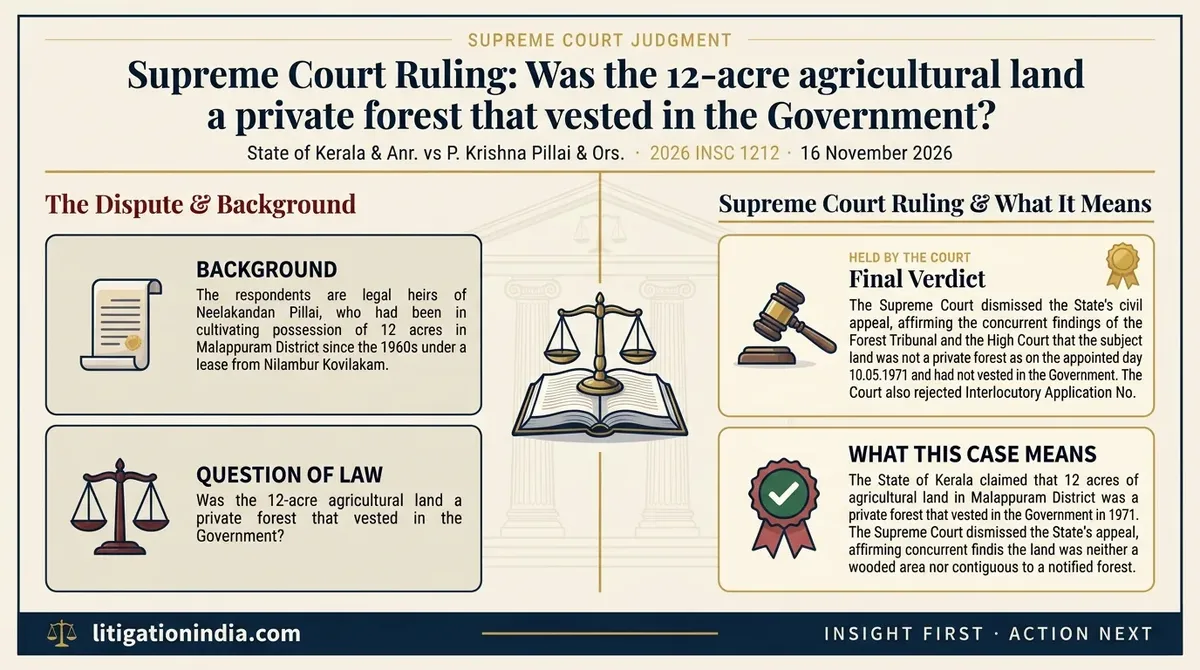
1. This appeal is directed against the judgment dated 02.01.2008 passed by the Division Bench of the High Court1 in an appeal2. The High Court, by the aforesaid judgment, affirmed the order dated 29.09.2001 passed by the Forest Tribunal by which it had declared that 12 acres of land situate in Nilambur Amsom, Edakkara Village, Ernad Taluk, Malappuram District (‘the subject land’) is not a private forest and thus did not vest in the State Government.
FACTUAL BACKGROUND
2. The respondents are the legal representatives of one Neelakandan Pillai. According to respondents, in October 1960, the subject land,
1 High Court of Kerala at Ernakulam 2 M.F.A. No. 166 of 2002 Digitally signed by KAPIL TANDON Date: 2026.11.16 17:09:33 IST Reason: Signature Not Verified
Page 2 of 16
along with 60 acres adjoining land were leased out by the Nilambur Kovilakam to one Koolimanikkath Dayanandan, who in turn, leased out the subject land to father of the respondents. Late Neelakandan Pillai was in cultivating possession of the subject land till his death in October 1976 and used to grow paddy and tapioca. Upon his death, the subject land devolved on the respondents who have continued to remain in possession of the same. 3. On 23.11.1988, the officials of the Forest Department obstructed the respondents from carrying on agricultural operations on the subject land. Thereafter, on 05.01.1989, the respondents filed an application under Section 8 of the Kerala Private Forests (Vesting and Assignment) Act, 1971 (‘the Act’) before the Forest Tribunal. The respondents sought a declaration on the ground that the subject land is not a private forest and the same has not vested in the Government. Alternatively, it was pleaded that the respondents are entitled to exemption under Sections 3(2) and 3(3) of the Act. 4. The Forest Tribunal by an order dated 29.06.1991, inter alia, held that the application filed by the respondents was not barred by limitation, as neither the inclusion of the land in the notification nor its publication under Rule 2A of the Kerala Private Forests (Vesting
Page 3 of 16
and Assignment) Rules, 1974 (‘the Rules’) was proved. However, the Tribunal found that the documents relied upon by the respondents were not proved, and that the possession of their father of the subject land on the appointed day i.e. 10.05.1971 under the Madras Preservation of Private Forests Act, 1949 (‘the MPPF Act’) was not established. The Tribunal concluded that the subject land was a private forest as on the appointed day i.e. 10.05.1971. Accordingly, the application under Section 8 of the Act was dismissed. 5. Being aggrieved, the respondents preferred an appeal. The High Court vide judgment dated 28.11.2000, inter alia held that the respondents had not proved their ownership. It was further held that the respondents would be entitled to the benefit of Sections 3(2) and 3(3) of the Act only if the subject land is a vested private forest. It was noticed that the Tribunal did not record any finding whether the subject land is a vested private forest. The High Court, therefore, remanded the matter to the Tribunal on the limited question whether the subject land was covered under the Act under a valid notification or was covered under the MPPF Act. 6. On remand, the respondents did not adduce any further evidence. However, the appellants examined the Range Officer and produced
Page 4 of 16
Exhibits B3-B7 which included the periphery sketch of the vested forest. The Forest Tribunal, by an order dated 29.09.2001, held that (i) there was no evidence that the subject land was governed by the MPPF Act, the Range Officers examined as RW1 and RW2 having admitted that there was no document to establish it; (ii) the notification took in only surveyed portions of Edakkara Village whereas the subject land is unsurveyed, and its publication under Rule 2A of the Rules was not proved; and (iii) the Commissioner found only bamboo clusters less than 10 years old and four wells, and the subject land was not a forest on 10.05.1971. Accordingly, the Tribunal allowed the application and declared that the subject land is not a private forest and has not vested in the Government. VIEWS OF HIGH COURT
7. The appellants challenged the order of the Tribunal in an appeal. The High Court, by the impugned judgment, held that vesting under Section 3(1) of the Act takes place automatically on the appointed day, whether or not the land is demarcated and notified, provided the land is a private forest as defined under the Act. Since the subject land is admittedly situated in the erstwhile Malabar District, it had
Page 5 of 16
to be shown to be land to which the MPPF Act applied immediately before the appointed day. 8. The High Court read Section 1(2) of the MPPF Act with the definition of ‘forest’ in Section 2(a), and held that the subject land had to be declared a forest by a notification of the Government. It noted that no such notification was published, and that the notification of 1949 referred to in the memorandum of appeal had not been produced. The High Court also took note of the findings of the Tribunal that, except bamboo clusters about 10 years old, there were no forest trees on the subject land, that there were four wells, and that the subject land was not contiguous to any forest area notified under the MPPF Act. It held that, in the absence of a notification under Section 2(a), there was no automatic vesting under Section 3(1) and the Act itself was not applicable. Accordingly, the appeal was dismissed.
PROCEEDINGS BEFORE THIS COURT: -
9. Being aggrieved, the appellants approached this Court. This Court while taking note of the statement of PW1 in his cross-examination that the Forest Department claimed lands on the eastern, northern and western sides of the property, and that the land on the eastern side had an extent of more than 100 acres, by an order dated
Page 6 of 16
16.11.2021 directed the appellants to file an affidavit indicating the present status of the properties to the west, north and east. 10. In compliance with the aforesaid order, the Chief Conservator of Forests and Custodian of Vested Forests inspected the subject land on 24.11.2021 and filed an affidavit. According to the appellants, the subject land is situated within Vested Forest Committee (VFC) Item Nos. 1, 16 and 38 and is covered with natural vegetation of moist deciduous and semi-evergreen species. In the affidavit it is stated that most of the trees are more than 75 years old, and adjoin the vested forest on its boundaries except for a private holding and a road. 11. The appellants also filed I.A. No. 5666 of 2022 seeking permission to place additional documents on record. The appellants along with the said application for the first time produced Notification No. 471 dated 30.10.1900 issued under the Madras Forest Act, 1882, by which the Government took over the management of the Nilambur leased forests. A bench of this Court, on 24.07.2025, noticed that the said notification had not been produced either before the High Court or before this Court since 2008. The appellants were, therefore, directed to file an affidavit of a senior officer explaining how, when and from
Page 7 of 16
which record, the said notification was discovered. Pursuant thereto, an affidavit dated 22.08.2025 was filed, wherein it is stated that the document was traced in 2021 from the Forest Headquarters, Thiruvananthapuram, along with copies obtained for prosecution of forest offences. It is further stated in the affidavit that the question of contiguity with the reserve forests was neither raised before the Tribunal nor before the High Court, and that the omission to produce the notification was not deliberate. 12. On 16.03.2022, the respondents, by way of reply, placed on record photographs and affidavits of local residents, which disclose the following facts: (i) the subject land was cultivated till about 1980, (ii) cultivation was given up owing to interference by the Forest Department, and (iii) the subject land is situated close to a police station, a hospital and a school. Thereupon, the appellants filed a reply affidavit dated 29.03.2022 of the Chief Conservator of Forests and Custodian of Vested Forests. SUBMISSIONS 13. Mr. Jaideep Gupta, learned senior counsel for the appellants submitted that the High Court erred in not examining whether the subject land is a private forest under Section 2(f)(1)(ii) of the Act. It
Page 8 of 16
was pointed out that the Tribunal had found that the subject land is not a private forest under Section 2(f)(1)(ii) of the Act, the High Court ought to have examined whether such findings were sustainable. It was further submitted that there is no need for a notification under Section 2A of the Act and the vesting of the private forest in the Government is automatic. It was contended that though the State had not produced any document to show that the subject land was covered under the Madras Act, but before this Court, a notification dated 30.10.1900 has been produced to show that subject land is a private forest as the same is included in the notification published under the Madras Forest Act, 1882. It was therefore prayed that the matter be remitted to the High Court to decide the appeal afresh in the light of aforesaid notification. 14. Mr. A. Hariprasad, learned senior counsel for the respondents supported the order passed by the High Court and submitted that concurrent findings of fact recorded by the Tribunal and the High Court do not call for any interference. It was contended that Section 2(c) of the MPPF Act defines ‘owner’ to include a lessee or any other person entitled to possession, and therefore a registered document of title is not necessary. It was urged that the notification dated
Page 9 of 16
30.10.1900 cannot be relied upon as the same fails to indicate that the subject land is a private vested forest. It was also pointed out that the said document has been produced 125 years after its existence and the entire topography of the lands would have been changed beyond recognition in such a long duration of time. It was therefore prayed that the appeal be dismissed. STATUTORY PROVISIONS
15. Before proceeding further, it is apposite to take note of the relevant statutory provisions. The Act was enacted to provide for the vesting in the Government of private forests in the State of Kerala and for the assignment thereof to agriculturists and agricultural labourers for cultivation. Section 2(f) of the Act, in so far as it is relevant, reads as under: “(f) “private forest” means— (1) in relation to the Malabar district referred to in sub-section (2) of Section 5 of the States Reorganisation Act, 1956 (Central Act 37 of 1956)— (i) any land to which the Madras Preservation of Private Forests Act, 1949 (Madras Act XXVII of 1949), applied immediately before the appointed day excluding—
Page 10 of 16
(A) lands which are gardens or nilams as defined in the Kerala Land Reforms Act, 1963 (1 of 1964); (B) lands which are used principally for the cultivation of tea, coffee, cocoa, rubber, cardamom or cinnamon and lands used for any purpose ancillary to the cultivation of such crops or for the preparation of the same for the market. …
xxx xxx xxx (ii) any forest not owned by the Government, to which the Madras Preservation of Private Forests Act, 1949 did not apply, including waste lands which are enclaves within wooded areas.”
16. Thus, Section 2(f)(1) of the Act contemplates two categories of private forests in relation to the Malabar District. The first one being the land to which the MPPF Act applied immediately before the appointed day, subject to the exclusions contained therein. The second one being any forest not owned by the Government to which the MPPF Act did not apply, including waste lands which are enclaves within wooded areas. 17. Section 3(1) of the Act provides that, notwithstanding anything contained in any other law, contract or document, but subject to subsections (2) and (3), with effect on and from the appointed day, the ownership and possession of all private forests in the State of Kerala
Page 11 of 16
shall, by virtue of the Act, stand transferred to and vested in the Government free from all encumbrances. Section 8(1) of the Act provides that where any dispute arises as to whether any land is a private forest or not, or whether any private forest or portion thereof has vested in the Government or not, the person who claims that the land is not a private forest or that the private forest has not vested in the Government may apply to the Tribunal for decision of the dispute. 18. The MPPF Act is an Act to prevent the indiscriminate destruction of private forest and interference with customary and prescriptive rights therein and for certain other purposes. Relevant extract of Section 1(2) of the MPPF Act, reads as under: “1(2) It applies— (i) to private forests in the districts of Malabar and South Kanara having a contiguous area exceeding 100 acres. Explanation:— Nothing in this clause shall be deemed to apply to any land which was brought under fugitive or other cultivation prior to the 14th December, 1949, by an owner or any person claiming under him; (ii) to forests situated in estates as defined in the Madras Estates Land Act, 1908 (Madras Act I of 1908) in the Malabar District; (iii) to private forests situated in other areas in the Malabar District and having a
Page 12 of 16
contiguous area exceeding 100 acres which may be declared by the State Government to be forests for the purposes of this Act by notification in the Kerala Government Gazette, but does not apply to reserved forests constituted under the Madras Forest Act, 1882 (Madras Act V of 1882) and lands at the disposal of the Government as defined in that Act.”
Thus, the MPPF Act applies to private forests in the districts of Malabar and South Kanara having a contiguous area exceeding 100 acres. However, Section 1(2)(iii) provides that the Act shall not apply to private forests situate in other areas in Malabar district and having a contiguous area exceeding 100 acres which may be declared by the State Government to be forests for the purposes of this Act by notification in the Kerala Government Gazette but does not apply to reserved forests constituted under Madras Forests Act, 1882 and the lands at the disposal of the Government as defined in that Act. 19. A conjoint reading of the aforesaid provisions makes it evident that, with effect from the appointed day, i.e., 10.05.1971, the ownership and possession of all private forests in the State stood vested in the Government by operation of law. The vesting is automatic and does not depend upon the demarcation of boundaries under Section 6 of
Page 13 of 16
the Act or the issuance of a notification under Rule 2A of the Rules. However, what vests in the Government is only a ‘private forest’ as defined in Section 2(f) of the Act. ANALYSIS
20. In the instant case, the solitary issue which arises for consideration is whether the subject land was a private forest on the appointed day, i.e. 10.05.1971 which vested with the State Government under the Act. 21. It is well settled in law that in a proceeding under Section 8 of the Act, the burden of proving the fact that the land is not a private forest lies on the person who asserts the same.3 At the same time, the standard of proof is that of preponderance of probabilities, and the claimant is not required to prove every historical fact with certainty.4 In the instant case, the respondents relied on the Commissioner’s report, Exhibit C1, showing young bamboo clusters, four wells and private holdings around the subject land. The State, which holds the records of survey and notification, examined RW1 and RW2, both of whom admitted that there was no document to establish that the
3 Kunjanam Antony v. State of Kerala, (2003) 3 SCC 221 and State of Kerala v. Popular Estates, (2004) 12 SCC 434 4 M. Jameela v. State of Kerala, 2025 SCC OnLine SC 2264
Page 14 of 16
subject land was governed by the MPPF Act. No evidence was led by the State as to the nature of the subject land as on the cutoff date i.e. 14.12.1949 or immediately before the appointed day under the MPPF Act. 22. The statement of PW1 (Sasidharan Pillai, s/o original lessee Neelakandan Pillai), only shows that Forest Department is claiming the adjoining lands. It does not amount to an admission that the subject land was a private forest, or the subject land is situated contiguous to a private forest. 23. A two-Judge Bench of this Court5 while dealing with provisions of the Act held that the word ‘forest’ means a large tract of uncultivated land covered with trees and underwood, excluding lands on which human skill and labour have been spent for agricultural operations. The Tribunal in consonance with the meaning of the expression ‘forest’ approved by this Court, on the basis of the Report of the Commissioner and on the basis of material available on record, held that the subject land was neither a wooded area nor an enclave as on the appointed day i.e. 10.05.1971 and concluded that subject land is not a private forest. The High Court has affirmed the aforesaid
5 Bhavani Tea and Produce Co. Ltd. v. State of Kerala, (1991) 2 SCC 463
Page 15 of 16
finding of fact which cannot be termed as perverse warranting interference in this appeal. I.A. No. 5666 of 2022
24. It is trite law that a party may be permitted to adduce additional evidence at the appellate stage only if it proves that despite due diligence, the same could not be produced earlier. A party cannot be permitted to adduce evidence to fill up the lacunae or to setup a new case. In the instant case, the appellants have produced a Notification No. 471 dated 30.10.1900 which relates to Nilambur leased forests to contend that the subject land formed part of a contiguous forest. It is pertinent to note that the copy of the aforesaid notification was attested only on 20.11.1993, several years after the remand by the High Court in the year 2000 by which the very question of contiguity of the subject land was remitted for reconsideration. However, the appellants neither tendered the aforesaid notification before the Tribunal on remand nor before the High Court. The explanation offered by the appellants exhibits lack of due diligence. 25. Even otherwise, the aforesaid notification does not contain any description by which the subject land can be identified, or it can be inferred that the same is having a contiguous area. According to the
Page 16 of 16
State’s affidavit, the private forest pertains to Kariam Muriam block forest and there is no material on record to show that it is contiguous to the subject land. By placing reliance on the aforesaid notification, the State has attempted to set up a case which is inconsistent with the case itself set up by it that the subject land was a private forest which vested with the State Government under the Act. For the aforementioned reasons, we are not inclined to entertain I.A. 5666 of 2022. Accordingly, the same is rejected. CONCLUSION
26. For the foregoing reasons, we do not find any merit in this appeal, the same fails and is therefore, dismissed. Pending application(s), if any, shall stand disposed of. There shall be no order as to costs.
………………………………………………J. [PAMIDIGHANTAM SRI NARASIMHA]
………..……………………………………J. [ALOK ARADHE]
NEW DELHI; NOVEMBER 16, 2026.