
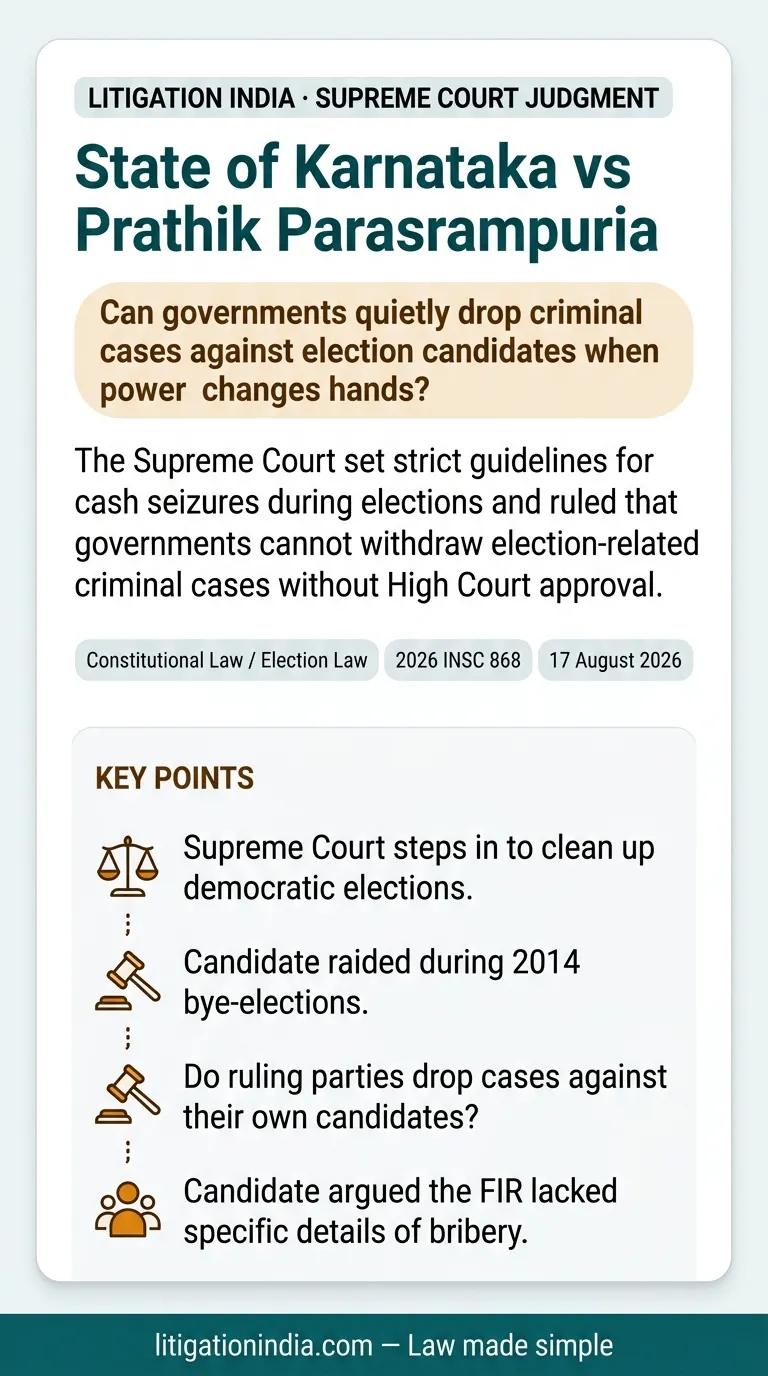
Can governments quietly drop criminal cases against election candidates when power changes hands?
State of Karnataka vs Prathik Parasrampuria
Case: State of Karnataka vs Prathik ParasrampuriaCitation: 2026 INSC 868Decided on: 17 August 2026
“The Supreme Court set strict guidelines for cash seizures during elections and ruled that governments cannot withdraw election-related criminal cases without High Court approval.”
Story Slides
In short
This landmark judgment by the Supreme Court of India addresses the corrupting influence of black money and bribery in democratic elections. The case began when the Karnataka High Court quashed a criminal case against an election candidate from whom over twenty lakh rupees in cash was seized during the 2014 bye-elections. Karnataka appealed, and the Supreme Court expanded the case to fix major loopholes in how election crimes are investigated. To prevent ruling parties from saving their own candidates after winning, the Supreme Court ruled that state governments cannot unilaterally withdraw election-related criminal cases. Any such withdrawal now strictly requires the permission of the respective state High Court. Additionally, the Court laid down strict procedures for flying squads and surveillance teams. When authorities seize cash or valuables during elections, they must record written reasons proving a connection to an election offence and report it to a magistrate within twenty-four hours. Furthermore, investigations into election-related offenses must generally be completed within one year. If Static Surveillance Teams find cash exceeding ten lakh rupees, they must immediately inform the Income Tax authorities. This decision ensures that election-related crimes are prosecuted fairly, transparently, and swiftly, protecting the integrity of the voting process from political manipulation.
Need clarity on a similar legal issue?
Request free pro bono guidance from a Supreme Court Advocate.
Background
During the 2014 Lok Sabha bye-elections in Bellary, authorities raided an election candidate and seized over twenty lakh rupees in cash suspected of being used for bribing voters. The Karnataka High Court quashed the criminal case against the candidate, prompting the State of Karnataka to appeal to the Supreme Court.
The Decision
The Supreme Court ordered that state governments cannot withdraw election crime cases without High Court approval. It also ordered that all election cash seizures must be reported to a magistrate within twenty-four hours with recorded written reasons, and investigations must be finished within one year.
Why it matters for you
This judgment stops winning political parties from letting their corrupt candidates off the hook by simply dropping criminal cases. It also protects ordinary citizens from harassment by requiring officers to write down reasons before seizing their cash during election times.
AI-assisted summary, reviewed and verified by our editorial team.
Need help with your case?
Facing a similar legal challenge in the Supreme Court or High Court? Connect with our pro bono volunteer advocates today.
Related Supreme Court services