
Can you get interest on your security deposit if the contract says no?
State of Haryana & Ors. vs. M/s. Jai Durgaa Finvest P. Ltd.
Case: State of Haryana & Ors. vs. M/s. Jai Durgaa Finvest P. Ltd.Citation: 2026 INSC 678Decided on: 13 July 2026
“The court ruled that while a 'no interest' clause on security deposits is valid, the government must pay interest if it keeps the money longer than the promised time after the contract ends.”
Story Slides
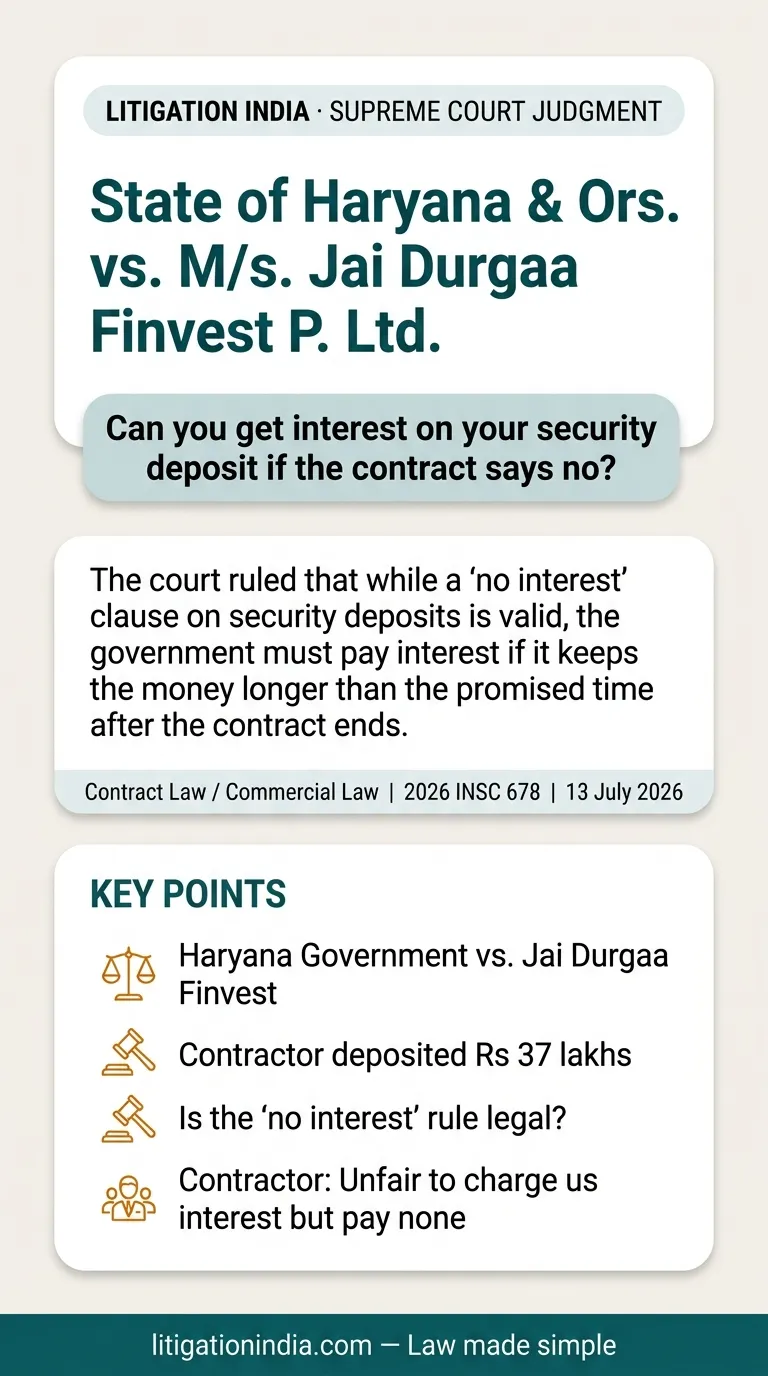
In short
A mining company (contractor) won a sand mining contract from the Haryana government and deposited Rs 37 lakhs as a security deposit. According to their contract, this deposit would earn no interest and had to be returned within three months after the contract ended. Later, because the contractor failed to pay monthly installments, the government cancelled the contract and held onto the deposit. The contractor sued, arguing that the 'no interest' rule was unfair. The High Court agreed with the contractor and ordered the government to pay 9% interest on the security deposit from the very day it was deposited. The Haryana government appealed to the Supreme Court. The Supreme Court corrected this decision. It ruled that courts cannot rewrite agreements that people sign with open eyes. The 'no interest' clause was completely legal and valid. However, the contract also promised to return or adjust the money within three months of the contract ending. Therefore, the government could only keep the money interest-free for those three months. Since the contract ended on March 9, 2000, the three-month period ended on June 9, 2000. The Supreme Court decided that the contractor is entitled to 9% interest, but only from June 9, 2000, onwards until the money was finally adjusted or returned.
Need clarity on a similar legal issue?
Request free pro bono guidance from a Supreme Court Advocate.
Background
A contractor won a three-year sand mining contract from the Haryana government and deposited Rs 37 lakhs. The contractor defaulted on payments, leading the government to cancel the contract and keep the security deposit.
The Decision
The Supreme Court ruled that the 'no interest' clause is legally valid, so no interest is due for the contract period and the first three months after cancellation. However, the government must pay 9% interest from June 9, 2000, for delaying the money beyond the promised three-month limit.
Why it matters for you
This judgment shows that you must carefully read and respect the terms of a contract you sign. It also protects citizens by making sure the government cannot keep your interest-free security money forever after a contract ends.
AI-assisted summary, reviewed and verified by our editorial team.
Need help with your case?
Facing a similar legal challenge in the Supreme Court or High Court? Connect with our pro bono volunteer advocates today.
Request Free Callback