
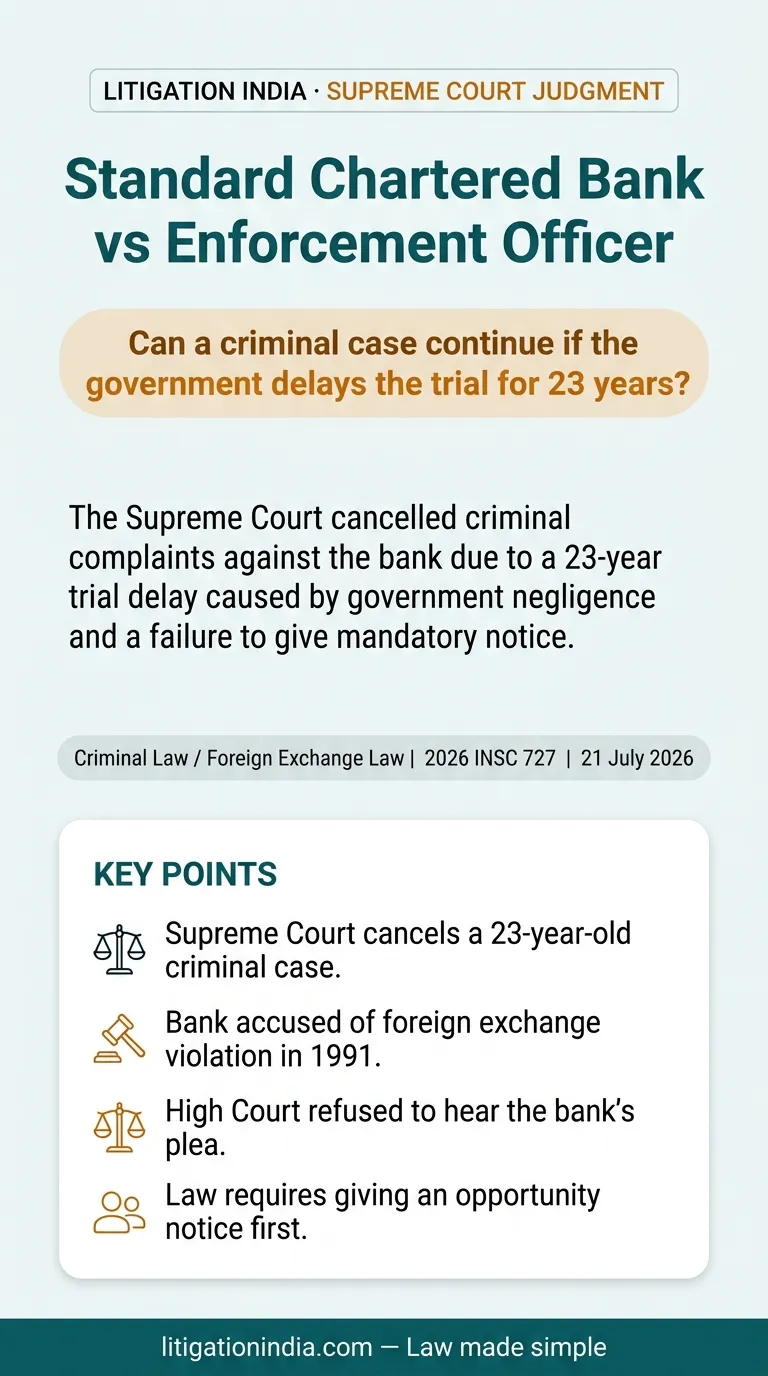
Can a criminal case continue if the government delays the trial for 23 years?
Standard Chartered Bank vs Enforcement Officer
Case: Standard Chartered Bank vs Enforcement OfficerCitation: 2026 INSC 727Decided on: 21 July 2026
“The Supreme Court cancelled criminal complaints against the bank due to a 23-year trial delay caused by government negligence and a failure to give mandatory notice.”
Story Slides
In short
This case is about Standard Chartered Bank, which was accused in 2002 of violating foreign exchange rules (FERA) for transactions done in 1991–1992. The bank asked the High Court to dismiss the case because the government had delayed the investigation and trial for years. However, the High Court refused, saying the bank should have filed a different type of petition (called a revision petition) instead of asking to cancel the case directly. On appeal, the Supreme Court ruled in favor of the bank. First, the Court clarified that the High Court cannot reject a request to cancel a case simply because another option to appeal exists. The High Court must stop the abuse of the legal process. Second, the Court found that the government failed to prove that it served a mandatory 'opportunity notice' to the bank before filing the case, which is a strict legal requirement. Finally, the Court observed that the trial did not even begin for 23 years entirely because of the government's laziness and failure to deliver court notices. This extreme delay violated the bank's fundamental right to a speedy trial under Article 21 of the Constitution. Therefore, the Supreme Court cancelled the case against the bank to prevent injustice.
Need clarity on a similar legal issue?
Request free pro bono guidance from a Supreme Court Advocate.
Background
The government filed a case against Standard Chartered Bank in 2002 for currency transactions from 1991-1992. The bank approached the High Court to cancel the case because of extreme delays and missing notices, but the High Court rejected their petition on a technical ground.
The Decision
The Supreme Court set aside the High Court's order and cancelled the criminal case against the bank. The Court held that a 23-year delay without trial, caused solely by the prosecution's negligence, violates the fundamental right to a speedy trial.
Why it matters for you
This judgment confirms that the government cannot drag a criminal case forever due to its own laziness. It protects common citizens by ensuring that their right to a speedy and fair trial is strictly respected, and technicalities cannot block justice.
AI-assisted summary, reviewed and verified by our editorial team.
Need help with your case?
Facing a similar legal challenge in the Supreme Court or High Court? Connect with our pro bono volunteer advocates today.
Request Free Callback