
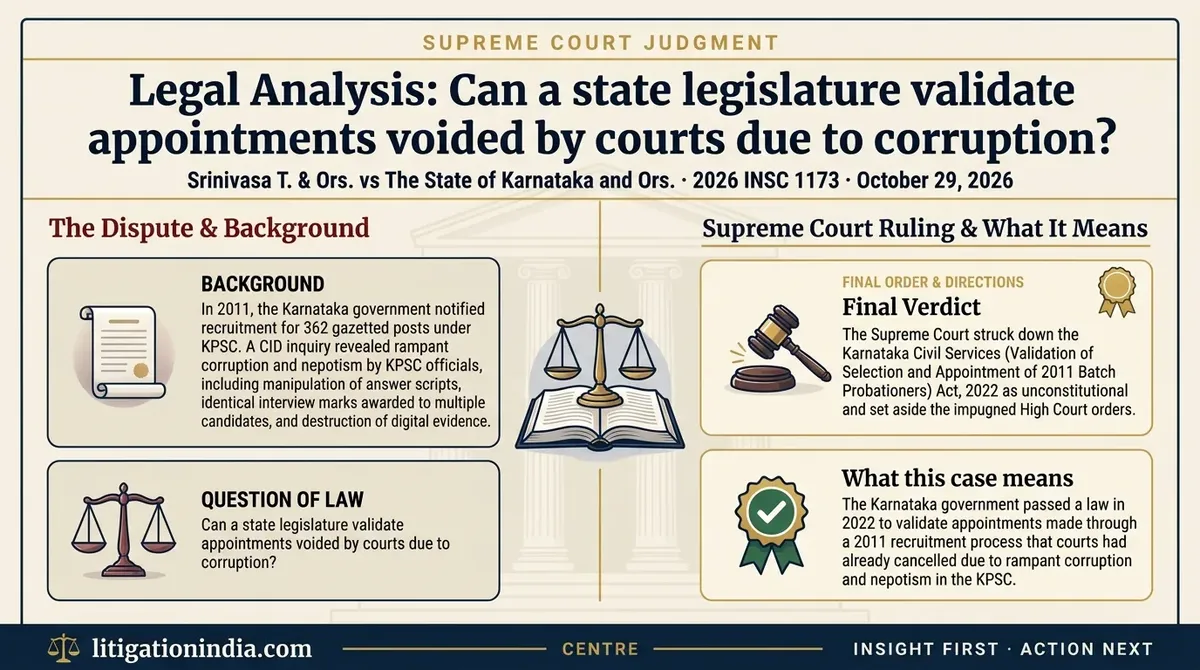
Full text of the judgment
Text extracted from Srinivasa T. & Ors. vs The State of Karnataka and Ors.. For the authoritative version refer to the Supreme Court of India's official website.
2026 INSC 1173 Page 1 of 14 Civil Appeals @ SLP(C) Nos. 21195-21196 of 2023 Non-Reportable
IN THE SUPREME COURT OF INDIA CIVIL APPELLATE JURISDICTION
Civil Appeal Nos. of 2026 (@ Special Leave Petition (C) Nos.21195-21196 of 2023)
SRINIVASA T. & ORS.
…. APPELLANTS Versus THE STATE OF KARNATAKA AND ORS. ETC. ETC.
…. RESPONDENTS
J U D G M E N T
K. VINOD CHANDRAN, J.
“When the winds of politics change direction, it is the common man, who gets caught in the storm”. (Unknown)
Leave granted. 2. A recruitment of 2011 is hanging fire still, putting to peril the aspirations of many, who have crossed the age for consideration and shattering the hopes of the selected few, from continuing in employment. Six appellants who would be over aged now have relentlessly pursued their cause in their zeal to join the Karnataka Civil Services. Digitally signed by CHANDRESH Date: 2026.10.29 15:57:38 IST Reason: Signature Not Verified
Page 2 of 14 Civil Appeals @ SLP(C) Nos. 21195-21196 of 2023 3. Long back, on 03.11.2011, the State Government issued a notification for recruitment to 362 posts of Group ‘A’ and ‘B’ Officers, as per the Karnataka Recruitment of Gazetted Probationers (Appointment by Competitive Examinations) Rules, 1997 (for short, the Rules of 1997). A total of 1,38,307 candidates applied for the recruitment, out of which 91,667 appeared for the preliminary examination. The candidates who sat for the mains; having qualified in the preliminary, were 6,211 out of which 1,090 were called for interview. In the year 2013, on the advice of the Advocate General, based on a complaint regarding illegalities in the selection, the State Government withheld the publication of the final select list, pending an inquiry, handed over to the State CID. Gross manipulations of the recruitment process, including rampant corruption and instances of blatant nepotism of officials of the Karnataka Public Service Commission (KPSC) were revealed in the inquiry, based on which the entire recruitment was cancelled. 4. The selected candidates approached the Karnataka Administrative Tribunal (KAT) which quashed the G.O. But a bunch of Public Interest Litigations (PILs) filed by the aggrieved candidates, including the appellants herein against the order of the KAT went in their favour. The State Government admitted the
Page 3 of 14 Civil Appeals @ SLP(C) Nos. 21195-21196 of 2023 irregularities and the cancellation of the selection list dated 21.03.2014 was affirmed by the High Court. The High Court’s order was challenged before this Court in three Special Leave Petitions which were dismissed by Annexure P2 order in Civil Appeal Nos.3543-3555 of 2018, ‘Avinash C. and Ors. v. State of Karnataka and Ors.’. This Court referred to the findings of the High Court which spoke inter alia of material on record, in the form of call details between candidates and Members of the KPSC. In the interview, certain candidates were awarded exactly the same marks, revealing no objective assessment by the individual members; at least in the case of 566 candidates. The digital video recorder in the KPSC building was replaced to destroy the evidence and there appeared to be extraneous reasons in awarding marks. This Court refused to interfere with the annulment of the selection as carried out by the State Government itself, affirmed by the High Court. There was a contention raised of only certain candidates having been found to be tainted which was rejected on the reasoning that when the selection itself is tainted, segregating tainted and untainted candidates would only interfere with the purity of the selection process. While upholding the decision of the High Court, the contention of some of the parties
Page 4 of 14 Civil Appeals @ SLP(C) Nos. 21195-21196 of 2023 that the written examination is not vitiated and the selection could be continued from the stage of interview was directed to be raised before the High Court. 5. Relying on this liberty reserved, Interlocutory Applications were filed in the disposed of PILs, seeking restoration of the recruitment process from the stage of publication of the results of the written examination. By Annexure P3, the High Court found that the revelations from the preliminary report of investigation were outrageous and scandalous which were also reproduced in Annexure P3. The irregularities in evaluation of answer scripts were found to be shockingly disgraceful, shaking the very confidence placed upon the Public Service Commission, a Constitutional Body meant to act in aid of efficient and smooth functioning of the administration by making recruitments without any taint thereat. The High Court rejected the prayer to resume the recruitment process, which order was again unsuccessfully challenged before this Court, as is seen from Annexures P4 to P6. 6. Quite interestingly, after more than a decade from the stage of recruitment, when obviously the political currents kept on changing, the Karnataka Civil Services (Validation of Selection and Appointment of 2011 Batch Gazetted Probationers) Act, 2022 (the
Page 5 of 14 Civil Appeals @ SLP(C) Nos. 21195-21196 of 2023 Act of 2022) was brought out which is produced at Annexure P7. The unsuccessful candidates who had been pursuing the matter challenged the Act of 2022 before the KAT by a petition on 15.03.2022. Simultaneously, one individual filed a Writ Petition on 23.03.2022 against the very same Act of 2022. The High Court dismissed the Writ Petition with a cryptic order dated 21.04.2022, which is impugned herein. In view of the order passed by the High Court in the Writ Petition, the KAT refused to grant an interim order which was again challenged before the High Court which too stood rejected by an order dated 23.08.2022, following the earlier order in the Writ Petition. The refusal to grant interim order is also taken up before this Court. We are, hence, considering the challenge against both the said orders, one in the PIL and the other in the Writ Petition, which affirmed the order of the KAT rejecting an interim order. 7. In the meanwhile, out of the 362 candidates selected, 46 were found tainted. Appointment was given to 191 candidates out of which 14 are tainted. The appointments were based on the Act of 2022. Continuing the narration on facts, the writ petitioner who challenged the Act of 2022 in the PIL filed an SLP before this Court which was not pursued properly and the said SLP stood rejected
Page 6 of 14 Civil Appeals @ SLP(C) Nos. 21195-21196 of 2023 but leaving open the contention of the petitioners herein whose SLP was entertained. 8. Mr. Shyam Divan, learned Senior Counsel appeared for the appellants and Mr. Kapil Sibal, learned Senior Counsel appeared for the respondent-State. 9. Mr. Shyam Divan argued that the Act of 2022 effectively nullified the decision of this Court which is against the accepted principle of validation which can only be legislated when an apparent error or defect, as noticed by a Constitutional Court is removed by a subsequent legislation paving way for the actions taken under the legislation to be validated. It is trite that the legislature cannot sit in appeal over a decision by the High Court or this Court and a host of decisions were also placed before us to urge the above proposition. 10. Mr. Kapil Sibal, learned Senior Counsel appearing for the respondent-State at the outset, candidly submitted that the legislation cannot at all be supported. Mr. C.A. Sundram, learned Senior Counsel and Mr. Anand Sanjay M. Nuli, learned Senior Counsel along with the other Advocates on Record appearing for the successful candidates, not only feebly attempted to sustain the
Page 7 of 14 Civil Appeals @ SLP(C) Nos. 21195-21196 of 2023 legislation but also vigorously canvassed the case of the successful candidates on grounds of equity. 11. Having gone through the decisions of the High Court and this Court at the earlier instances, both in the first round and in the second round, nothing remains to be looked into to sustain the recruitment of 2011 which has been set aside not merely on defect or irregularity noticed in the process, but on rampant corruption and blatant nepotism having vitiated the entire selection. There could be no equity, insofar as the selected candidates are concerned, especially the selection being based on a recruitment which is declared as tainted by the Constitutional Courts and the appointment having been effectuated based on a stillborn legislation; the Act of 2022. 12. Suffice it to refer to Medical Council of India v. State of Kerala1 in which this Court was seized of an identical situation. Therein admissions to two medical colleges in the State of Kerala for the academic year 2016-17 were found to be illegal, by the Admission Supervisory Committee, which decision was upheld by the High Court of Kerala and by this Court. The State then
1 (2019) 13 SCC 185
Page 8 of 14 Civil Appeals @ SLP(C) Nos. 21195-21196 of 2023 promulgated an Ordinance for regularising the admission of 180 students who were illegally admitted in the two colleges on the proclaimed laudable objective of the hardship visited on the students; just as the intention revealed by the State of Karnataka, in the instant case, as coming out from the legislation, of relieving the hardship to the selected candidates. 13. The Act No. 22 produced as Annexure P7 itself makes interesting reading especially in the Statements of Objects and Reasons, after the narration of the facts starting from the commencement of the recruitment. The order of the KAT at the first instance is noticed where it quashed the order of the Government cancelling the recruitment and directed appointment to the applicants. It is then stated that the candidates were not responsible and none of them were arrayed as accused. The Chairman, Members, Staff and some middlemen were alone arraigned in the chargesheet filed by the CID. It was hence found that there is no justification in penalizing the candidates and relying on the oft-quoted principle in Taylor v. Taylor2 that when something is prescribed to be done in a particular manner, the
2 (1875) 1 Ch.D 426
Page 9 of 14 Civil Appeals @ SLP(C) Nos. 21195-21196 of 2023 same shall be done in that manner or not at all, the annulment/cancellation of the recruitment was set aside by the legislation. However, there is nothing stated as to the irregular manner in which the cancellation was made and in any event the cancellation having been upheld by the High Court and this Court, the power does not lie with the legislature to annul the cancellation, even by a legislation and thus nullify the judgments of the Constitutional Courts. The lofty ideal stated in the legislation of providing justice to the 2011 Batch Gazetted Probationers falls flat for reason of the recruitment itself having been found tainted with corruption and nepotism by the High Court, which decision was upheld by this Court in a Civil Appeal. 14. This Court in Medical Council of India1 relied on a number of decisions from which we refer to Janapada Sabha, Chhindwara Etc. v. The Central Provinces Syndicate Ltd. and Another3 which held that it is not open to the legislature to render a judgment ineffective, though, it is open, within certain limits, to amend the provisions of an enactment, retrospectively and declare that the law shall be deemed to have been, as enacted subsequently and
3 (1970) 1 SCC 509
Page 10 of 14 Civil Appeals @ SLP(C) Nos. 21195-21196 of 2023 validate the same, notwithstanding a decision of the Court which invalidated the enactment and the consequential action based on the defect, which stood removed in the subsequent legislation. 15. In re: Cauvery Water Disputes Tribunal4 cautioned that if the exercise of power of judicial review can be set at naught by the State Government or the State Legislature by overriding the decision given against it, then it would sound the death knell of rule of law. The Constitution Bench, however, also observed that it is open to change the law in general by changing the very basis, but it is not open to set aside an individual decision inter parties, affecting their rights and liabilities; which is the exercise attempted by the State in enacting the Act of 2022. 16. S.T. Sadiq v. State of Kerala and Ors.5 laid down that the legislative function consists of making law and not declaring what the law shall be. While making a law retrospectively and validating it, notwithstanding the decision of a Court of law, it is permissible to alter the very basis of an earlier decision but cannot directly annul the final judgment by a subsequent legislation, which act of the legislature would be declared unconstitutional.
4 1993 Supp (1) SCC 96 5 (2015) 4 SCC 400
Page 11 of 14 Civil Appeals @ SLP(C) Nos. 21195-21196 of 2023 17. We have no doubt in our minds that the subject legislation is unconstitutional. We set aside the same, as also the judgments impugned herein, both in the PIL and the Writ Petition filed against the order of the KAT. The PIL though not agitated by the individual who filed it, would stand allowed transposing the appellants herein as the petitioners. In any event, in a PIL, the petitioner’s role is minimal, especially when it is not prosecuted properly and the Constitutional Court finding substance in the challenge made, de hors the participation of the writ petitioner, would examine the matter on accepted principles of law. It is trite that a public interest litigant cannot move for withdrawal of the petition on the principle of dominus litis, without the leave of the Court. In the present case, what comes to fore is an attempt by an unconnected individual to stultify a valid challenge to the notification. We cannot but record, a little bit of surprise and a lot more alarm, insofar as the impugned judgments are concerned. The PIL was cursorily dealt with, and the later Writ Petition was also dealt with in a similar manner, throwing to winds every tenet of law; upholding an enactment clearly beyond the scope of the powers conferred on the law-making authority and bordering on the absurd.
Page 12 of 14 Civil Appeals @ SLP(C) Nos. 21195-21196 of 2023 18. The candidates who were selected and who were not found tainted by the CID has made a fervent plea before us in their written submissions not to disturb their appointments. Their first argument is that the prosecution initiated by the CID only arrayed members of the KPSC and none of the candidates, much less the selected ones in the FIR or in the chargesheet. Subsequently, the cognizance taken by the Special Court was set aside by the High Court. We are not convinced that the prosecution having not resulted in a trial would, in any way, enable the continuation of the selected candidates, which is premised on the legislation under challenge in the present proceedings. The intervenors, the selected candidates also contended that in the earlier round, the State had been defending the cancellation and hence, retaining the untainted candidates could not have been raised as a plea. Now, the State has changed its stance, as evidenced from the legislation, is their argument. It is the shifting stances of the State, depending on the hues and colours in the changing times, we criticised at the outset. Further, the entire selection having been cancelled, there is no scope for now entertaining a contention of the tainted and untainted candidates to be segregated on the basis of a CID report. More importantly, the appointment of the selected candidates was
Page 13 of 14 Civil Appeals @ SLP(C) Nos. 21195-21196 of 2023 only by virtue of the impugned legislation which we have found to be unconstitutional. 19. Having found the Act of 2022 unconstitutional, we cannot but observe that the appointments made pursuant to the tainted recruitment will also come to an end. The passage of a decade and a half from the initial recruitment restrains us from resuming the entire selection from the stage at which it was found tainted; i.e. after the stage of the preliminary examination. Moulding the relief at this stage, we would only direct the State Government to notify the recruitment for the vacant posts, remaining as of now in the Group ‘A’ and ‘B’ services as per the presently existing recruitment rules in which the appointed candidates who were not found tainted and the six appellants herein, as also the petitioners in the pending proceedings before the KAT, be granted age relaxation to appear in the recruitment process as a one-time opportunity, along with other candidates now eligible. If selected, we make it clear that their seniority shall be only from the date of appointment and they shall not be entitled to any back wages or notional appointment, from an earlier point of time. Insofar as the persons who are continuing now, if selected, then their seniority shall also be only from the date of their fresh appointment as per
Page 14 of 14 Civil Appeals @ SLP(C) Nos. 21195-21196 of 2023 the selection and recruitment directed by us. However, if the persons working now gets selected and appointed, the period they have been in service pursuant to their earlier appointment shall be reckoned for computation of their pension and retirement benefits. 20. With the above directions, the appeals stand allowed. 21. The Interlocutory Applications filed for impleadment, and the interventions prayed for shall stand rejected.
.……………………………... J. (J. B. PARDIWALA)
..………….…………………. J. (K. VINOD CHANDRAN)
NEW DELHI; OCTOBER 29, 2026.