
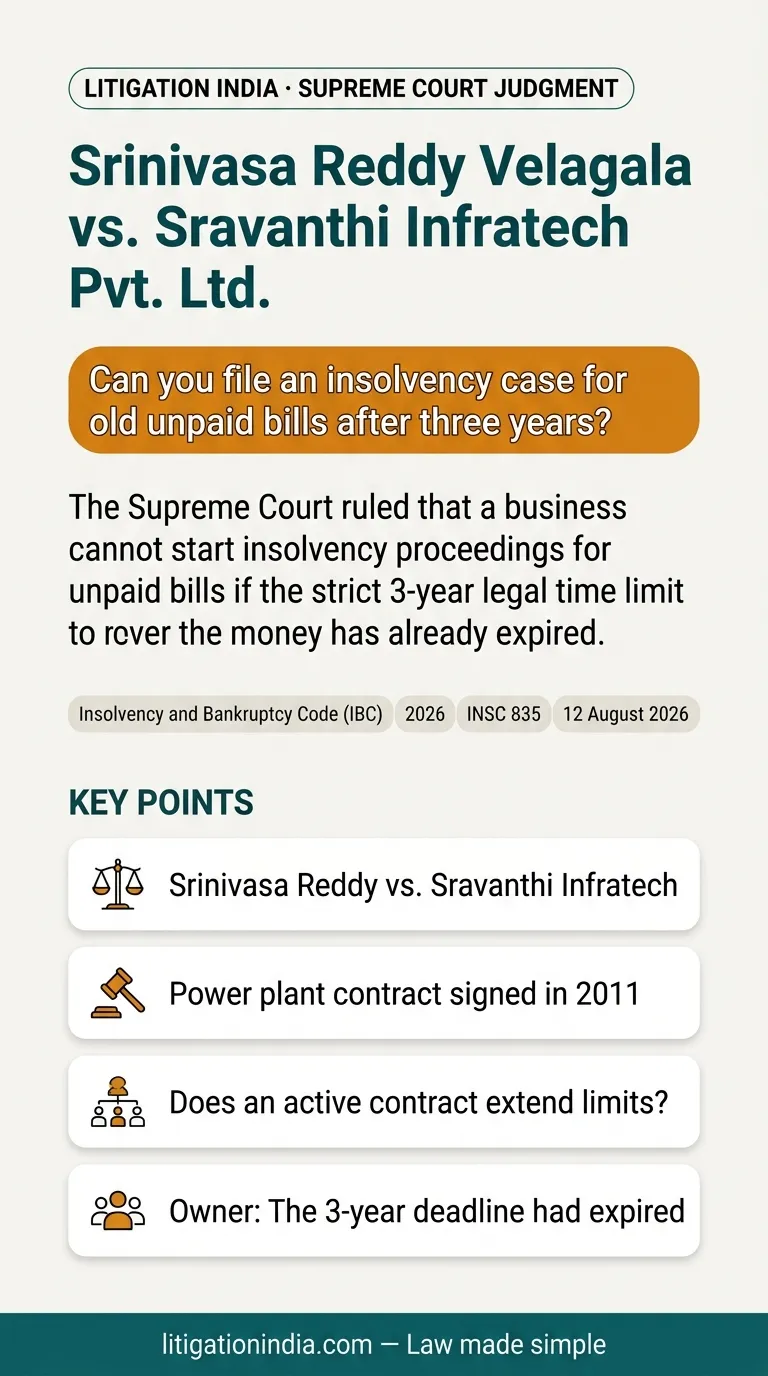
Can you file an insolvency case for old unpaid bills after three years?
Srinivasa Reddy Velagala vs. Sravanthi Infratech Pvt. Ltd.
Case: Srinivasa Reddy Velagala vs. Sravanthi Infratech Pvt. Ltd.Citation: 2026 INSC 835Decided on: 12 August 2026
“The Supreme Court ruled that a business cannot start insolvency proceedings for unpaid bills if the strict 3-year legal time limit to recover the money has already expired.”
Story Slides
In short
In this case, a contractor was hired in 2011 to set up a power station but suspended all work later that year because the owner failed to make the agreed payments. Neither party officially canceled the contract. Many years later, in 2018, the contractor filed a bankruptcy (insolvency) case against the owner to recover over Rs. 1,200 crores in unpaid dues and damages. The lower tribunals allowed the insolvency case to proceed, reasoning that since the contract was never formally canceled, it was still active, and therefore the claim was not too late. However, the Supreme Court reversed this decision and highlighted three vital legal principles. First, the Court clarified that extra charges like 'waiting fees' or 'demobilization costs' are considered 'damages' (compensation), not 'operational debts,' and cannot be claimed in an insolvency court unless decided first by a civil court. Second, if a debtor remains completely silent and never disputes bills for seven years, they cannot suddenly invent a 'prior dispute' just to escape insolvency. Finally, and most importantly, the Court ruled that the time limit to file a case under the insolvency law is strictly three years from the date of the first payment default. Running a continuous contract does not extend this limit. Sending legal notices years later cannot restart the three-year clock. Therefore, the contractor's claim was dismissed as time-barred.
Need clarity on a similar legal issue?
Request free pro bono guidance from a Supreme Court Advocate.
Background
A builder stopped construction on a power plant in 2011 because the owner did not pay the agreed milestone amounts. Over the next few years, the builder sent legal notices demanding payment but received no response. Finally, in 2018, the builder filed an insolvency case to recover the unpaid dues under the Insolvency and Bankruptcy Code.
The Decision
The Supreme Court allowed the appeal and canceled the insolvency proceedings. It ruled that the builder's application was filed way past the strict three-year legal time limit, and sending unilateral legal notices did not reset or extend this period.
Why it matters for you
This judgment protects businesses from being dragged into sudden insolvency proceedings over very old, expired financial disputes. It establishes that creditors must act promptly and file legal recovery cases within three years of a payment default, rather than waiting indefinitely.
AI-assisted summary, reviewed and verified by our editorial team.
Need help with your case?
Facing a similar legal challenge in the Supreme Court or High Court? Connect with our pro bono volunteer advocates today.
Related Supreme Court services