Full text of the judgment
Text extracted from Sri. Rajkumar Madki vs. Dr. Shailendra Beldale. For the authoritative version refer to the Supreme Court of India's official website.
2026 INSC 1138 Page 1 of 9
REPORTABLE IN THE SUPREME COURT OF INDIA CRIMINAL APPELLATE JURISDICTION
CRIMINAL APPEAL NO. 3387 OF 2026
SRI. RAJKUMAR MADKI
… APPELLANT
DR. SHAILENDRA BELDALE
… RESPONDENT
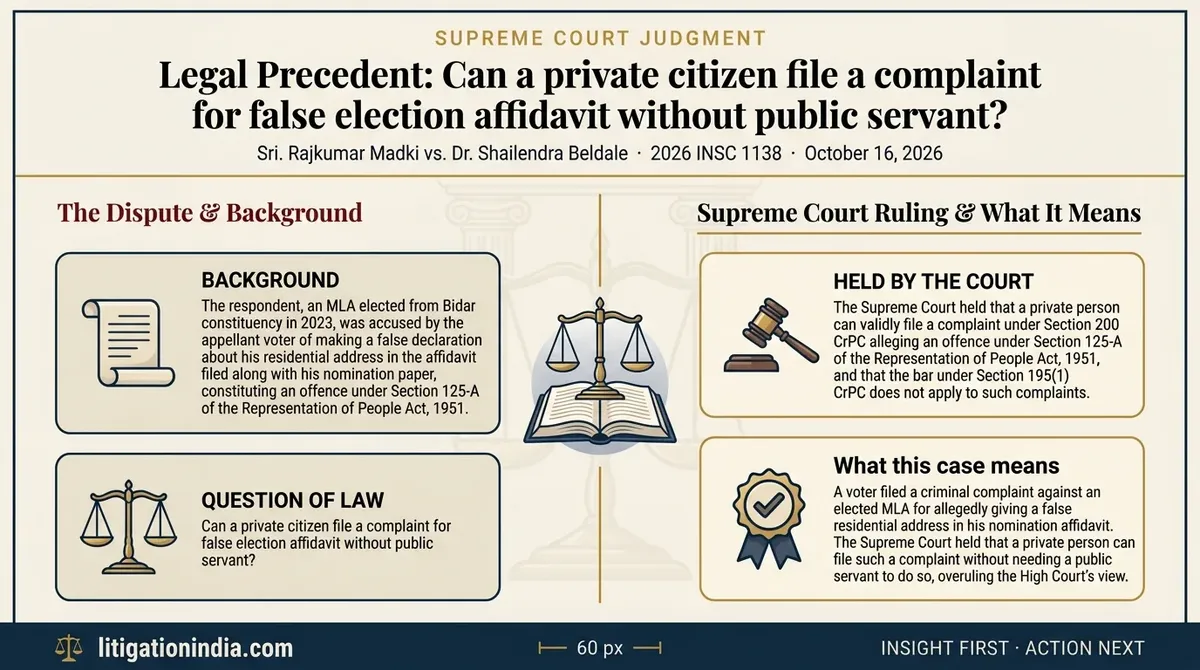
J U D G M E N T DIPANKAR DATTA, J. 1. Under assail in this appeal, by special leave granted on 20th July, 2026, is a judgment and order1 dated 7th March, 2025 of the High Court of Karnataka at Bengaluru2. The High Court, inter alia, allowed a writ petition3 presented by the respondent and quashed a complaint dated 21st August, 2023 lodged by the appellant under Section 200, Code of Criminal Procedure, 19734. 2. The complaint on the file of the 42nd Additional Chief Metropolitan Magistrate at Bengaluru, lodged by the appellant, gave rise to PCR No. 9254 of 2023 in CC No. 29813 of 2023. It was alleged therein
1 impugned judgment 2 High Court 3 Writ Petition No. 7458 of 2024 4 Cr. PC Digitally signed by MANIK KUMAR Date: 2026.10.16 17:23:16 IST Reason: Signature Not Verified
Page 2 of 9
that the respondent, a member of the Karnataka Legislative Assembly having been elected from Bidar constituency in the year 2023, had committed an offence punishable under Section 125-A, Representation of People Act, 19515 by making a false disclosure with regard to his residential address in an affidavit accompanying his nomination paper. The High Court was of the opinion that “Section 125A of the Act also should pass muster the rigours of Section 195(1) of the Cr. PC” and hence, “the offence has to be complained of only by the Election Commission particularly, of the offence under Section 125A of the Act”. It was also reasoned that a “right given to the voter is only to file an election petition, and not to register a private complaint of crime, of the kind considered supra, which is the duty of the Election Commission, if it wants to do so”. 3. We have heard Ms. Meenakshi Arora, learned senior counsel duly assisted by Mr. Kamat, learned senior counsel for the appellant and Mr. Anand Sanjay M Nuli, learned senior counsel duly assisted by Ms. Akhila Wali, learned counsel for the respondent, and perused the materials on record. 4. A substantial question of law of general public importance, hitherto undecided by this Court, does arise for our consideration. It is: Whether Section 125-A of the RoP Act should pass muster the rigours of Section 195(1) of the Cr. PC? In other words, whether any private
Page 3 of 9
person can file a complaint under Section 200 of the Cr. PC against a returned candidate for an offence punishable under Section 125-A of the RoP Act?
5. We propose to answer the said question on a holistic consideration of the submissions advanced by the rival parties. However, having regard to the facts giving rise to the offence alleged, we are of the considered opinion that it would be futile to allow continuance of the proceedings before the trial magistrate for him to pronounce on the merits of the complaint. This is primarily because of the nature of documents placed on record by the parties. The allegation levelled by the appellant of false declaration as to residence given by the respondent in his affidavit, prima facie, has been more than effectively rebutted by him. Even at this stage, we may safely say that the possibility of a conviction is remote. Permitting the proceedings to continue for the trial magistrate to decide one way or the other would only consume precious judicial time. Thus, even at the very inception of this opinion, we record that while the impugned judgment ordering quashing of proceedings before the trial magistrate need not be disturbed, the decision on the legal question given by the High Court on the question of maintainability of the private complaint lodged by the appellant needs to be considered based on proper construction of the provisions of the Cr. PC as well as the RoP Act. To that extent, we need to settle the law clear in the absence of any authoritative judgment of this Court till now.
Page 4 of 9
6. The ordainment of Section 195 is that no court shall take cognizance of any offences, inter alia, punishable under Sections 172 to 188 (both inclusive) of the Indian Penal Code, 18606. 7. Mr. Nuli contended that: 1. Section 33 A and Section 125 A were introduced in the RoP Act by Act No.72 of 2002, w.e.f. 24th August, 2002, in light of the decision of this Hon'ble Court in Union of India v. Association for Democratic Reforms & Anr.7 wherein it was held that for maintaining purity of elections and a healthy democracy, voters are required to be educated and well informed about the contesting candidates and such information would include the candidate's assets, educational qualifications and criminal antecedents (whether pending or disposed).
2. Rule 4A of the Conduct of Election Rules, 1961 prescribes that the candidate or his proposer, as the case may be, shall at the time of delivering to the returning officer the nomination paper under Section 33(1) of the RoP Act, also deliver to him an affidavit sworn by the candidate before a Magistrate of the first class or a Notary in Form 26.
3. Section 125-A of the RoP Act is a non-cognizable and bailable offence. Section 177, IPC which provides punishment for knowingly furnishing false information to a public servant, is also a non-cognizable and bailable offence. The offence under Section 125-A of the RoP Act is triggered when the candidate or through his proposer submits his nomination and affidavit to the Returning Officer (public servant). As per Section 195(1), Cr. PC, no court shall take cognizance of any offence punishable under Sections 172 to 188, IPC (both inclusive) except on the complaint in writing of the public servant concerned or of some other public servant to whom he is administratively subordinate.
6 IPC 7 (2002) 5 SCC 294
Page 5 of 9
Hence, Section 125-A of the RoP Act should pass muster the rigours of Section 195(1), Cr. PC.
4. Further, Section 125-A of the RoP Act should also pass muster the rigours of Section 195(1), Cr. PC in order avoid filing of frivolous complaints as has been done in the present case. The other candidates may resort to initiation of criminal proceedings against the returned candidates by getting private complaints filed through private persons. If Section 195(1), Cr. PC is not followed, filing of frivolous cases is likely to increase and the purpose of incorporation of Section 125-A will be lost.
5. In the decision in Raghunath Deshpande v. State of Karnataka8, the complaint was filed by a private complainant for offences punishable under Sections 171(g), 177, 181, 182, 199, 420, 465, 467 & 468, IPC. Solely upon reading the letter dated 26th April, 2014 issued by the Election Commission of India9, the High Court had observed that a private person can file a complaint under Section 125-A of the RoP Act. Since, the provisions of the IPC were also invoked in the aforesaid case, the High Court held that Section 195(1), Cr. PC will come into play and no complaint can be filed by a private complainant. The aforementioned decision is not applicable to the present case as the private complaint is filed against the respondent for offence punishable under Section 125-A of the RoP Act alone.
6. Subsequent Press Note dated 16th June, 2020 issued by the ECI reveals decision having been arrived at to take cognizance of complaints and refer such matters to the relevant investigating authorities on a case-to-case basis. The ECI found that many complaints were being filed with it and in order to address the same, the aforementioned Press Note was issued. The relevant
8 2015 SCC OnLine Kar 9709 9 ECI
Page 6 of 9
extract of the Press Note dated 16th June, 2020 reproduced below was relied upon: "Commission has been receiving complaints regarding furnishing of false information in the affidavits of some candidates. As per the extant provision, individuals are filing such complaints in the competent Court under section 125A of the Representation of People Act, 1951. Now, Commission has reviewed this position and decided that, in pursuit of a level-playing field, it will take cognizance of complaints, which indicate serious omission on the part of the candidate, and refer such matters to the relevant investigating authorities on a case-to-case basis."
8. According to Mr. Nuli, the offence alleged by the appellant, if at all has a semblance of merit, would be covered by Section 177, IPC and, therefore, the High Court was absolutely right in holding that it was only the public servant deputed by the ECI which could have approached the court with a complaint under Section 200, Cr. PC alleging offence punishable under Section 125-A of the RoP Act and not a voter like the appellant. 9. Since we have expressed hereinabove that the complaint will not be allowed to be pursued further, we refrain from noting the submissions of Mr. Nuli on the merits of the complaint itself. 10. Section 125-A of the RoP Act reads as follows: 125-A. Penalty for filing false affidavit, etc.—A candidate who himself or through his proposer, with intent to be elected in an election,— (i) fails to furnish information relating to sub-section (1) of Section 33-A; or (ii) gives false information which he knows or has reason to believe to be false; or (iii) conceals any information, in his nomination paper delivered under sub-section (1) of Section 33 or in his affidavit which is required to be delivered under subsection (2) of Section 33-A, as the case may be, shall notwithstanding anything contained in any other law for the time being in force, be punishable with imprisonment for a term which may extend to six months, or with fine, or with both.
Page 7 of 9
(emphasis ours) 11. It is significant to note that sub-clauses (i) to (iii) of clause (a) of sub-section (1) of Section 195(1) of the Cr. PC impose a statutory prohibition on a court in relation to taking cognisance of offences punishable under Sections 172 to 188, IPC or of abetment of/attempt to/criminal conspiracy to commit such offences, except on the complaint in writing of the public servant concerned or of some other public servant to whom he is administratively subordinate. It is plain that the text of clause (a) of sub-section (1) of Section 195 does not include Section 125-A of the RoP Act. Should we read into Section 195, Cr. PC a prohibition in respect of Section 125-A of the RoP Act also, apart from those expressly included? If indeed it were the intention of the legislature that cognizance of any offence relating to furnishing of false information by a candidate in an affidavit with intent of being elected in an election (referred to in Section 125-A of the RoP Act) could only be taken if the complainant were a public servant, the same could have been provided by an amendment of Section 195, Cr. PC since Section 125-A of the RoP Act is of fairly recent origin. Significantly, Section 125-A was inserted in the RoP Act with effect from 24th August, 2002, while it is noticed that Section 195, Cr. PC suffered an amendment thereafter in April, 2006. The legislature is presumed to be conscious of its insertion of Section 125-A in the RoP Act four years back. It stands to reason that omission of the legislature to include Section 125-A of the RoP Act
Page 8 of 9
in Section 195, Cr. PC is deliberate and no court, in terms of the latter provision, would be barred from taking cognizance of an alleged offence under Section 125-A of the RoP Act, even on the complaint lodged by a private person. This interpretation is also fortified by the absence of any provision in any enactment stipulating that a complaint in relation to an offence under Section 125-A of the RoP Act can only be lodged by a public servant as well as the ordainment in Section 125-A that the penalty it envisages is “notwithstanding anything contained in any other law for the time being in force”. This means that the rigour of Section 195, Cr. PC would not be applicable insofar as a complaint lodged by a private person, alleging an offence under Section 125-A of the RoP Act, under Section 200, Cr. PC, is concerned, whereby the court is urged to penalise the offender for furnishing false information in an affidavit to get elected. The High Court was, therefore, clearly in error in returning the finding that it did. 12. Having so held on a plain construction of the statutory provisions, we need not fall back on the clarifications provided by the ECI. Even though the ECI is supreme in its own sphere and has, indeed, issued guidelines/press notes based on its understanding of the statutory provisions, interpretation of statutes is primarily the task of the courts and such guidelines/press notes do not bind us.
Page 9 of 9
13. In conclusion, we hold that a private complaint alleging offence committed under Section 125-A, RoP Act need not pass muster of the rigours of Section 195, Cr. PC, as held by the High Court. If at all a complaint is lodged to harass an elected candidate or frivolous allegations are levelled therein, the laws of the country duly equip and empower the competent magistrates to pass such order(s) as they deem fit and proper commensurate with the facts and circumstances of each case. 14. Having answered the question, we reiterate that the decision of the High Court closing the proceedings before the trial magistrate stands upheld for reasons different from the one assigned by it. 15. On the above terms, the appeal stands disposed of. 16. Parties shall bear their own costs.
…………………………….J. (DIPANKAR DATTA)
…………………………….J. (SHEEL NAGU) NEW DELHI; OCTOBER 16, 2026.