Updates
Service Law / Employment
0 views

S.P. Chandrakar vs State of Chhattisgarh

The big legal question

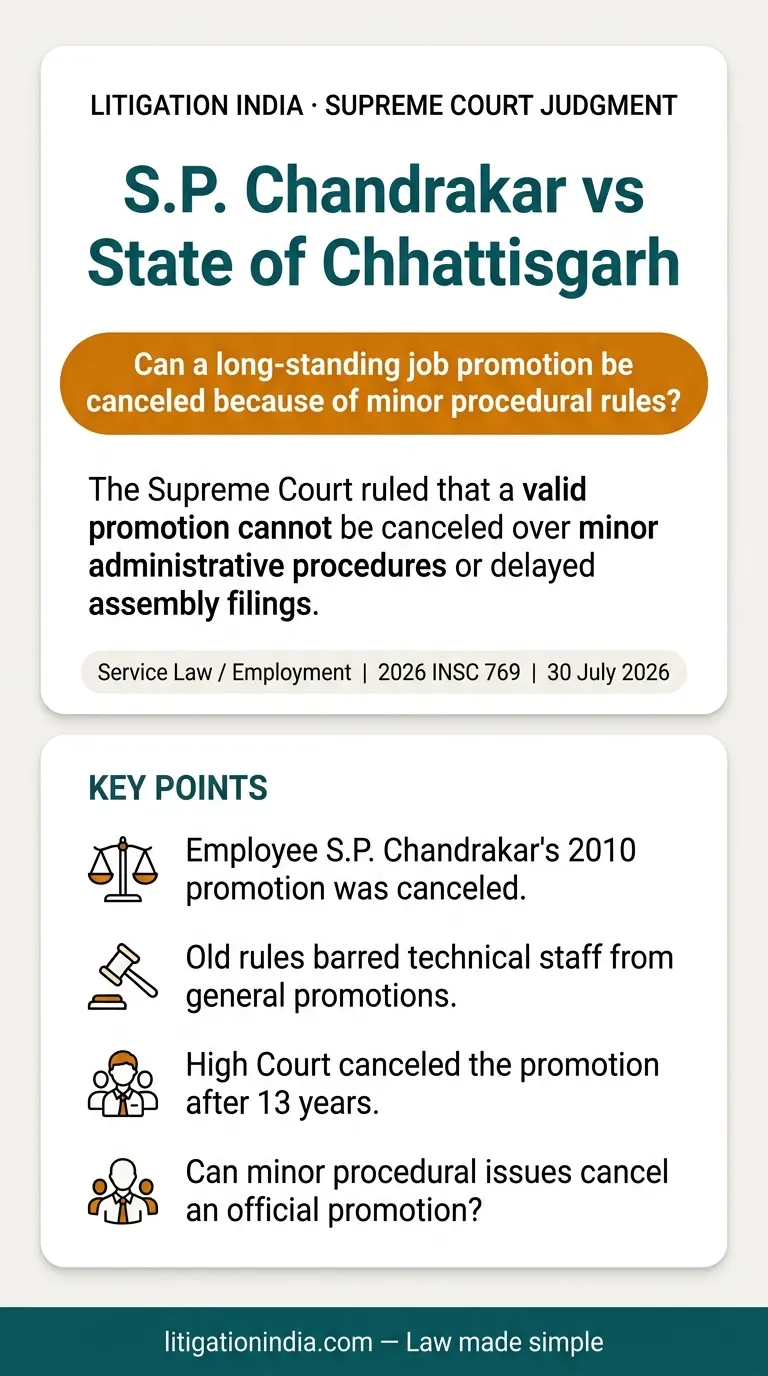
Can a long-standing job promotion be canceled because of minor procedural rules?

“The Supreme Court ruled that a valid promotion cannot be canceled over minor administrative procedures or delayed assembly filings.”

Story Slides
1 / 7

A Battle for Deserved Promotion

  • Employee S.P. Chandrakar's 2010 promotion was canceled.
  • A co-worker challenged the rules of promotion.
  • Supreme Court restored the long-serving employee's job.
S.P. Chandrakar vs State of Chhattisgarh30 July 2026
2 / 7

Deleting the Technical Bar

  • Old rules barred technical staff from general promotions.
  • The Registrar deleted this unfair rule in 2005.
  • Chandrakar was promoted based on this rule change.
S.P. Chandrakar vs State of Chhattisgarh30 July 2026
3 / 7

Canceled Over Minor Details

  • High Court canceled the promotion after 13 years.
  • It ruled that the change was just a circular.
  • The rules were also not presented to the Assembly.
S.P. Chandrakar vs State of Chhattisgarh30 July 2026
4 / 7

Do Circulars Hold Power?

  • Can minor procedural issues cancel an official promotion?
  • Does not showing rules to Assembly invalidate them?
S.P. Chandrakar vs State of Chhattisgarh30 July 2026
5 / 7

Substance Over Style

  • The power to make rules includes changing them.
  • Calling an amendment a circular doesn't make it invalid.
  • Assembly tabling is advisory, not mandatory for validity.
S.P. Chandrakar vs State of Chhattisgarh30 July 2026
6 / 7

Complete Justice Delivered

  • Chandrakar must be reinstated immediately.
  • His seniority and promotion benefits are protected.
  • He gets 50% back wages within two months.
S.P. Chandrakar vs State of Chhattisgarh30 July 2026
7 / 7

Protect Your Rights

  • Long-standing settled promotions are protected by law.
  • Technical delays do not easily defeat substantive justice.
S.P. Chandrakar vs State of Chhattisgarh30 July 2026

At a glance (infographic)

S.P. Chandrakar vs State of Chhattisgarh — infographic summary
Download infographic

In short

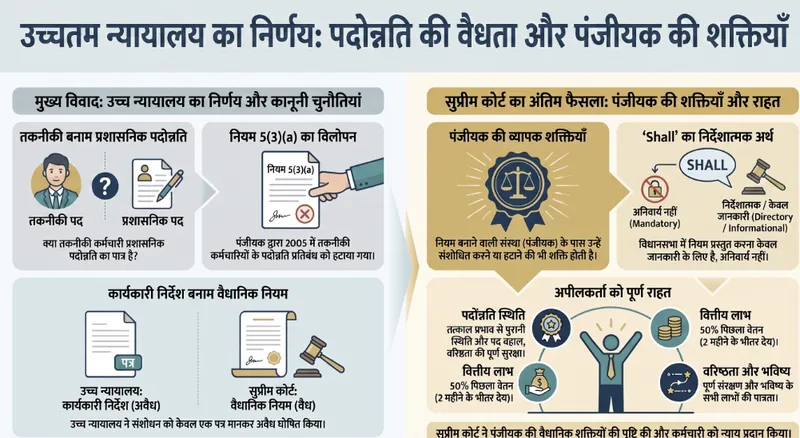
The Supreme Court of India restored the promotion of an employee, S. P. Chandrakar, who was promoted to the post of Additional Manager in a cooperative bank in 2010. Originally hired as a technical worker (Assistant Engineer), his promotion was challenged by a co-worker, Kishor Bagh. The co-worker argued that technical employees were barred from administrative posts under the old rules. However, the government's Registrar had deleted this restrictive rule in 2005. The High Court had canceled the promotion, stating that the rule change was published as a simple circular instead of a formal order, and was not presented before the state legislature as required. The Supreme Court overturned the High Court's decision. It held that the authority who has the power to make rules also has the power to change or delete them. It clarified that calling a rule change a 'circular' does not make it invalid as long as the authority had the power to make that change. Furthermore, the Court explained that the requirement to present new rules to the State Assembly is directory, not mandatory, because the law does not mention any punishment or cancellation if it is not done. Finally, the Court ruled that since the appellant worked in the promoted post for over thirteen years, his long-standing service should not be disturbed.

Background

S. P. Chandrakar was promoted from a technical role to an administrative post in a cooperative bank after the governing rules restricting such promotions were deleted by the Registrar. A co-worker challenged this, claiming the rule change was technically invalid, and the High Court agreed, canceling the promotion after thirteen years of service.

The Decision

The Supreme Court set aside the High Court's order and fully restored Chandrakar's promotion and seniority. The Court ordered the bank to pay him 50% of his back wages within two months, along with all consequential promotional benefits.

Why it matters for you

This judgment clarifies that minor bureaucratic errors or delays in presenting rules to the legislature do not invalidate otherwise lawful government decisions. It protects honest employees from losing their hard-earned promotions due to technical procedural lapses or long-pending court cases.

Photos
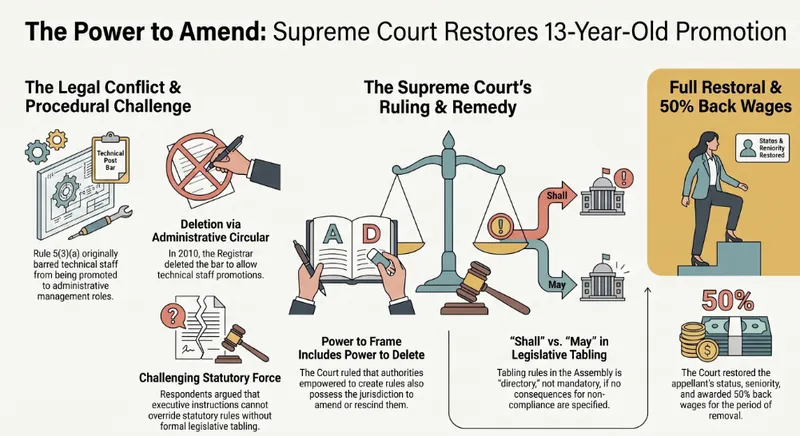
The Supreme Court allowed the appeal and restored S. P. Chandrakar's promotion, ruling that the Registrar has the valid statutory power to amend service rules and that the legislative tabling requirement under Section 95(3) of the Act is directory rather than mandatory

AI-assisted summary, reviewed by our editors.

Litigation India

A public-service initiative to make justice understandable for every Indian.

contact@litigationindia.com

+91 9956486585

New Delhi, India

Quick Links

Our Mission

To make every important Supreme Court of India judgment understandable to ordinary citizens in simple English and Hindi, and to connect litigants and junior lawyers with experienced Supreme Court advocates — so that no one suffers injustice merely for lack of correct guidance.

Disclaimer: Summaries are for general public understanding only and are not legal advice. Always consult a qualified lawyer for your specific case.

© 2026 Litigation India. All rights reserved.