Full text of the judgment
Text extracted from Shubham Equipment Private Limited & Anr. vs Rothwell Water Company Limited & Ors.. For the authoritative version refer to the Supreme Court of India's official website.
2026 INSC 1098 1
IN THE SUPREME COURT OF INDIA
CIVIL ORIGINAL JURISDICTION
ARBITRATION PETITION (CIVIL) NO.7 OF 2025
Shubham Equipment Private Limited & Anr. .… Petitioner(s)
Rothwell Water Company Limited & Ors. …. Respondent(s)
ARBITRATION PETITION (CIVIL) NO.8 OF 2025
Joymalya Bagchi, J.
1. Both the petitions involve same parties and raise common questions of law and fact. Accordingly, they are being disposed of by a common order. 2. Petitioner No. 1, Shubham Equipment Private Limited (‘SEPL’) is an Indian company originally incorporated under Companies Act, 1956, now governed by Companies Act, 2013, having its registered office at Thane, Maharashtra, India. It is engaged in the business of providing services with respect to cleaning of drinking water tanks under the trade Digitally signed by SATISH KUMAR YADAV Date: 2026.10.08 16:01:57 IST Reason: Signature Not Verified
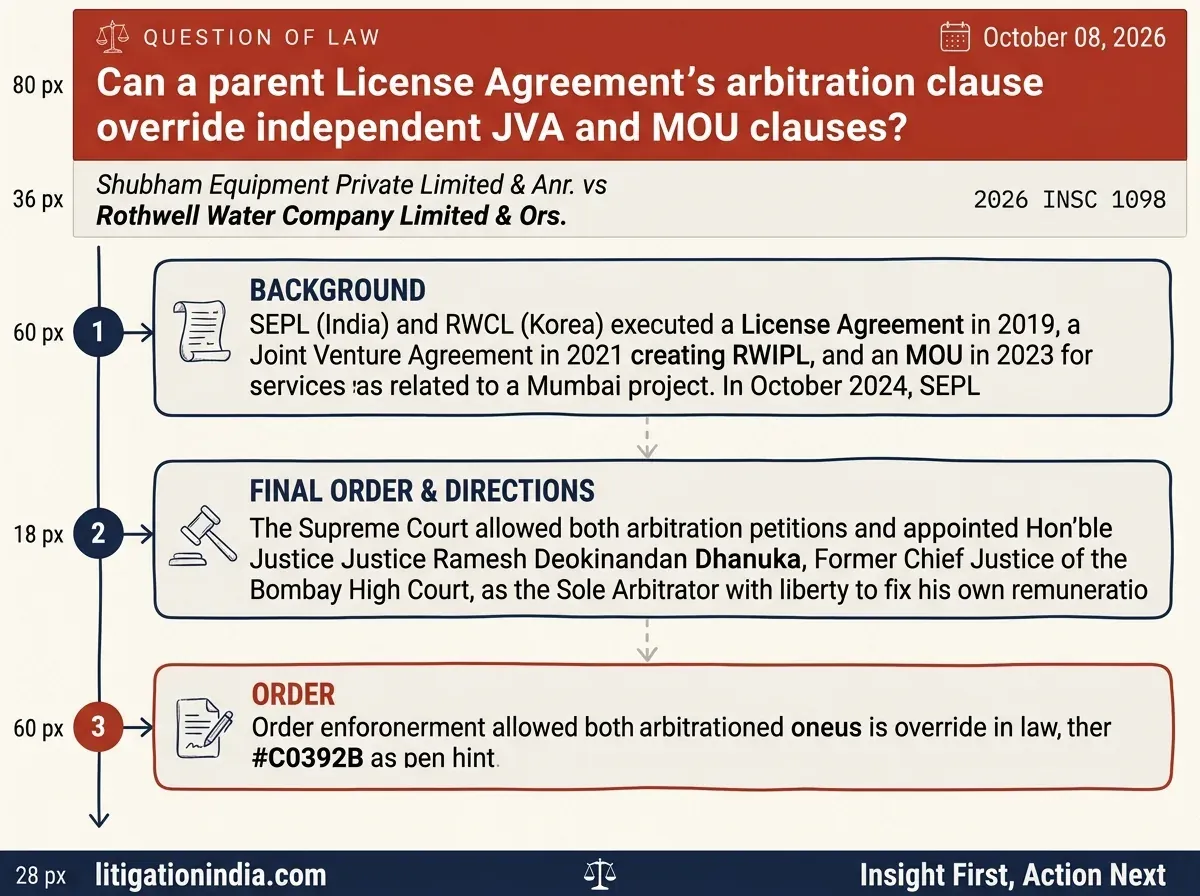
names ‘TANCLEAN’ and ‘SHUBHAM’. Petitioner No. 2, Mr. Sunil Suresh Uplap is one of the main promoters of SEPL. 3. Respondent No. 1, Rothwell Water Company Limited (‘RWCL’) is a company having its principal office at Gyeonggi-do, Korea, incorporated under the Companies Act, 2012 of the Republic of Korea. It is the holder of multiple patents in the technology of ‘Biological Nutrient Removal Process in Wastewater Treatment’. Respondent No. 2, Mr. Keonho Lee is one of the main promoters and President of RWCL. Respondent No. 3, Rothwell Business International Private Limited (‘RBIPL’), is a wholly owned subsidiary company of RWCL, having its registered office at Pune, Maharashtra. It was incorporated by Respondent No. 2 along with his daughter Ms. Ryouree Lee and one Mr. Sayaji Krishnarao Shinde. 4. On 30.01.2019, SEPL and RWCL entered into a Technical Collaboration Licence Agreement (‘Licence Agreement’) whereby vide Clause 2.1 RWCL granted SEPL and/or its affiliates an exclusive, non-transferable, royalty-bearing license for various licensed patents relating to technology of
wastewater treatment project with specifics described more particularly in the said Licence Agreement. 5. On 01.10.2021, a Joint Venture Agreement and Share Holding Agreement (‘JVA’) was executed by Petitioner No.2 as promoter/partner of SEPL and Respondent No.2 as promoter and President of RWCL. Under the said JVA, a joint venture company, namely, Rothwell Water (India) Private Limited (‘RWIPL’) was created for carrying on business activities providing for supply, installation, operation and maintenance of latest generation sewage treatment plants and other liquid procession products and equipment under the brand name of ‘ROTHWELL’. 6. A perusal of the signature clause of this agreement unequivocally shows that Petitioner No.2 affirmed the signature on behalf of Shubham Group of Companies, defined as the 'Indian Group'. Likewise, Respondent No.2 affirmed the signature on behalf of RWCL, i.e. defined as the 'South Korean Group', thereby signifying that the companies of the Indian Group and South Korean Group represented through their respective Promoter/Director signatories were
bound by the said agreement. The arbitration clause incorporated vide Article 43 in the said JVA reads as follows: “ART. 43. ARBITRATION (i) Any and all disputes or differences between the Parties arising out of or in connection with this Agreement or its performance shall, so far as it is possible, be settled amicably between the Parties. (ii) If after 30 days of consultation, the Parties have failed to reach an amicable settlement, on any and all disputes-or differences arising out of or in connection with this Agreement or its performance, such disputes or differences shall be referred to in arbitration in Mumbai which shall be conducted in accordance with the Law of the Republic of India which governs and protects the interest of Indian and South Korean parties respectively and any statutory modification and re-enactment thereto for the time being in force all the parties thereto irrevocably agree that the decision of the Arbitrator(s) shall be final and binding upon the parties hereto and the judgment or arbitration award may be entered in any court of competent jurisdiction. The language of the Arbitration shall be English.”
7. On 24.10.2022, a sub-contract agreement was executed between one JWIL Infra Ltd. (‘JWIL’), having its office at New Delhi and RWCL. On 01.02.2023, a Memorandum of Understanding (‘MoU’) was executed between SEPL and RWCL, inter alia, providing that SEPL would render services like liaison with JWIL and Municipal Corporation of Greater Mumbai on behalf of RWCL, customs clearance of goods at
Mumbai port, logistical arrangements, port handling, transportation, warehousing, et cetera. 8. Clause 9 of the said MoU provided for dispute resolution via arbitration, as follows: “9.0 DISPUTE RESOLUTION 9.1 In case of any dispute or difference arising between the parties as to the interpretation or effect of this Agreement and/or the rights and liabilities of the Parties, thereunder, and the Parties thereunder, the Parties shall endeavour to settle such disputes/differences amicably, failing which the dispute/difference shall be settled in accordance with the provisions of the Arbitration and Conciliation Act, 1996 of any statutory reenactments or modification thereof. Sole arbitrator to be appointed with mutual consent of both the Parties. The seat and venue of Arbitration shall be Mumbai. The language of the Arbitration shall be English. The Award passed by the Arbitrator shall be final and binding upon the parties herein.”
9. On 11.10.2024, SEPL through Petitioner No.2 sent a notice of termination of the JVA to RWCL and RBIPL (subsidiary company of RWCL) which is alleged to have been incorporated to compete with the joint venture entity RWIPL in breach of the non-compete covenant, namely Article 24.1 of the JVA. The grounds of termination set out are inter alia as under: (a) Incorporation of RBIPL by RWCL to compete with the joint venture entity RWIPL (constituted by SEPL and RWCL) in contradiction of Article 24.1 of the JVA.
(b) Business loss and opportunity due to rejection of projects on grounds of technical incompetence. (c) In addition to floating RBIPL as a competitor of the joint venture RWIPL, RWCL caused inordinate delay in giving inputs for the technological viability of various big projects and subsequently used such delay to reject such projects for lack of technical competence. This was done with the ulterior motive of promoting and propagating RBIPL which had been incorporated in contravention of the JVA itself. (d) Under the MoU, SEPL procured decanter systems from RWCL worth Rs. 15,27,72,420/- as on 25.05.2023 to supply them to JWIL (the main contractor on Municipal Corporation of Greater Mumbai's Bhandup project). As per mutual agreement, the government dues and costs thereof were payable by RWCL. Pursuant to the same, SEPL vide its email on 06.09.2024, subsequent reminders on 19.09.2024 and 20.09.2024 and final reminder on 30.09.2024 raised a claim of Rs. 4,24,35,647/- towards receivable liability from RWCL
to SEPL for the costs, taxes, liabilities and interest incurred by SEPL on behalf of RWCL. Quoting these infractions, SEPL issued the termination notice of the JVA and called upon RWCL to pay Rs. 20,00,00,000/- for business loss and a sum of Rs. 4,24,35,647/- under the MoU. 10. Another notice of the same date was issued by SEPL to RWCL with regard to the aforesaid claim of Rs. 4,24,35,647/- plus applicable taxes, interest, etc. under the MoU, which was disputed by RWCL and Respondent No.2. 11. In their reply, RWCL and Respondent No. 2 disputed the aforesaid termination notice vide letter dated 28.10.2024, countering the allegations of outstanding dues raised by SEPL and called upon the latter to amicably settle the dispute. RWCL further mentioned in the reply that the dispute is directly linked with the operation and management of the License Agreement dated 30.01.2019 and, therefore, the dispute resolution clause of the said License Agreement would be applicable to the dispute. 12. In the backdrop of the aforesaid disputes, SEPL issued notices of arbitration dated 28.11.2024 under Article 43 of
the JVA and Clause 9 of the MOU respectively. In reply to the said notices, RWCL while acknowledging the disputes, reiterated its stance that the said disputes were intrinsically connected to the License Agreement dated 30.01.2019 and that any dispute resolution via arbitration was covered under Clause 12.1 of the said agreement in accordance with the law of the Republic of Korea. The said clause reads as follows:- “If after 30 days of consultation, the Parties have failed to reach an amicable settlement, on any and all disputes or differences arising out of or in connection with this Agreement or its performance, such disputes or differences shall be referred to arbitration in Seoul which shall be conducted in accordance with the Law of Republic of Korea which governs and protects the interest of the Republic of Korea and Indian parties respectively and any statutory modification and re-enactment thereto for the time being in force all the parties thereto irrevocably agree that the decision of the Arbitrator(s) shall be final and binding upon the parties hereto and the judgment or arbitration award may be entered in any court of competent jurisdiction. The language of the Arbitration shall be English.”
13. In these circumstances, Petitioners have taken out the petitions under Section 11 of the Arbitration and Conciliation Act, 1996 (“1996 Act”) for referring the disputes to arbitration and appointment of an arbitrator under Article 43 of the JVA and Clause 9 of the MoU respectively.
14. In their counter affidavits to the aforesaid petitions, Respondents, while not denying that disputes have arisen by and between the parties under the JVA and MoU, contended that Petitioners had not referred the said dispute for an amicable resolution as contemplated in the arbitration clauses. They have also taken a specific plea that these agreements are governed by the License Agreement dated 30.01.2019 as their mother agreement. Accordingly, the dispute resolution clause therein, namely Clause 12.1, providing for arbitration in Korea would prevail. It is further alleged that there was a breach of the exclusivity clause under the License Agreement. RWCL has also issued a notice of arbitration dated 08.08.2025 under Clause 12 of the said License Agreement for arbitration in Korea. It was also argued that RBIPL, being a non-signatory to the aforesaid agreements, is not bound by the arbitration clause. 15. Initially, we had referred the matter for an amicable resolution of the dispute via mediation. Learned Senior Counsel Mr. C.U. Singh and Mr. Sudhanshu Choudhari appearing for the parties informed that though some progress
was made during mediation, the parties finally could not arrive at an amicable resolution. 16. Given the situation, we have considered the matter on merits. While both parties do not dispute the existence of the arbitration agreements namely the JVA and MoU in respect whereof the disputes have arisen, Mr. Choudhari, for the Respondents, argued that the said agreements are intrinsically intertwined with the mother agreement i.e., License Agreement dated 30.01.2019 and the dispute resolution clause therein, namely Clause 12.1, providing for arbitration in Korea, would govern such disputes. He further asserted that his client has already issued a notice alleging breach of the exclusivity clause in the License Agreement and has already issued a notice invoking arbitration on 08.08.2025 under the said License Agreement in Korea. He also contended that RBIPL is an independent non-signatory entity and cannot be bound by the arbitration agreements. 17. In rebuttal, Mr. Singh submitted that the JVA and MoU are independent of the License Agreement. In support thereof, he referred to Article 25 of the JVA and Clause 10.8 of the MoU. He also asserted that RBIPL is a wholly owned
subsidiary of RWCL and Respondent No.2 and his daughter are the directors of RBIPL. It was incorporated in contravention of Article 24.1 of the JVA to unfairly compete with the joint venture entity RWIPL and hence is a necessary party to the arbitration agreement. 18. Having considered the rival submissions at the Bar, we find that the existence of the arbitration agreements governing disputes under the JVA and MoU is admitted. Furthermore, Article 25 of the JVA states that the agreement is an entire agreement between the parties in respect of the subject matter thereof and supersedes all prior agreements, if any, between them with respect thereto. Similarly, Clause 10.8 of the MoU cancels and supersedes any and all prior agreements as to the subject-matter. 19. Section 11(6-A) of the 1996 Act prescribes the principle of minimal judicial intervention by restricting the scope of inquiry to prima facie existence of the arbitration agreement.1 Once the prima facie existence of an arbitration agreement is
1 In re: Interplay Between Arbitration Agreements under the Arbitration and Conciliation Act, 1996 and the Indian Stamp Act, 1899, (2024) 6 SCC 1.
adduced before the Referral Court, it ought to appoint an arbitrator and refer the parties to arbitration. 20. Admittedly, the existence of the agreements is not in dispute. What is contended is that the JVA and MoU spring from the mother agreement, namely License Agreement, and have no independent existence. As such, the dispute resolution clause, namely Clause 12.1 of the mother agreement, envisaging arbitration in Korea would override the dispute resolution clauses in the subsidiary agreements. 21. Having examined the terms of the License Agreement, JVA and MoU, we note that the License Agreement deals with grant of multiple licenses by RWCL to SEPL and/or its affiliates; JVA creates a joint venture company in India namely RWIPL to carry on business activities in supply, installation, operation and maintenance of latest generation sewage treatment plants and other liquid procession products and equipment under the brand name ‘ROTHWELL’; and MoU is an arrangement between SEPL and RWCL by which SEPL would render liaison and other services on behalf of RWCL with JWIL and Municipal Corporation of Greater Mumbai. Thus, the License Agreement, JVA and MoU
prima facie operate in different fields and the disputes arising exclusively under the JVA and MoU are amenable to the dispute resolution clauses engrafted therein and not the clause in the License Agreement. We are further fortified to come to such conclusion with reference to Article 25 of the JVA and Clause 10.8 of the MoU which inter alia provide that the said agreements are exclusive in respect of the subject matter thereof and supersede all or any prior agreements. Mr. Choudhari’s argument that the disputes pertaining to the JVA and MoU cannot be adjudicated in isolation and overlap with claims under the License Agreement in respect whereof his clients have already raised a dispute for arbitration in Korea, would fall within the jurisdiction of the arbitrator vis- à-vis the scope and ambit of disputes amenable to arbitration under the JVA/MoU, and cannot constitute a ground to refuse a reference at the threshold. 22. Similarly, the other issue that RBIPL is an independent nonsignatory entity which is not bound by the arbitration agreement is a contentious one as RBIPL is a wholly owned subsidiary of RWCL (a signatory) and is alleged to have been incorporated by RWCL in derogation of the terms of the JVA.
Given this situation, such issue needs to be relegated to the arbitrator for appropriate adjudication. 23. In light of the above, we allow the present arbitration petitions and appoint Hon’ble Mr. Justice Ramesh Deokinandan Dhanuka, Former Chief Justice of Bombay High Court as the Sole Arbitrator. The Arbitrator shall have the liberty to fix his own remuneration/fees. 24. There shall be no order as to costs in these petitions.
..…………....................CJI. (SURYA KANT)
…..…………....................J. (JOYMALYA BAGCHI)
..…..………......................J. (V. MOHANA) NEW DELHI October 08, 2026