
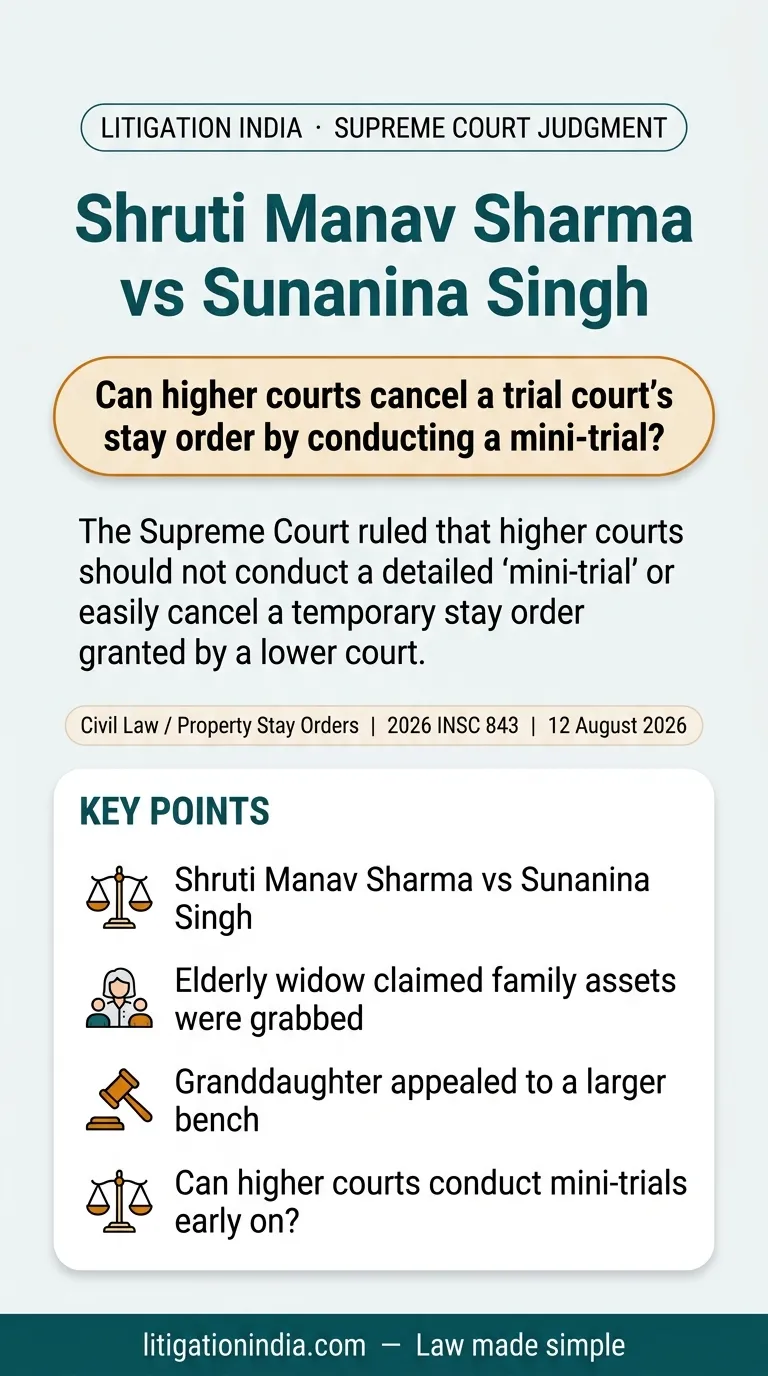
Can higher courts cancel a trial court's stay order by conducting a mini-trial?
Shruti Manav Sharma vs Sunanina Singh
Case: Shruti Manav Sharma vs Sunanina SinghCitation: 2026 INSC 843Decided on: 12 August 2026
“The Supreme Court ruled that higher courts should not conduct a detailed 'mini-trial' or easily cancel a temporary stay order granted by a lower court.”
Story Slides
In short
This judgment from the Supreme Court of India clarifies how courts should handle requests for temporary stay orders, known legally as temporary injunctions. The case began when an elderly widow accused her granddaughter of using undue influence to grab family properties, shares, and assets. The widow asked the court to temporarily stop her granddaughter from selling or transferring these assets while the main lawsuit was being decided. A Single Judge of the Delhi High Court agreed and put a stay on the properties. However, on appeal, a larger Division Bench of the High Court cancelled this stay by deeply analyzing the legal documents and merits of the case. The Supreme Court set aside the Division Bench's decision and restored the stay. The Court explained that a temporary stay is only meant to keep things as they are so that properties are not destroyed or sold before the final trial. Courts must not conduct a 'mini-trial' by closely examining evidence and deciding who will win at this early stage. Higher courts should not interfere with a lower court’s decision to grant a stay unless that decision was completely arbitrary, unfair, or against established legal rules. This ruling ensures that the subject matter of a lawsuit remains safe until the final judgment is delivered.
Need clarity on a similar legal issue?
Request free pro bono guidance from a Supreme Court Advocate.
Background
An elderly widow, Mrs. Sita Chaudhary, claimed that her granddaughter and her husband took advantage of her old age to illegally transfer family assets and company shares to themselves. She filed a lawsuit to get them back and asked for a temporary stay to stop them from selling these properties during the trial. The Single Judge of the Delhi High Court granted the stay, but a higher bench of the same High Court later cancelled it.
The Decision
The Supreme Court allowed the appeal and restored the temporary stay order granted by the Single Judge. It held that higher courts must not conduct 'mini-trials' at the early stage of a case and should only interfere with a lower court's stay if the decision was completely arbitrary or unlawful.
Why it matters for you
This judgment protects ordinary litigants from having their properties sold off while their main lawsuit is still being decided. It clarifies that temporary stay orders are meant to preserve properties so that final victory in court does not become meaningless.
AI-assisted summary, reviewed and verified by our editorial team.
Need help with your case?
Facing a property, eviction, or landlord-tenant dispute? Consult our property lawyers for a free initial review.
Related Supreme Court services