
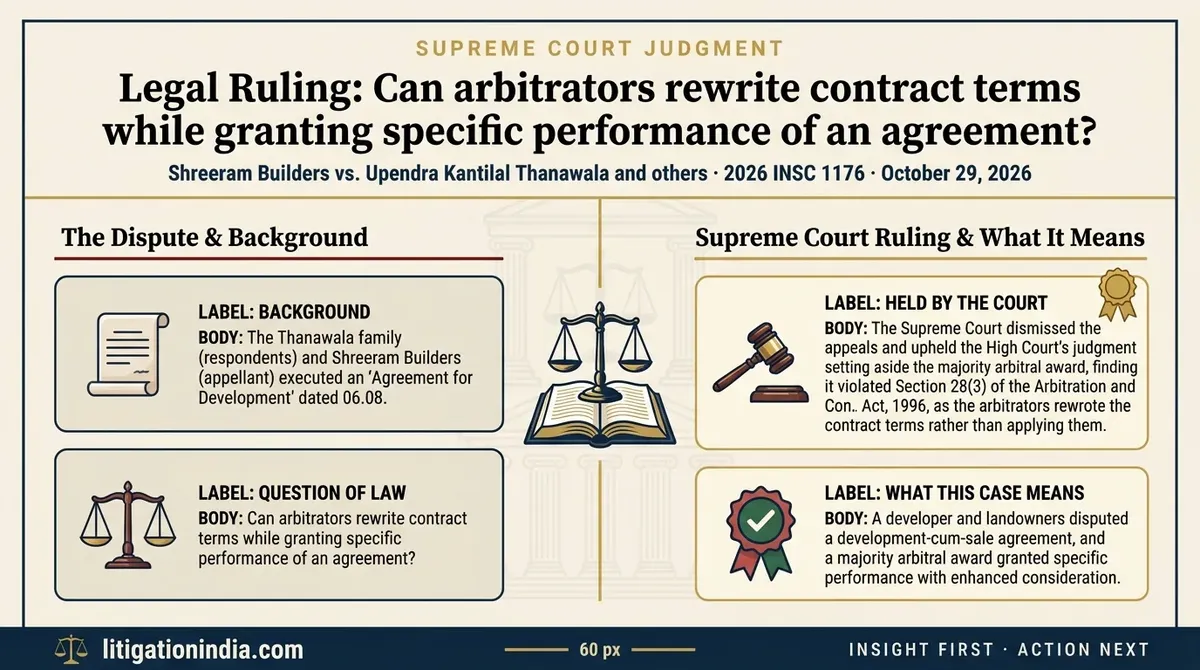
Full text of the judgment
Text extracted from Shreeram Builders vs. Upendra Kantilal Thanawala and others. For the authoritative version refer to the Supreme Court of India's official website.
2026 INSC 1176
Reportable IN THE SUPREME COURT OF INDIA CIVIL APPELLATE JURISDICTION
Civil Appeal Nos. 9817- 9818 of 2024
Shreeram Builders
… Appellant
Upendra Kantilal Thanawala and others
… Respondents
J U D G M E N T
SANJAY KUMAR, J 1. Yet again, the saga of an arbitral award sailing into rough seas. Finding affirmation under Section 34 of the Arbitration and Conciliation Act, 19961, the arbitral award was set aside in appeal under Section 37 thereof. Hence, these appeals. 2. The origin of this lis is sourced in the ‘Agreement for Development’ dated 06.08.2003, executed by Upendra Kantilal Thanawala and his son, Vishal Upendra Thanawala, along with Pankaj Kantilal Thanawala, and his sons, Kunal Pankaj Thanawala and Niket Pankaj Thanawala, viz., the respondents, with Shreeram Builders, the appellant firm, and its partners, Ramesh Amrutlal Mehta, Deepak Ramesh Mehta and Alpa Ketan Mehta. Clause 61 therein provided for adjudication of disputes arising between
1 For short, ‘the Act of 1996’ Digitally signed by babita pandey Date: 2026.10.29 18:01:16 IST Reason: Signature Not Verified
the parties, in respect of the said agreement, by way of arbitration under the provisions of the Act of 1996. It further provided that each party shall appoint an arbitrator and they would, in turn, elect an umpire, and the decision of the arbitrators would be binding. Upon termination of the agreement dated 06.08.2003 by the respondents under legal notice dated 09.04.2008, the parties took recourse to this clause and nominated their respective arbitrators, who elected an umpire. The arbitral tribunal comprised Justice S.D. Pandit (retired), the umpire; P.S. Mudholkar, a retired judge, the arbitrator named by the appellant and its partners; and V.P. Patil, a retired judge, the arbitrator named by the respondents. Ramesh Amrutlal Mehta, the partner, and Vyomesh Kantilal Thanawala were examined by the appellant and its partners and documents were marked in evidence. Upendra Kantilal Thanawala was examined by the respondents and documentary evidence was also adduced by them. 3. The majority arbitral award dated 10.12.2011 was pronounced by Justice S.D. Pandit and P.S. Mudholkar while the dissenting award of the same date was delivered by V.P. Patil. The majority award held in favour of the appellant and its partners, the claimants in the arbitral proceedings, and declared that the termination of the agreement dated 06.08.2003 by the notice dated 09.04.2008 was illegal. It further held that the claimants were entitled to specific performance of the said agreement on depositing ₹10,91,30,164/- within 3 months. Upon the said deposit, the respondents
were directed to execute a sale deed in respect of their 2/9th share in the properties in Schedules A, B and C of the ‘Statement of Claims’, excluding their share in the bungalow and the garden; a room in Chawl No. 1; and the open courtyard of the said room, adjacent to the said bungalow. The sale deed was to be executed by them within a month from the date of deposit and liberty was given to the claimants to get the same executed through Court, if they failed to do so. The sum of ₹10,91,30,164/- was directed to be paid to the respondents only after execution of the sale deed. The respondents’ counter-claim was dismissed. Both parties were directed to bear their own costs. By his dissenting award, V.P. Patil dismissed the claim and the counter-claim, both with costs. 4. While so, the respondents filed an application under Section 33(4) of the Act of 1996 praying for an additional award to be passed on the ground that the majority award failed to consider Clauses 1 and 3 of the agreement dated 06.08.2003, while quantifying the amount to be paid to them by the appellant and its partners. This application was filed by them in February, 2012, and they sought condonation of the delay of 27 days in doing so. However, by order dated 18.02.2012, Justice S.D. Pandit and P.S. Mudholkar dismissed the application, holding that it was barred by limitation, in terms of the prescription of 30 days in Section 33(4) of the Act of 1996. They also noted that no valid reason had been offered for the delay. Costs of ₹35,000/- were imposed upon the respondents.
5. Dissatisfied with the majority award dated 10.12.2011, both sides filed applications under Section 34 of the Act of 1996 before the learned Principal District Judge, Thane. The appellant and its partners filed Civil Miscellaneous Application No. 35 of 2012 while the respondents filed Civil Miscellaneous Application No. 76 of 2013. In the first instance, the learned Principal District Judge, Thane, by common order dated 29.03.2017, held in favour of the appellant and its partners and allowed Civil Miscellaneous Application No. 35 of 2012 while dismissing Civil Miscellaneous Application No. 76 of 2013. Aggrieved thereby, the respondents filed Arbitration Appeal Nos. 38 and 39 of 2018 before the Bombay High Court under Section 37 of the Act of 1996. By order dated 26.06.2019, a learned Judge disposed of the appeals, recording the consent of both sides to have the matter decided afresh by the learned Principal District Judge, Thane. The order dated 29.03.2017 was, accordingly, set aside and the matter was remitted for fresh consideration. 6. However, in the second round, both parties proved unsuccessful, as the learned Principal District Judge, Thane, dismissed both applications, vide judgment dated 25.01.2020, and upheld the majority award in its entirety. This judgment was again subjected to challenge by both sides before the Bombay High Court. Arbitration Appeal (ST.) No. 5662 of 2020 was filed by the appellant while Arbitration Appeal (ST.) No. 93127 of 2020 was filed by the respondents. By judgment dated 05.03.2024, a learned
Judge of the High Court held in favour of the respondents and allowed their Arbitration Appeal (ST.) No. 93127 of 2020. In consequence, the majority award dated 10.11.2011 and the order dated 18.02.2012 were set aside. In the result, the appellant’s Arbitration Appeal (ST.) No. 5662 of 2020 was disposed of on the ground that it did not need to be considered. Aggrieved by this turn of events, the appellant is before this Court. 7. By order dated 12.08.2024, as clarified thereafter, this Court directed the parties to maintain status quo as regards the shares in the subject land. This order was extended until further orders on 30.09.2024. 8. Facts relevant to this adjudication need to be recounted at length. We are concerned with three parcels of land in Village Panchpakhadi, Taluka & District Thane. The first parcel is an extent of 12,826 square yards in Survey Nos. 371, 373 to 409 (Land A); the second parcel is an extent of 1,265 square yards in Survey No. 108, Hissa No. 1 (Part), along with 555 square yards in Survey No. 108, Hissa No. 2 (Part) (Land B); and the last parcel comprises 195 square yards in Survey No. 524 (Land C). These three adjoining parcels of land form a compact parcel, admeasuring 16,414.23 square yards (13,723 square meters). Land A belonged to two brothers, Govindlal Jugaldas Thanawala and Maneklal Jugaldas Thanawala. While so, Maneklal relinquished his right, title and interest therein in favour of his brother, Govindlal, who then became its absolute owner. Govindlal died intestate on 10.06.1936, survived by his widow,
Leelavati, and three sons, Kantilal, Prabhulal and Madhukant. Leelavati and her sons acquired Land B under registered sale deed dated 09.01.1942. Thereafter, in 1962, they acquired Land C under a registered sale deed. Various structures, such as chawls, buildings, sheds and a bungalow, were constructed on the lands. Leelavati relinquished her right, title and interest in the lands in favour of her sons. They, accordingly, became joint owners, each entitled to a 1/3rd share therein. Registered partition deed dated 31.03.1974 was executed by them, allotting 1/3rd share to each brother. However, no actual partition was effected on the ground by metes and bounds. 9. Prabhulal died intestate on 27.03.1997, survived by his widow, Gunvanti, and two sons, Mrugesh and Hiren. Madhukant died intestate on or about 13.12.1999, survived by his widow, Sumati, a son, Hemal, and a daughter, Kamal Pillay. Kantilal died intestate on or about 03.09.2002, survived by three sons, Upendra, respondent No. 1; Pankaj, respondent No. 2; and Vyomesh; and a daughter, Shweta Shreyas Shah. She relinquished her interest in favour of her brothers on 01.07.2003. In effect, Kantilal’s 1/3rd share devolved upon his three sons in equal measure. 10. Earlier, as a partition was not made my metes and bounds, Kantilal had made an application on 14.10.1983 to the District Inspector of Land Records (DILR), Thane, seeking partition of the property. The DILR passed order dated 24.10.1983, partitioning the lands into three equal
parts. Assailing the said order, Prabhulal filed a writ petition before the Bombay High Court. By order dated 29.10.1983 passed therein, the DILR’s order came to set aside and the DILR, Ulhasnagar, was directed to take up the matter. He submitted his report on 14.01.1985 to the Consolidation Officer, Thane. While so, Kantilal and Madhukant made an application to the Collector, Thane, for partition of the property by metes and bounds. Thereupon, the Collector, Thane, passed order dated 30.04.1987. However, assailing the said order, Prabhulal filed an appeal before the Additional Commissioner, Konkan Division, but the same was dismissed. Thereafter, upon his death, his heirs filed a writ petition challenging the order dated 30.04.1987 passed by the Collector, Thane. This writ petition was pending at the time this litigation started. Prabhulal’s widow, Gunvanti, along with her sons, Mrugesh, and Hiren, filed Special Civil Suit No. 650 of 1995 before the learned Civil Judge (Senior Division), Thane, against Kantilal, Madhukant, their family members and others, for specific performance of the partition deed dated 31.03.1974. Thereafter, the appellant, as the power-of-attorney of the respondents and Madhukant’s heirs, filed Special Civil Suit No. 119 of 2005 before the learned Civil Judge (Senior Division) against Prabhulal’s heirs seeking an injunction restraining them from repairing the bungalow. 11. While so, Civil Suit No. 445 of 2008 was filed by Chandru Nebhandas Mirani, Ashwin Laxmikant Vasavda and Mehul Laxmikant
Vasavda against the brothers, Upendra, Pankaj and Vyomesh; Hemant Madhukant Thanawala; and others, including the appellant and its partner, Ramesh Mehta, seeking specific performance of an agreement to sell 2/3rd undivided share in the property, said to have been executed in their favour on 26.10.1983. Upendra and Pankaj were arrayed therein as defendant Nos. 5 and 3 respectively while the appellant and Ramesh Mehta were shown as defendant Nos. 7 and 9. In the said suit, Upendra and Pankaj specifically took the stand in their written statement that, by the agreement dated 06.08.2003, they and their sons, Vishal Upendra Thanawala, Kunal Pankaj Thanawala and Niket Pankaj Thanawala, had given the right of development and had agreed to sell the property to defendant No. 7, viz., the appellant. 12. We may also note that, by agreement dated 11.02.2003, Vyomesh agreed to sell his undivided 1/9th share in the property to the appellant. He executed deed of conveyance dated 21.08.2008 in its favour, transferring his 1/9th share. Similarly, on 29.09.2003, the legal heirs of Madhukant executed an agreement in favour of the appellant for development of their undivided share in the property. On 02.04.2009, they executed a deed of conveyance transferring their undivided 1/3rd share in the property to the appellant. We may also note that the appellant claims to have acquired about 44.44% of the larger property comprised in Lands A, B and C from the other family members of the respondents. Be that as it may.
13. As noted earlier, the arbitration proceedings centred on the agreement dated 06.08.2003. One of the main issues considered by the arbitral tribunal was the status of this agreement, that is, whether it was a development agreement or an agreement to sell. The majority award held it to be an agreement to sell while the dissenting award held otherwise. The learned Principal District Judge, Thane, upheld the majority award and affirmed the finding therein that the agreement was an agreement to sell and was not just for development. However, in appeal under Section 37 of the Act of 1996, the Bombay High Court reversed that finding and opined that it was nothing more than a development agreement. Notably, it was recorded on the first page of the agreement that the agreement value was ₹2,28,75,000/- and that the document had suffered stamp duty of ₹2,29,000/-. The stamp duty, therefore, came to 1% of the agreement value. One of the factors that weighed with the High Court to hold that the agreement was a development agreement and not an agreement to sell was the fact that stamp duty of 1% was payable only on development agreements as an agreement to sell had to suffer stamp duty of 5% of the value. The High Court, accordingly, opined that, as the subject agreement had suffered only 1% stamp duty, it was clearly intended to be a development agreement only. 14. However, we are not persuaded to agree that this fact was sufficient to categorise the agreement as a development agreement. As is wont to
happen, attempts are made by parties to a document to escape the rigour of paying higher stamp duty and in the course of that endeavour various measures are adopted, including portrayal of the document as something other than what it is actually intended to be. Naming the document as a development agreement and paying commensurate stamp duty may, thus, be a means of escaping the higher stamp duty applicable to an agreement to sell. The settled legal position is that the nomenclature of a document would not be decisive as to its nature. In Sasan Power Limited vs. North American Coal Corporation (India) Limited2, this Court held that it is the rights and obligations created under an agreement that determine its legal character. Thus, it is the contents of the agreement that would determine its actual nature. Hence, the stamp duty did not conclude the issue and the agreement had to be examined, not only for its import but also what it entailed in the context of the arbitration proceedings. 15. Significantly, the first paragraph of the said agreement, after naming the five Thanawalas, stated that they would be referred to as the ‘Vendors of the one part’. The appellant firm and its three partners, viz., Ramesh Amrutlal Mehta, Deepak Ramesh Mehta and Alpa Ketan Mehta, were referred to as the ‘Purchaser’, but the word ‘Purchaser’ was then cut out and, by hand, the word ‘Developers’ was inserted. However, this correction was not initialled by whoever had made the same. Further, in
2 (2016) 10 SCC 813
the rest of the document, the appellant and its partners continued to be referred to as the ‘Purchaser’ and no corresponding corrections were made. We then find that the title to Lands A, B and C was traced out in great detail, dating back to the initial sale deed executed on 23.05.1921, whereunder the two brothers, Govindlal and Maneklal, had purchased Land A. Details of the lineage of the Thanawalas and how the property devolved thereafter were also set out at great length. These details took up paragraphs ‘A’ to ‘Z’ of the agreement. Paragraph R noted that Kantilal and his sons, Upendra and Pankaj, had entered into a Memorandum of Understanding (MoU) on 15.03.2002 with Ramesh Mehta and Deepak Mehta, the appellant firm’s partners, in respect of their share in the property. As regards the five Thanawalas who constituted the ‘Vendors’, paragraph ‘W’ stated that Upendra and Pankaj had 8/90th share each and Vishal, Upendra’s son, was entitled to 2/90th share while Kunal and Niket, Pankaj’s sons, had 1/90th share each. In effect, their shares put together came to 20/90th or 2/9th undivided share in Lands A, B and C. 16. Paragraph ‘CC’ recorded that the ‘Purchaser’ had approached the ‘Vendors’ with an offer to develop the said property by constructing a shopping, commercial and residential complex thereon. Paragraph ‘DD’ recorded that the ‘Vendors’ had agreed to allow the ‘Purchaser’ to develop their share in the said property, excluding (1) the bungalow and the garden in front of and behind the bungalow and (2) Room No. 1 in Chawl No. 1
adjacent to the bungalow; and also the open space in front of and behind Chawl No. 1. Description of the area to be excluded was set out in the Second Schedule. The area and description of all the other structures on the property, leaving out the excluded area, were set out in the Third Schedule. The property, leaving out the excluded area but including all other structures and buildings thereon, was referred to as ‘the property agreed to be developed’. Paragraph ‘EE’ stated that the ‘Purchaser’ had agreed to take from the ‘Vendors’, the right to develop their share in the property agreed to be developed and the ‘Vendors’ had agreed to give to the ‘Purchaser’ the right to develop their share in the property agreed to be developed. Paragraph ‘FF’ stated that the ‘Vendors’ and the ‘Purchaser’ had surveyed the property and found that the undivided share of the ‘Vendors’ in the property agreed to be developed would measure 3,049.57 square meters or thereabouts. Paragraph ‘GG’ stated that the ‘Vendors’ and the ‘Purchaser’ had negotiated the terms and conditions for development of the share of the ‘Vendors’ in the property agreed to be developed and had agreed to enter into the said agreement. The terms agreed upon by the parties were set out thereunder from Clauses 1 to 64. Three schedules were appended to the agreement. 17. Clause 1 recorded that the ‘Vendors’ agreed to give and the ‘Purchaser’ agreed to take from them the right to develop their undivided 2/9th share in the total Floor Space Index (FSI) available for the property
agreed to be developed at the time of sanctioning of the plan of the proposed project by the municipal authorities. The undivided share was computed at 3049.57 square meters or thereabouts and the ‘Vendors’ and ‘Purchaser’ jointly calculated the net FSI available for the 2/9th share of the ‘Vendors’ to be around 25,000 square feet. Clause 2 stated that the net available FSI of 25,000 square feet was arrived at after deducting the FSI that would be applicable for the excluded area. Clause 3 is of relevance and is extracted hereunder: - ‘3. That the Vendors and the Purchaser agree that the said development right shall be given to the Purchaser at the price/consideration of Rs. 915/- (Nine Hundred and Fifteen) per square feet. That as per the same the total consideration for these presents is Rs.2,28,75,000/- (Rupees Two Crores Twenty Eight Lakhs and Seventy Five Thousand Only). That the said total consideration is calculated on the basis of the total available F.S.I. on the undivided 20/90th share of the property agreed to be developed being 25,000 square feet. That in the event of any additional F.S.I. being available on account of any change in the rules, laws and regulations for computing F.S.I. at the time of the sanctioning of the plan or on account of any arithmetical error in calculating the said F.S.I., the consideration payable will proportionately increase and in the event of there being any decrease in the F.S.I. being available at the time of the sanctioning of the plan on account of any change in the rules, laws and regulations for computing F.S.I. or on account of any arithmetical error in calculating the said F.S.I., the consideration payable will proportionately decrease. The Purchaser and the Vendors agree, that any change in the relevant rules, regulations and laws for computing the F.S.I. available after the sanctioning of the plan shall operate to the benefit or prejudice of the Purchaser and the consideration for these presents shall not be affected thereby and the Vendors shall not claim any benefit therefrom.’
18. Clause 4 stated that, in the event of the ‘Purchaser’ constructing basements in the proposed project, the ‘Purchaser’ shall pay to the ‘Vendors’ a further sum of ₹5,00,000/- as a one time and full and final
consideration for the same, over and in addition to the amount payable under Clause 3. This sum of ₹5,00,000/- was to be added to the last instalment payable to the ‘Vendors’ by the ‘Purchaser’. It was agreed by and between the ‘Vendors’ and the ‘Purchaser’ that the said payment was not to be claimed by the ‘Vendors’ if the ‘Purchaser’ did not actually construct basements and it would be within the sole discretion of the ‘Purchaser’ whether or not to construct basements. Clause 5 recorded that the ‘Purchaser’ had, simultaneously with the execution of the agreement, paid to the ‘Vendors’ a sum of ₹55,00,000/- as earnest money. The balance consideration of ₹1,73,75,000/-, out of the total consideration of ₹2,28,75,000/-, was to be paid as per Clauses 6 and 7. 19. Clause 6 stated that the balance consideration of ₹1,73,75,000/would be paid by the ‘Purchaser’ to the ‘Vendors’ in ten equal instalments of ₹17,37,500/- each. The payment was to be made in one of the following manners, whichever was earlier in point of time: (i) all the instalments would be paid within 30 months from the date of the commencement certificate, or (ii) all the instalments would be paid within 30 months from the date of the sanction of the plan by the municipal corporation, or (iii) the first instalment shall be paid on 30.04.2005, the second instalment shall be paid on 01.08.2005, the third instalment shall be paid on 01.06.2006 and, thereafter, successive instalments shall be payable on the first day of each fourth successive month. Clause 7 provided for the
‘Purchaser’ issuing individual cheques in favour of each of the ‘Vendors’, proportionate to their respective shares in the property agreed to be developed. It further recorded that it was agreed by and between the ‘Purchaser’ and the ‘Vendors’ that, in the event of there being any default in payment of instalments or amounts, as mentioned therein, the ‘Vendors’ shall cause to be served upon the ‘Purchaser’ a notice in writing, giving the details of the default and calling upon the ‘Purchaser’ to remedy the same within 15 days of receipt of the notice. It was also recorded by and between the ‘Vendors’ and the ‘Purchaser’ that the payments due, as above, shall be the essence of these presents and time shall be the essence of these presents. 20. Clause 9 recorded that the ‘Vendors’ had, simultaneously, with the execution of these presents, handed over possession of their undivided 2/9th share in the property agreed to be developed to the ‘Purchaser’. It further recorded that the ‘Vendors’ would not hand over the possession of the bungalow and the garden in front of and behind the bungalow and Room No. 1 in Chawl No. 1, adjacent to the bungalow, to the ‘Purchaser’. It also recorded that ‘Vendors’ had handed over possession of all other structures and buildings on the property agreed to be developed, as set out in the Third Schedule, to the ‘Purchaser’ and the ‘Purchaser’ would be free and entitled to use and occupy the property agreed to be developed to do all things necessary and deemed fit and proper by the ‘Purchaser’
for the purpose of development of the property agreed to be developed. Clause 10 affirmed that the ‘Vendors’ confirmed that possession of their undivided 2/9th share in the property agreed to be developed was handed over to the ‘Purchaser’ and the ‘Purchaser’ had entered thereon for the development thereof. 21. Clause 11 required the ‘Purchaser’, after entering into possession of the property agreed to be developed but before commencement of the construction, to either enter into an agreement with the heirs of Prabhulal and, thereafter, develop the entire property or develop only the property agreed to be developed, along with the shares of the heirs of Madhukant apart from the shares of Vyomesh and his son, Rohan Vyomesh Thanawala. Clause 12 stated that, in the event the ‘Purchaser’ was unable to enter into an agreement with the heirs of Prabhulal, the ‘Vendors’ would consent to the partition of the property agreed to be developed and the terms and conditions of the agreement would be construed as if entered into with respect to the partitioned share of the ‘Vendors’ and the ‘Purchaser’ would be free to take all necessary steps for effecting the said partition/subdivision and the ‘Vendors’ would not raise any objection to the partition/subdivision. The ‘Purchaser’ was required to bear the entire expenses of the said partition. The ‘Vendors’ agreed that, in the event of partition or subdivision of the property agreed to be developed, they would take their share of the property agreed to be developed joined, physically
and notionally, with the heirs of Madhukant along with Vyomesh and his son, Rohan. 22. Clause 13 also spoke of the partition/subdivision of the property. Clause 14 recorded that it was agreed by and between the ‘Vendors’ and the ‘Purchaser’ that, in any event, the ‘Purchaser’ would, before commencement of construction, physically separate or cause to be separated/partitioned/subdivided by metes and bounds, the share of the ‘Vendors’ in the property agreed to be developed and separate/demarcate the same by the use of visible signs and allocate the same to the ‘Vendors’. It further stated that the ‘Purchaser’ would, after the said partition/subdivision and before commencement of construction, intimate to the ‘Vendors’, in writing, that the partition has been effected and the share of the ‘Vendors’ had been allocated to them and describe in writing the visible signs by which the share of the ‘Vendors’ was separated. It was agreed that, after the said partition/subdivision, the ‘Purchaser’ would be free to carry out the development as per the sanctioned plan and the provisions of these presents. It was also agreed between the ‘Vendors’ and the ‘Purchaser’ that from the date of the said partition/subdivision, the share of the ‘Vendors’ in the property agreed to be developed shall be physically and legally separate for all practical purposes and the partition/subdivision of the share of the ‘Vendors’ before commencement of construction would be the essence of the contract.
23. Clause 15 provided that, immediately after issuance of the commencement certificate, the ‘Purchaser’ would create security in favour of the ‘Vendors’ for payment of the instalments and amounts, as payable under the provisions of these presents. The ‘Purchaser’ was required, at any time after issuance of the commencement certificate but before commencement of construction, to create a mortgage over the proposed shopping, commercial and residential complex to be built on the property agreed to be developed by executing a deed of mortgage. This deed of mortgage was to be registered by the ‘Purchaser’ before commencement of construction and the stamp duty payable thereon was to be paid by the ‘Purchaser’ and the ‘Vendors’ in the ratio of 75% and 25% respectively. The ‘Purchaser’ was required to mortgage to the ‘Vendors’ specific units in the proposed shopping, commercial/residential complex to be built on the property agreed to be developed. The choice of units to be mortgaged was with the ‘Vendors’. Insofar as the residential units were concerned, only units between the 3rd and 6th floor were to be mortgaged. The mortgage was to be created equally over the shopping, commercial and residential units and not exclusively over any one of them. It was also made clear that the ‘Purchaser’ would have no right to sell, transfer or, in any way, charge or encumber the mortgaged units and the ‘Vendors’ would release the units mortgaged to them proportionately upon payment of each instalment as mentioned in these presents. The ‘Purchaser’ could
sell or transfer the units mortgaged to the ‘Vendors’ only after they were released by them. The ‘Vendors’ also agreed that they would not sell, mortgage, charge, encumber or create any lien or third-party interest on the mortgaged units as long as the ‘Purchaser’ was regularly making payment of the monies payable under these presents. 24. Clause 16 required the ‘Vendors’ to make out a marketable title to the undivided 2/9th share of the property agreed to be developed, free from any encumbrance and from any doubt. The ‘Vendors’ agreed to indemnify the ‘Purchaser’ against any claim in respect of their undivided 2/9th share of the property agreed to be developed. Clause 17 required the ‘Purchaser’ to apply to the municipal authorities for change of use, viz., from industrial to commercial/residential and the ‘Purchaser’ was to bear the entire expenses incurred therefor. Clause 18 provided that the ‘Purchaser’, as the attorney of the ‘Vendors’ and in their name and on their behalf, was to prepare plans of the said shopping, commercial and residential complex and submit the same to the municipal corporation for approval. All expenses in that regard were to be borne by the ‘Purchaser’. 25. Clause 19 recorded that, simultaneously with the signing of these presents, the ‘Vendors’ had also executed an irrevocable general power of attorney in favour of Ramesh Mehta and Deepak Mehta, the partners, authorizing them to jointly or severally carry out the work of development. Clause 20 recorded that the ‘Vendors’ assured, promised and represented
to the ‘Purchaser’ that they were in adverse possession of some portion of land towards the ‘nallah’ side of the property and the ‘Purchaser’ was at liberty to get the said land regularized by the competent authority at its sole cost and expense for which the ‘Vendors’ had no liability. The ‘Vendors’ further stated that that they had 2/9th share in the said land also and the ‘Purchaser’ could purchase, @ ₹450/- per square foot, the FSI granted to the ‘Vendors’ in respect of the said land and any FSI granted in lieu of balconies, stilts, basements, etc., or any additional FSI granted in respect thereof. The said amount was to be paid to the ‘Vendors’ by the ‘Purchaser’ as and when the said adverse possession was regularized by the competent authority and not otherwise. 26. Clause 22 recorded that the ‘Purchaser’ was entitled to commence, carry out and complete the construction of the proposed project in accordance with the sanctioned plan; and to sell the flats, shops, garages, or other units in the proposed project to prospective purchasers and to appropriate the proceeds thereof. The ‘Purchaser’ was empowered to register the documents related to such transfer/sale with the concerned Sub-Registrar. Clause 26 recorded that the ‘Vendors’ and the ‘Purchaser’ agreed that all the taxes, rates, cesses, penalties, whatsoever, etc., in respect of the property agreed to be developed till 31.03.2002 would be paid by the ‘Vendors’ and, thereafter, i.e., from 01.04.2002, the ‘Purchaser’ would be liable to pay all the taxes, rates, cesses, penalties, whatsoever,
etc., on their own account to the concerned authorities in respect of the property agreed to be developed. It was also made clear that the ‘Vendors’ would bear the taxes, rates, cesses, penalties, whatsoever, in respect of the property set out in the Second Schedule, i.e., the bungalow and Room No. 1 in Chawl No. 1, which were in their possession. Clauses 28 and 29 provided that all the building material, rubble from the existing buildings and structures, set out in the Third Schedule, would belong to the ‘Purchaser’ and would be removed by the ‘Purchaser’ at its own cost and expense. The ‘Purchaser’ was to clear the site and construct the project after demolition of the existing buildings and structures. The cost of such demolition was to be paid by the ‘Purchaser’ alone at its own risk and on its own account. Clause 33 recorded that Vendors 1 and 2 had their factory and garage upon the property agreed to be developed, shown in the Third Schedule, and it was agreed that the said factory and the garage would be relocated and adjusted within the area of the property agreed to be developed at the cost and expense of the ‘Purchaser’. It was also stated that Vendors 1 and 2 would, after the commencement certificate was issued to the ‘Purchaser’ and after actual payment of two instalments to the ‘Vendors’, shift/relocate the said factory and garage out of the property agreed to be developed at their own cost and expense. 27. Clause 35 provided that the ‘Purchaser’ shall construct a compound wall enclosing the property agreed to be developed to safeguard it. The
‘Purchaser’ was to bear the expense thereof. Clause 36 provided that the ‘Purchaser’ shall form and register a cooperative shopping, commercial and residential society and the ‘Vendors’ shall sign and execute the application for registration and the other papers necessary for formation and registration of the society. This society of flat/shop purchasers was to be registered under Section 10 of the Maharashtra Ownership of Flats (Regulation of the Promotion of Construction, Sale, Management and Transfer) Rules, 1964. Clause 37 required the ‘Vendors’ to execute a deed of conveyance along with the other owners (responsibility of negotiating with the other owners being the sole responsibility of the ‘Purchaser’ and the ‘Vendors’ had no responsibility for the same) for the undivided 2/9th share in the property agreed to be developed, in favour of the ‘Purchaser’ or their nominees, including the cooperative society of the shop/flat purchasers in the shopping, commercial and residential complex. All the costs, charges and expenses of such deed or other documents required to be signed by the ‘Vendors’, including stamp duty and registration charges, were to be borne by the ‘Purchaser’. The ‘Purchaser’ also had the right to execute the said deed of conveyance as the certified attorney of the ‘Vendors’ but such deed of conveyance was not to be executed till payment of all the instalments and amounts due under these presents. Clause 38 stated that it would be the responsibility of the ‘Purchaser’ to form and register the cooperative shopping, commercial and residential
society of flat/shop purchasers and the ‘Vendors’ would not be concerned with or be responsible for the same. 28. Clause 40 contained a declaration by the ‘Vendors’ while Clause 41 was the declaration of the ‘Purchaser’. Clause 47 stated that, notwithstanding anything contained in the agreement or in any other agreement between the ‘Purchaser’ and the ‘Vendors’ or between the ‘Purchaser’ and other owners and, specifically, with the heirs of Madhukant and/or with Vyomesh, the ‘Purchaser’ declared that neither the firm nor its partners had any right, title, claim or interest over the bungalow and the gardens in front of and behind the bungalow and Room No. 1 in Chawl No. 1 adjacent to the bungalow. The ‘Purchaser’ declared that it would not, in any way, interfere with the possession and right of the ‘Vendors’ over the said bungalow and the garden in front of and behind the bungalow and Room No. 1 in Chawl No. 1 adjacent to the bungalow and shall not in any way attempt to partition or develop the same. It was further recorded that the ‘Purchaser’ gave up, released and relinquished all rights, title or interest in the said bungalow and the garden in front of and behind the bungalow and Room No. 1 in Chawl No. 1. Clause 51 recorded that the present agreement would be in supersession of all prior agreements between the parties, including the MoU dated 15.03.2002, and all rights between the parties, inter se, under any prior agreement would come to an end and stand forfeited. Clause 53 stated that, in the
event of there being any default in payment of any of the instalments or amounts, under any and/or all of the provisions of these presents in the stipulated time as aforesaid, the present agreement would come to an end and all rights given to the ‘Purchaser’ under this agreement would automatically come to an end. Clause 54 stated that, in the event of paragraph 53 above applying and in the event there was no construction carried out by the ‘Purchaser’ on the share of the ‘Vendors’ on the date of such default, the ‘Vendors’ would not be liable to pay the ‘Purchaser’ any amount towards the value of any structure/building constructed on the share of the other owners and the ‘Vendors’ would only be liable to repay to the ‘Purchaser’ the consideration paid to them by the ‘Purchaser’ without interest. It was further recorded that, on the date on which the ‘Vendors’ paid the said amount, the ‘Purchaser’ would transfer to the ‘Vendors’, the divided and regulated possession of their share of the property agreed to be developed. The ‘Vendors’ were to enter upon their share, as above, only after payment of the amount and not before that. Clauses 55 and 56 spoke of a situation where construction was carried out by the ‘Purchaser’ on the land that fell to the share of the ‘Vendors'. 29. Clause 61 stated that, in case of any disputes, doubts or differences arising between the parties in respect of any of the terms and conditions of these presents or in respect of the interpretation of any of the terms and conditions of these presents or in respect of any other matter, cause or
thing whatsoever not contained herein or otherwise provided for, the same shall be referred to arbitration for adjudication, subject to the provisions of the Indian Arbitration Act, 1996, or any other statutory modifications or enactments thereof, for the time being in force. It further provided that each party shall appoint one arbitrator and such arbitrators shall, in turn, elect an umpire and the decision of the said arbitrators shall be binding upon all the parties. Clause 63 confirmed that it was agreed by and between the ‘Purchaser’ and the ‘Vendors’ that payment of instalments under these presents on the due dates shall be the essence of the agreement. This was again reiterated in Clause 64, wherein it was agreed by and between the ‘Purchaser’ and the ‘Vendors’ that time shall be the essence of this agreement. 30. This being the long and short of the agreement dated 06.08.2003, the claimants’ contention before the arbitral tribunal was that, in all, ₹1,59,22,000/-, out of the total sale consideration of ₹2,28,75,000/-, had been paid by them to the respondents. In addition, they claimed that a sum of ₹1,71,971/- was paid by them to the Gujarat Finance Corporation to settle the respondents’ liability and, earlier, they had paid ₹19,50,000/to Kantilal, which the respondents had agreed to reimburse to them. They also claimed that they paid ₹3,00,000/- to one Jariwala to meet the respondents’ liability. They asserted that they had sent cheques for ₹34,75,000/- to the respondents in October, 2007, but they were not
encashed. They claimed that they were ready and willing to pay the balance sale consideration to the respondents, after deducting the amounts paid, for transfer of their 2/9th share in the property, possession of which was already delivered to them. In the alternative, they raised a claim for damages of ₹41,46,49,688/-. 31. Contesting these claims before the arbitral tribunal, the respondents raised the issue of limitation. They also asserted that the claimants had committed breach of various clauses of the agreement dated 06.08.2003. They denied that the claimants were in possession of their 2/9th share in the property. They denied that the claimants had paid ₹19,50,000/- to Kantilal and that they had agreed to reimburse the same. They also denied payment by the claimants of ₹1,71,971/- to Gujarat Finance Corporation and of ₹3,00,000/- to Jariwala. Their main contention was that the subject agreement was merely for development and was not an agreement to sell their share to the claimants. The respondents raised a counter-claim for compensation of ₹110,70,00,000/- along with costs of ₹20,00,000/-. 32. The majority award noted that the nomenclature of a document was not conclusive proof of the nature of transaction therein and undertook detailed analysis of the terms and conditions in the agreement dated 06.08.2003. It was noted that there was no separate defined property, whereupon the development was to be carried out and it was observed that, had the transaction been only for development, the agreement would
have described the developments to be carried out by the claimants. It was further noted that the respondents had agreed to give their 2/9th share to the claimants and the consideration therefor was to be calculated on the basis of the FSI. Referring to Clause 3 of the agreement, it was observed that, if the transaction was only for development and the claimants were only developers, then the benefit or prejudice on account of a change in the FSI Rules ought not to go to the claimants as it would ordinarily be given to the owners. It was opined that Clause 3 indicated that the transaction was for sale and not for development. It was observed that, had it been only a development agreement, then the question of satisfying the claimants about marketable title to the property would not arise and indemnifying the claimants in that regard would also not arise. 33. It was further noted that, if the property was given to the claimants only for development, the agreement would have provided for possession thereof to be returned after completion of the development but there was no such clause. Further, as Clause 22 of the agreement envisaged sale of the flats, shops and other units in the proposed project to be built by the claimants without any portion of the sale consideration being paid to the respondents or even their approval or consent being required for such sale or transfer, it was opined that this clause demonstrated that it was an agreement to sell. Similarly, the liability for payment of taxes, rates, cesses etc. being with the claimants after the cut-off date, 31.03.2002, was held
to be a further indication in this regard. It was noted that, as per Clauses 36 and 37, the deed of conveyance was to be executed by the respondents in favour of the purchasers or their nominees, including the co-operative society to be formed at the cost of the claimants, and no stipulation was made as to any additional amount being paid to the respondents therefor, apart from the consideration of ₹2,28,75,000/- that was agreed upon. Reference was made to Clause 50, which provided that the claimants would continue all pending cases/litigation/proceedings, in relation to the property agreed to be developed, at their own risk and cost, and it was observed that this clause would not have been agreed to by the respondents had they intended to remain the owners. It was observed that this clause showed that the claimants, being the purchasers, were to take on the responsibility of fighting pending litigation relating to the property which they would not have taken on, if they were not the owners. 34. Reference was then made to the stand of Upendra and Pankaj in Civil Suit No. 445 of 2008, wherein they had candidly asserted, by way of their written statement, that they had agreed to sell the property to defendant No.7 therein, viz., Shreeram Builders, claimant No.1. It was opined that this admission would be binding upon them and reference was made to the decision of this Court in Union of India vs. Moksh Builders and Financiers Ltd. and others3, wherein it was observed that an
3 AIR 1977 SC 409
admission by a party would be substantive evidence of the fact admitted, irrespective of whether the said party appeared in the witness box and whether such party was confronted with that statement. The respondents’ contention that the admission must necessarily be made in the same proceedings was rejected. It was further held that, as the sons of Upendra and Pankaj, respondent Nos. 3 to 5 herein, were out of India, the stand taken by Upendra and Pankaj would be binding on them also. 35. It was noted that, though the respondents denied the payments made by the claimants, Upendra admitted in his cross-examination that the claimants had paid ₹80,000/- and ₹2,00,000/- towards municipal taxes. He also admitted that nearly ₹19,00,000/- was paid by the claimants to meet their needs. Adverting to the contention of the respondents that time was the essence of the contract, in terms of the payments being made within the stipulated timeframes, it was observed that, as the respondents accepted belated payment of six instalments at the very outset, without raising any objection and without issuing a notice under Clause 7, they could not rely on the time stipulation. It was noted that the respondents had not offered to return the monies received by them from the claimants under the agreement even after the purported termination thereof. 36. Dealing with the breaches of the agreement alleged by the claimants, it was noted that out of the consideration of ₹2,28,75,000/-, the
respondents admitted receipt of ₹55,00,000/- by way of earnest money and as regards the payment of balance amount of ₹1,73,75,000/-, it was noted that the claimants had paid the initial six instalments and the respondents received the same. It was noted that payment of those six instalments was with delay, but the respondents neither raised a protest nor received the instalments without prejudice to their rights arising out of the agreement. The contention of the respondents that the delayed payment of these instalments amounted to a breach was rejected, as Clause 7 of the agreement specifically provided for a notice being given to the claimants in the event of a breach, calling upon them to remedy the same within 15 days. It was observed that the respondents never issued any such notice despite the delay in the payment of those six instalments and the same could not be taken to be a breach. It was further noted that only the cheques given for the 7th to 9th instalments had been returned but even at that stage, no notice was given in writing under Clause 7. It was, therefore, opined that the claimants had not committed any default in terms of Clauses 5 to 7. It was, accordingly, concluded that termination of the agreement dated 06.08.2003 by way of the legal notice dated 09.04.2008 was not justified and the same would have no legal consequences or validity. 37. It was further noted that prior to the termination notice dated 09.04.2008, the claimants had sent 10 cheques for the sum of
₹34,75,000/- and 5 cheques for ₹17,37,500/- drawn in favour of the respondents but the same were refused by them. This fact was held to be sufficient to infer that the claimants had the financial capacity to pay the balance consideration. As there was no documentary evidence in proof of payment of ₹3,00,000/- to Jariwala, the claimants’ claim in that regard was rejected. As regards the payment to Gujarat Financial Corporation, it was held that the liability of Upendra and Pankaj in that regard came to ₹26,222/- and only that part of the payment by the claimants could be attributed to them. Out of the amount of ₹19,50,000/- said to have been paid to Kantilal, it was observed that Upendra conceded in his cross examination that the said amount was, in fact, paid. However, the liability of Upendra and Pankaj apropos the same was determined at ₹6,59,167/each and only those sums were directed to be taken into account. 38. As regards the total sum paid by the claimants to the respondents under the agreement, it was noted that a sum of ₹1,19,18,670/- was paid in that regard but, in addition thereto, ₹13,18,334/- out of the sum of ₹19,50,000/- paid to Kantilal, which was attributable to Upendra and Pankaj, along with ₹26,222/- being their share in the payment to Gujarat Financial Corporation were also added. In effect, the respondents were stated to have received ₹1,19,18,670/- + ₹55,00,000/- + ₹13,18,334/- + ₹26,222/-, aggregating to ₹1,87,63,226/-. However, taking note of the passage of time and escalation of land prices, it was held that the
claimants should pay six times the agreed rate of consideration of ₹915/per square foot, i.e., ₹5,490/- per square foot. Applying this rate, it was held that the claimants had to pay, in all, ₹13,72,75,000/- and upon deducting the sum of ₹1,87,63,226/- therefrom, the balance payable by the claimants to the respondents was held to be ₹11,85,11,774/-. However, as the sum of ₹1,87,63,226/- had been paid to the respondents more than five years back, it was held that interest would have to be added thereto at the rate of 10%. Accordingly, ₹93,81,610/- was deducted from the total amount payable and the net amount payable by the claimants to the respondents was quantified at ₹10,91,30,164/-. The claim in the alternative by the claimants towards damages was for ₹41,46,49,688/-. It was held that, in the event the findings in favour of the claimants were reversed by a superior authority, holding that they were not entitled to specific performance of the agreement, the damages payable to the claimants would be ₹23,21,19,892/-. As regards the respondents’ counterclaim for ₹110,70,00,000/- along with costs of ₹20,00,000/-, the same was rejected for want of supporting documents or material. 39. In the result, the claimants were held entitled to specific performance of the agreement dated 06.08.2003 upon payment of ₹10,91,30,164/-. They were further held entitled to execution of the sale deed in respect of the respondents’ 2/9th share in the property, excluding their share in the bungalow and the garden in front of and behind the
bungalow and Room No. 1 in Chawl No. 1 along with the open courtyard of the said room, adjacent to the bungalow. 40. Considering this majority award in the impugned judgment dated 05.03.2024 passed in the appeals filed by both sides, the learned Judge of the High Court held that, as per the agreement, there were three conditions precedent to execution of the deed of conveyance in favour of the claimants, viz., (i) the deed of conveyance would be executed along with conveyance deeds in relation to the properties of the other owners, i.e., Vyomesh and Madhukant’s heirs; (ii) execution of the conveyance deed would be after the project was fully constructed, and (iii) all instalments and amounts payable under the agreement were duly paid. The learned Judge held that none of these conditions stood fulfilled and, therefore, the obligation to execute the conveyance deed had not arisen. 41. It was also noted that determination of the sale consideration depended on additional amounts being added after the construction and the consideration, therefore, remained variable. Without determination of the full consideration payable after completion of the project, the learned Judge opined that the majority award could not have directed execution of the deed of conveyance in favour of the claimants. Noting that the validity of the award had to be tested under the unamended Section 34 of the Act of 1996, the learned Judge opined that the award was contrary to Section 28(3) of the Act of 1996 as it was in violation of the terms of the
contract. Reference was made to the decision of the Bombay High Court in Board of Control for Cricket in India vs. Deccan Chronicle Holdings Ltd.4, wherein it was held that the arbitral tribunal could not rewrite the contractual terms. The learned Judge opined that the majority award had not interpreted the contract in a reasonable manner and ignored the material terms thereof, whereby a jurisdictional error had been committed. Another instance cited in this regard was the consideration of the sum of ₹19,50,000/- said to have been paid by the claimants to Kantilal and others under the earlier MoU. The learned Judge noted that, as per Clause 51, the agreement dated 06.08.2003 was in supersession of all prior agreements and, therefore, the amount paid, if any, under the earlier MoU could not have been taken into account under the present agreement. It was further noted that the majority award, despite granting the relief of specific performance, had awarded the alternate relief of damages in the event the primary relief granted was set aside and the learned Judge held that this was not in keeping with the procedure and amounted to violation of the fundamental policy of Indian law. 42. The learned Judge further held that the subject agreement was not an agreement to sell but was an agreement for development only. In that regard, he opined that the responsibility to make out a marketable title was only in the context of satisfying the claimants that the respondents
4 2021 SCC Online Bom. 834, (2021) 4 Bom CR 481, (2021) 3 Arb LR 125
had the right to transfer the development right in their favour. The learned Judge opined that the agreement had to be read as a whole and, by doing so, no inference could be drawn that it was not a development agreement. As regards the admission made by Upendra and Pankaj in the earlier suit, the learned Judge opined that the legal position, on the strength of the decision in Ramabai Shriniwas Nadgir vs. Government of Bombay5, was that an admission of a party could be used against the maker only in the same proceedings in which it is made. Pausing here for a moment, we may note that reliance placed on this decision by the learned Judge was misplaced, as the said decision was commented upon by the Bombay High Court itself in Dattatraya Shripati Mohite vs. Shankar Ishwara Mohite and another6 and it was held that Ramabai (supra) is not an authority in support of the view that the Court is not entitled to consider admissions made by a party in the course of proceedings in other suits relating to the same subject matter. This aspect was also noted by this Court in Basant Singh vs. Janki Singh and others7. 43. Further, the learned Judge was also of the opinion that acceptance of the belated payment of six instalments did not estop the Thanawalas from raising the contention that default in that regard constituted breach of the agreement. Reference in this regard was made to Clauses 52 and
5 AIR 1941 Bom 144 6 AIR 1960 Bom 153 7 AIR 1967 SC 341: 1966 SCC OnLine SC 234
53 of the agreement. The learned Judge opined that there was clear lack of readiness and willingness on the part of the claimants in performing their part of the agreement but the same had been overlooked in the majority award. The learned Judge, accordingly, concluded that the majority award was patently illegal as it struck at the root of the agreement and shocked the conscience of the Court. The appeals were disposed of in the light of these findings. 44. This being the factual framework vis-à-vis the majority award and its consideration under Sections 34 and 37 of the Act of 1996, we may note that the edict of the Constitution Bench in Gayatri Balasamy vs. ISG Novasoft Technologies Limited8 puts it beyond the pale of doubt that appellate jurisdiction under Section 37 of the Act of 1996 is coterminous with, and as broad as, the jurisdiction of the Court deciding objections under Section 34 thereof. Therefore, the High Court, in exercise of such appellate jurisdiction, was empowered to again test the award on the anvil of Section 34, notwithstanding its confirmation under Section 34 by the learned Principal District Judge, Thane. However, we may also note that Section 34 was subjected to changes by the Arbitration and Conciliation (Amendment) Act, 2015 (Act 3 of 2016), with retrospective effect from 23.10.2015 and in that context, in Ssangyong Engineering and Construction Company Limited vs. National Highways Authority of
8 (2025) 7 SCC 1
India (NHAI)9, this Court affirmed the view taken earlier in Board of Control for Cricket in India vs. Kochi Cricket Private Limited and others10 that the amended Section 34 of the Act of 1996 would apply only to applications filed thereunder on or after 23.10.2015. In effect, Section 34 of the Act of 1996, as amended by the Act 3 of 2016, has no application in the present case as both sides filed their applications under Section 34 of the Act of 1996 long prior to 23.10.2015. The unamended Section 34 of the Act of 1996 would, therefore, be applicable. Section 34 of the Act of 1996, as it then stood, reads as under: ‘34. Application for setting aside arbitral award.—(1) Recourse to a court against an arbitral award may be made only by an application for setting aside such award in accordance with sub-section (2) and sub-section (3).
(2) An arbitral award may be set aside by the Court only if—
(a) the party making the application furnishes proof that—
(i) a party was under some incapacity, or (ii) the arbitration agreement is not valid under the law to which the parties have subjected it or, failing any indication thereon, under the law for the time being in force; or
(iii) the party making the application was not given proper notice of the appointment of an arbitrator or of the arbitral proceedings or was otherwise unable to present his case; or
(iv) the arbitral award deals with a dispute not contemplated by or not falling within the terms of the submission to arbitration, or it contains decisions on matters beyond the scope of the submission to arbitration:
Provided that, if the decisions on matters submitted to arbitration can be separated from those not so submitted, only that part of the arbitral award which contains decisions on matters not submitted to arbitration may be set aside; or
(v) the composition of the arbitral tribunal or the arbitral procedure was not in accordance with the agreement of the parties, unless such agreement was in conflict with a provision of this Part from which the
9 (2019) 15 SCC 131 10 (2018) 6 SCC 287
parties cannot derogate, or, failing such agreement, was not in accordance with this Part; or
(b) the Court finds that—
(i) the subject-matter of the dispute is not capable of settlement by arbitration under the law for the time being in force, or
(ii) the arbitral award is in conflict with the public policy of India.
Explanation.—Without prejudice to the generality of sub-clause (ii) it is hereby declared, for the avoidance of any doubt, that an award is in conflict with the public policy of India if the making of the award was induced or affected by fraud or corruption or was in violation of section 75 or section 81.
(3) An application for setting aside may not be made after three months have elapsed from the date on which the party making that application had received the arbitral award or, if a request had been made under section 33, from the date on which that request had been disposed of by the arbitral tribunal:
Provided that if the Court is satisfied that the applicant was prevented by sufficient cause from making the application within the said period of three months it may entertain the application within a further period of thirty days, but not thereafter.
(4) On receipt of an application under sub-section (1), the Court may, where it is appropriate and it is so requested by a party, adjourn the proceedings for a period of time determined by it in order to give the arbitral tribunal an opportunity to resume the arbitral proceedings or to take such other action as in the opinion of arbitral tribunal will eliminate the grounds for setting aside the arbitral award.’
45. In Renusagar Power Co. Ltd. vs. General Electric Co.11, dealing with the scope of ‘public policy’ in the context of unamended Section 34 in the Act of 1996, this Court held that an award which is contrary to (i) the fundamental policy of Indian law or (ii) the interest of India or (iii) justice or morality, would be against ‘public policy’. Thereafter, in Oil & Natural Gas Corporation Ltd. vs. Saw Pipes Ltd.12, this Court held that the phrase
11 (1994) Supp 1 SCC 644 12 (2003) 5 SCC 705
‘public policy of India’ used in Section 34 of the Act of 1996 is required to be given a wider meaning and that the concept of ‘public policy’ connotes some matter which concerns public good and public interest. It was noted that what is for public good or in public interest or what would be harmful to public good or public interest has varied from time to time. Therefore, in addition to the narrower meaning given to ‘public policy’ in Renusagar (supra), this Court held that an award could be set aside if it was patently illegal. In the result, this Court held that an award could be set aside if it was contrary to: (a) fundamental policy of Indian law; or (b) the interest of India; or (c) justice or morality; or (d) if it is patently illegal. It was observed that such illegality must go to the root of the matter and should not be of a trivial nature. It was held that an award could also be set aside if it is so unfair and unreasonable that it shocks the conscience of the Court, as it would be opposed to ‘public policy’ and require to be adjudged void. 46. In Centrotrade Minerals & Metals Inc. vs. Hindustan Copper Ltd.13, elaborating on the scope of ‘patent illegality’, this Court observed that such patent illegality must go to the root of the matter and should be so unfair and unreasonable as to shock the conscience of the Court and where an arbitrator had gone contrary to or beyond the expressed law of the contract or granted relief on a matter not in dispute, it would come within the purview of Section 34 of the Act of 1996.
13 (2006) 11 SCC 245
47. In Delhi Development Authority vs. R.S. Sharma and Company, New Delhi14, this Court summarized the law thus: - ‘21. From the above decisions, the following principles emerge: (a) An award, which is (i) contrary to substantive provisions of law; or (ii) the provisions of the Arbitration and Conciliation Act, 1996; or (iii) against the terms of the respective contract; or (iv) patently illegal; or (v) prejudicial to the rights of the parties; is open to interference by the court under Section 34(2) of the Act. (b) The award could be set aside if it is contrary to: (a) fundamental policy of Indian law; or (b) the interest of India; or (c) justice or morality. (c) The award could also be set aside if it is so unfair and unreasonable that it shocks the conscience of the court. (d) It is open to the court to consider whether the award is against the specific terms of contract and if so, interfere with it on the ground that it is patently illegal and opposed to the public policy of India.’
48. In Oil and Natural Gas Corporation Limited vs. Western Geco International Limited15, this Court considered what would constitute ‘fundamental policy of Indian law’. Without exhaustively elaborating on the concept, three distinct juristic principles were held to be part and parcel of ‘fundamental policy of Indian law’. The first and foremost principle was that in every determination, whether by a Court or other authority, that affects the rights of a citizen or leads to any civil consequences, the Court or authority concerned is bound to adopt what is, in legal parlance, called a 'judicial approach' in the matter. The second principle was that a Court and so also a quasi-judicial authority, while determining the rights and
14 (2008) 13 SCC 80 15 (2014) 9 SCC 263
obligations of a party before it, must do so in accordance with the principles of natural justice. It was noted that, besides the ‘audi alteram partem’ rule, one of the facets of the principles of natural justice is that the Court or authority deciding the matter must apply its mind to the attendant facts and circumstances while taking a view one way or the other. It was observed that non-application of mind is a defect that is fatal to any adjudication. The requirement that an adjudicatory authority must apply its mind was held to be so deeply embedded in our jurisprudence that it could be described to be a ‘fundamental policy of Indian law’. The third principle recognized as a salutary juristic fundamental in administrative law is that a decision which is so perverse or irrational that no reasonable person could have arrived at the same cannot be sustained. Perversity or irrationality of decisions was to be tested on the touchstone of the Wednesbury principle of reasonableness. 49. In Associate Builders vs. Delhi Development Authority16, considering Section 28(3) of the Act of 1996, this Court observed that an arbitral tribunal must decide in accordance with the terms of the contract but, if an arbitrator construes a term of the contract in a reasonable manner, it would not mean that the award can be set aside on that ground. It was observed that construction of the terms of the contract is primarily for an arbitrator to decide, unless the arbitrator construes the contract in
16 (2015) 3 SCC 49
such a way that it could be said to be something that no fair-minded or reasonable person could do. It was further observed that when a Court is applying the ‘public policy’ test to an arbitral award, it does not act as a Court of appeal and a plausible view of facts by the arbitrator necessarily has to be accepted, as the arbitrator is the ultimate master of facts. Similarly, in UHL Power Company Limited vs. State of Himachal Pradesh17, a 3-Judge Bench of this Court confirmed that, if a plausible interpretation of the contract is available, no fault can be found with the arbitrator if he accepted one such interpretation as against another. 50. In OPG Power Generation Private Limited vs. Enexio Power Cooling Solutions India Private Limited and another18, a 3-Judge Bench of this Court held that an arbitral tribunal must decide in accordance with the terms of the contract and in case it does so against the terms of the contract, the award would be patently illegal. On the same lines, in South East Asia Marine Engineering and Constructions Limited (SEAMEC LTD.) vs. Oil India Limited19, this Court had held that, if on a full reading of the contract, the view of the arbitral tribunal on the terms of the contract is not a plausible view, the award would be considered perverse and, as such, amenable to interference. In Ssangyong Engineering (supra), this Court found that the award created
17 (2022) 4 SCC 11 18 (2025) 2 SCC 417 19 (2020) 5 SCC 164
a new contract by applying a circular that was not even placed before the arbitral tribunal. It was, therefore, held that a fundamental principle of justice was breached, i.e., that a unilateral addition or alteration of a contract could not be foisted upon an unwilling party nor can a party to the agreement be made liable to perform a bargain not entered into by it. It was held that such a course of conduct would be contrary to the fundamental principles of justice as followed in this country and shocked the Court’s conscience. It was, however, cautioned that this ground would be available only in exceptional circumstances and, under no circumstances, would the Court interfere with an award on the ground that justice, in its opinion, was not done. 51. Before applying these settled legal principles to the present case, we may note that the subject agreement dated 06.08.2003, though titled ‘Agreement for Development’, does not conform to the typical prototype of a development agreement, whereunder a landowner would expect returns, usually in the shape of a share in the built-up area. The normal bargain in a development agreement is that the landowner would provide the land on which the development is to be made while the developer would bring in the funds and the wherewithal to undertake such development and upon completion of the project, both would share the built-up area in the agreed upon ratio. However, the subject agreement was not a run-of-the-mill development agreement but was a complex
document that contemplated development being undertaken but, in effect, also providing for conveyance of title over the respondents’ share in the land to the appellant or its nominee. In effect, the respondents literally washed their hands off the whole project and did not expect any returns from the development itself. They were not benefited in any manner by the actual development, either by appropriating to themselves a share in the built-up area or a part of the sale proceeds thereof. They were only to be paid the consideration on the strength of the FSI and the additional amounts payable in the context of the extra FSI, if any, and basements, if any. Further, the price for computing the consideration payable to the respondents was based on the projected FSI of 25,000 square feet and remained flexible only till municipal sanction of the plan. Thereafter, the consequences of changes in the FSI Rules, be it beneficial or otherwise, were to be borne by the appellant alone. Ordinarily, such benefit would go to the landowner also and not just to the developer. 52. In any event, irrespective of the slotting of the subject agreement, in terms of whether it was only for development or it was also an agreement to sell, the performance of obligations envisioned thereunder was clearly set out. Once the agreement made it clear that the parties thereto were to perform their respective obligations in a particular order, the same was binding upon them and the agreement had to be given effect to as envisaged therein. Viewed in that context, it was not essential to identify
and label the character of the agreement as it was the terms thereof, stipulating sequential performance of obligations, that assumed importance. While so, the majority award proceeded on the premise that the subject agreement was not for development but was an agreement to sell and, treating it as such, it went on to analyse the terms thereof. In that regard, we may note that Section 28(3) of the Act of 1996 mandates that, in all cases, the arbitral tribunal shall decide and make the award by taking into account the terms of the contract and the trade usages applicable to the transaction. Trite to state, when the terms of the contract are clear and explicit, it would not be necessary to import trade usages, as that step would usually be necessary when the contract is silent on such aspects. It is in the light of this statutory provision that we have to examine the majority award, as the High Court interfered with it on the ground that there was violation of Section 28(3) of the Act of 1996. 53. The fundamental error writ large in the majority award is that it dealt with the matter as if it was a regular suit for specific performance of an agreement to sell and not as an arbitration arising out of a contract that visited obligations upon the parties thereto with a binding sequence as to how they were to perform their respective parts. That erroneous approach continued even before this Court, as arguments were advanced as if we were dealing with a regular appeal arising out of a decree for specific performance of an agreement to sell. On those lines, it has been stated
on behalf of the appellant that it paid about 82% of the total consideration of ₹2,28,75,000/-, i.e., ₹1,87,63,226/-, and that the balance consideration of ₹41,11,744/- was deposited with the District Judge’s Court at Thane on 15.07.2017. The appellant expressed willingness to conclude the sale transaction under the agreement, by agreeing to enhancement of the consideration to ₹13,72,75,000/-, as per the direction in the majority award. It was stated that, though the appellant filed an appeal against the direction to pay six times the agreed rate of ₹915/- per square foot, the appellant would not pursue the same and was willing to abide by the direction in that regard. However, our jurisdiction presently is different from that of an appellate Court dealing with a regular specific performance decree, as we are only required to test the validity of the majority award on the anvil of Section 34 of the Act of 1996. 54. As stated earlier, the agreement terms specified the sequence in which they were to be acted upon. However, it is clear that the said sequence did not come to pass in reality. For starters, the violation of the payment schedule, in terms of the agreement, is apparent. We may note that, under Clause 3 of the agreement, the consideration payable to the respondents, as set out therein, was to be remitted within the time frame stipulated under Clause 6 thereof. It was made clear that such payments were to be timebound and it was affirmed more than once that time was of the essence. Clause 6 provided for three alternative modes for paying
the balance consideration in ten instalments of ₹17,37,500/- each, stipulating that the mode which would be earlier in point of time had to be resorted to. The first mode was that it would be paid within 30 months from the date of issuance of the commencement certificate. The second mode was that it would be paid within 30 months from the date of sanction of the municipal plan. Neither of these events took place, as the admitted position is that the appellant failed to secure a sanctioned plan for the development that was to be carried out. Therefore, the third mode was the only mode that could be adopted for payment of the consideration. This mode stated that the first instalment would be paid on 30.04.2005; the second instalment on 01.08.2005; the third instalment on 01.06.2006 and successive instalments, thereafter, on the first day of each fourth successive month. The amount was to be paid in full by 01.03.2008. 55. However, the first instalment due on 30.04.2005 was remitted on 02.05.2005 with 02 days delay. Further, out of the sum of ₹17,37,500/due towards this instalment, ₹1,95,000/- was paid only on 06.07.2005. The second instalment, due on 01.08.2005, was paid on 20.09.2005 with 50 days delay. The third instalment that was due on 01.06.2006 was paid on 27.06.2006 with 26 days delay. The fourth instalment, due on 01.09.2006, was paid on 06.10.2006 with 35 days delay. The fifth instalment, due on 01.12.2006, was paid on 04.01.2007 with 34 days delay. The sixth instalment, due on 01.03.2007, was paid on 17.04.2007
with a delay of 47 days. The seventh, eighth and ninth instalments were due on 01.06.2007, 01.09.2007 and 01.12.2007 respectively. Ten cheques dated 10.10.2007, for ₹34,75,000/-, and five cheques dated 27.03.2008, for ₹17,37,500/-, were offered by the appellant towards these instalments. However, the cheques were not encashed and were returned by the respondents on 16.04.2008. The delay in offering payment of these instalments, reckoned from the due dates, works out to 144 days, 52 days and 117 days respectively. The tenth instalment of ₹17,35,500/- that was due on 01.03.2008 was never tendered, but the appellant communicated readiness to make the payments due, under its letter dated 27.03.2008. However, as this letter was not accepted, letter dated 09.04.2008 was again sent along with fresh cheques. These cheques were also returned by the respondents on 16.04.2008, under cover of a letter. Thus, the admitted position is that the payment of the balance consideration was not completed by 01.03.2008, in terms of Clause 6 of the agreement. 56. No doubt, the first six instalments were paid belatedly by the appellant and were accepted by the respondents without protest. The failure on their part to raise an objection was held against them in the majority award. This is due to the fact that Clause 7 of the agreement provided that, in the event of the appellant and its partners committing default in payment of any instalments, the respondents were to serve upon them a notice in writing giving the details of the default and calling
upon them to remedy the same within 15 days. We may, however, note that the clause, having stated so, goes on to record that the due payments were to be treated as the essence of the presents under the agreement and that time shall be the essence. Further, all that this clause stated was that, if there was a delay in any payment, the respondents were to issue a notice and the payment due had to be cleared within 15 days of the receipt thereof. The failure on the part of the respondents to issue a notice under Clause 7, therefore, had the effect of curing the delay in the payment of those six instalments which were accepted by the respondents without protest. However, it did not mean that either the time stipulations or the oft-repeated insistence in the agreement that time shall be the essence thereof stood wiped out. To hold so would mean that, irrespective of when the amounts due under the agreement were remitted, the respondents were bound to accept the same. That was never the intention of the parties, as is clear from the agreement itself. 57. More importantly, the total consideration payable by the appellant to the respondents was not fully determined as per the agreement terms and remained fluid as on the date of the award. The consideration payable to the respondents, though reckoned on the projected FSI area of 25,000 square feet in Clause 3, was left open to modification as any change in the FSI Rules prior to sanctioning of the municipal plan was to enure to the benefit of the respondents and was to be taken into account while
computing the total consideration. As the appellant did not secure a sanctioned plan, the total consideration amount remained open to change and could not be restricted to the amount worked out on the basis of the estimated FSI area of 25,000 square feet. Similarly, Clause 20 of the agreement provided for further addition being made to the FSI area if the land, allegedly in the adverse possession of the respondents, was gotten regularized by the appellant. This additional amount was to be paid when the adverse possession was regularized by the competent authority. Further, the consideration was to increase if the appellant constructed basements in the proposed project. Clause 4 stated that a sum of ₹5,00,000/- was to be paid in this regard and the said sum was to be added to the last instalment. The clause made it clear that it was only if basements were constructed that it would be payable. Therefore, the consideration amount was amenable to alteration after completion of the project. These agreement clauses made it clear that the consideration payable to the respondents did not stand frozen and remained flexible, linked with the sanctioning of the building plan and the total FSI area available at that time; the additional FSI area that would be available upon regularization of the respondents’ adverse possession; and construction of basements, if any, in the project. 58. Surprisingly, the majority award completely overlooked and ignored the obligations in the agreement and the sequence in which they were to
be performed. Even if the award, on the analysis undertaken, proceeded on the premise that the subject agreement was an agreement to sell and was not just for development, it was not for the two learned arbitrators to rewrite its terms. As per the agreement, the total consideration payable to the respondents hinged upon later events that did not materialize by the date of the award. Further, as per the agreement, even the estimated total consideration of ₹2,28,75,000/- was to be paid in full by 01.03.2008, but it was not paid. Significantly, it was only on payment of all the amounts due under the agreement that a conveyance deed was to be executed by the respondents in favour of the appellant or its nominee. Thus, the execution of the conveyance deed was linked to the full amount being paid to the respondents. Admittedly, this event had not come to pass by the time the majority award was passed, be it in terms of the estimated consideration or the actual consideration, which still remained indeterminate. To compound matters further, the majority award not only directed execution of a conveyance deed but also went on to include a part of the excluded property therein, contrary to the agreement terms. The agreement made it quite clear that the bungalow and the appurtenant gardens along with Room No. 1 in Chawl No. 1, in their entirety, were to be left out from the scope of the agreement. However, the majority award merely excluded the 2/9th share of the respondents in the excluded property, thereby including the rest of such excluded property within the proposed deed of
conveyance. Notably, the owners of the remaining 7/9th share in the excluded property were not before the arbitral tribunal, whereby their share therein could have been dealt with to their detriment. 59. The majority award also fell in error in ignoring the clear mandate of Clause 51 that all prior agreements stood superseded by the subject agreement, including the MoU dated 15.03.2002. The sum of ₹19,50,000/allegedly paid to Kantilal was under the said MoU. As all the rights under that MoU stood forfeited under Clause 51, the payment made under the said MoU, if any, could not be considered under the subject agreement. However, the majority award took into account the alleged payment made under the said MoU and adjusted a sum of ₹13,18,334/- from the amount payable, treating it as the sum reimbursable by Upendra and Pankaj. Similarly, the sum of ₹26,222/- which was adjusted against the amount payable to the respondents, being the liability of Upendra and Pankaj to the Gujarat Financial Corporation, was also beyond the scope of the agreement. Last but not the least, when the agreement stipulated the rate as ₹915/- per square foot for the FSI area that would be available at the time of sanctioning of the plan and the rate of ₹450/- per square foot for the extra FSI area, if the respondents’ adverse possession was regularized, it was not for the two learned arbitrators to come up with a new rate at which the consideration should be paid. Strangely, no computation exercise was undertaken in this regard and no reasoning was
offered as to why the rate at six times the stipulated rate of ₹915/- per square foot was adopted, bringing the net rate to ₹5490/- per square foot. This direction in the majority award was, therefore, completely beyond the scope of the agreement and defied logic. 60. Further, the agreement did not provide for any claim being made by either side towards damages, liquidated or unliquidated. Though both sides raised claims in this regard before the arbitral tribunal, be it termed as damages or as compensation, it ought to have been noted that the agreement did not speak of any such relief being granted to either of them. The award of damages to the appellant in the majority award was, therefore, without foundation. Further, the grant of such relief, in the alternative, if the relief of specific performance was set aside, is contrary to the established tenets applicable to an arbitral award and was, therefore, opposed to public policy, as rightly noted by the High Court. 61. Thus, the two learned arbitrators not only construed the express terms of the agreement contrarily but completely supplanted them with new terms, as per their own fancies. Their approach was clearly at variance with the edicts of this Court as to interpretation of the underlying contract. Their award, therefore, ought not to have granted the relief of specific performance to the appellant and its partners, by holding them entitled to execution of a deed of conveyance for the 2/9th share of the respondents, in total derogation of the agreement terms. These were the
aberrations in the majority award that weighed with the High Court while exercising appellate jurisdiction under Section 37 of the Act of 1996. Though the High Court also went into the issue as to whether the subject agreement was an agreement to sell or was merely for development, that exercise was not necessary, in the light of the correct finding by the High Court that Section 28(3) of the Act of 1996 stood violated by the rewriting of the contract in the majority award. In essence, the judgment dated 05.03.2024 passed by the High Court gave effect to the settled principle of law that it is not open to an arbitral tribunal to do so. 62. However, we may note one other crucial fact at this stage. Though the respondents attributed breach of the agreement to the appellant to justify its termination by way of their legal notice dated 09.04.2008, there is no denying the fact that they themselves failed to abide by Clause 54 of the agreement. Clause 53 thereof recorded that, in the event of there being any default in payment of amounts within time, the agreement would come to an end and the rights given to the appellant would automatically stand terminated. In the event of this clause having application, Clause 54 stated to the effect that if no construction was made by then on the 2/9th share of the respondents, they would be liable to pay back the amount paid towards consideration only, without interest. The respondents, therefore, had to return the consideration paid by the appellant, as no construction was made on their 2/9th share. It was not open to them to
retain the said amount when they wished to retract from the agreement. Therefore, though we find no grounds to uphold the majority award for the reasons aforestated, we deem it appropriate to exercise jurisdiction under Article 142 of the Constitution, so as to do complete justice instead of relegating the parties to a fresh round of litigation on this issue. Further, we may note that the ‘no-interest’ condition would have applied had the respondents returned the monies on 09.04.2008, when they terminated the agreement, but they failed to so and retained the same till date. It would only be fair that they do so now with reasonable interest. We, accordingly, direct the respondents to return the amounts paid to them under the agreement with simple interest thereon @ 9% per annum from the date of each payment made by the appellant till the date of actual refund. Further, the appellant’s amounts lying in deposit with the Courts may also be returned, along with the interest accrued thereon, if any. The appeals are disposed of in the above terms. Parties shall bear their own costs.
..............................., J SANJAY KUMAR
..............................., J. SANJEEV SACHDEVA October 29, 2026 New Delhi.