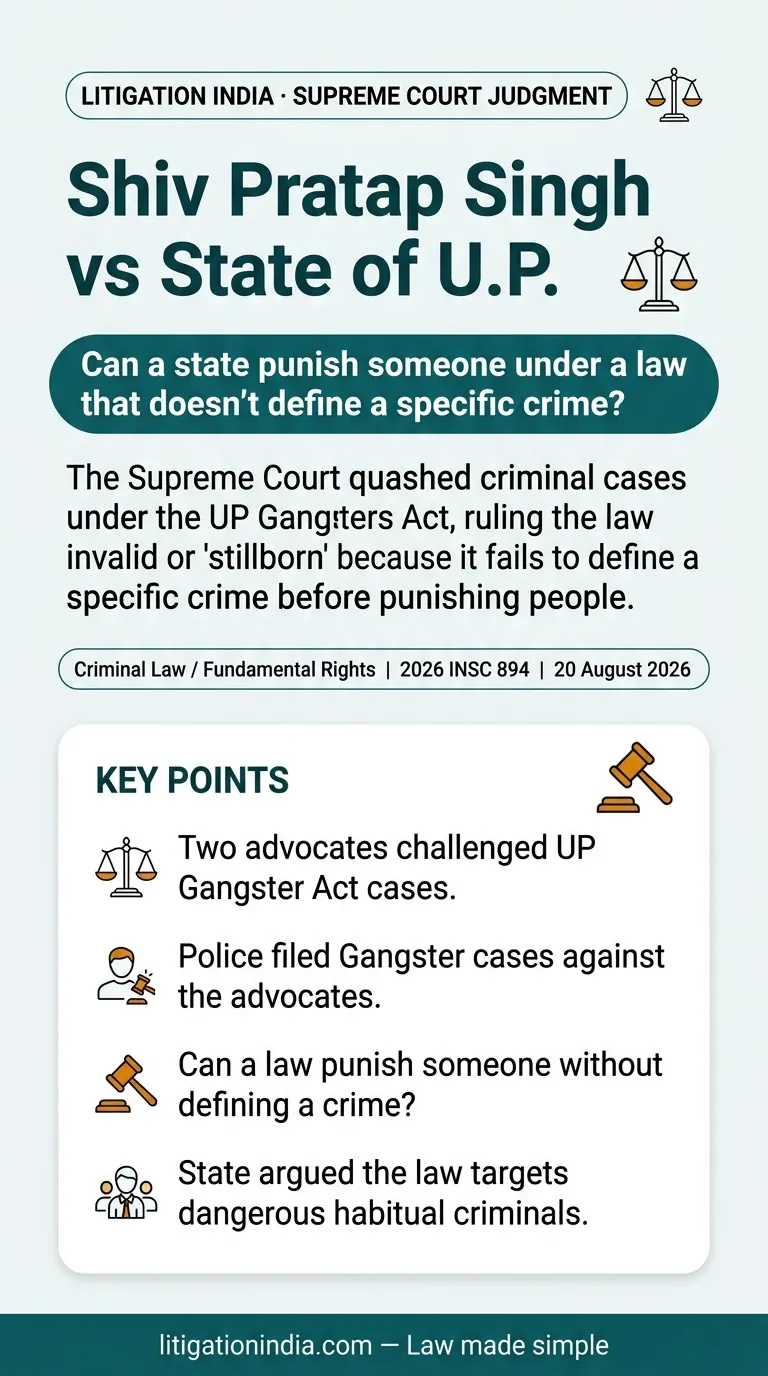
Shiv Pratap Singh vs State of U.P.
The big legal question
Can a state punish someone under a law that doesn't define a specific crime?
“The Supreme Court quashed criminal cases under the UP Gangsters Act, ruling the law invalid or 'stillborn' because it fails to define a specific crime before punishing people.”
Story Slides
In short
The Supreme Court of India delivered a landmark ruling on the Uttar Pradesh Gangsters and Anti-Social Activities (Prevention) Act, 1986. Two practicing advocates challenged the criminal proceedings initiated against them under this Act. The police had prepared 'Gang Charts' and registered FIRs based on previous disputes and cases. The Supreme Court examined whether the Act actually creates a distinct criminal offence. It observed that under criminal law, there can be no punishment without a clearly defined crime (the principle of 'nulla poena sine lege'). The Court found that the UP Gangsters Act merely defines the 'status' of a person as a gangster based on other existing crimes, but fails to define any new, independent crime under the Act itself. Instead, the police and executive authorities were given unchecked power to label someone a gangster using a 'Gang Chart' prepared under administrative Rules, which go beyond the parent Act. Comparing it to preventive detention, the Court noted that the Act lacked essential constitutional safeguards, making it a tool for arbitrary harassment. Describing the Act as 'stillborn' (dead from birth), the Supreme Court allowed the appeals and quashed the Gangster Act charge sheets and proceedings against the appellants. The Court clarified that trials for other regular crimes under the Indian Penal Code will continue independently.
Background
Two advocates in Uttar Pradesh challenged the criminal cases filed against them under the state's Gangsters Act. The police had targeted them using 'Gang Charts' based on previous local disputes, leading to potential long-term jail terms without proper trial safeguards.
The Decision
The Supreme Court allowed the appeals and quashed the Gangster Act charge sheets against the appellants. The Court ruled that the UP Gangsters Act is invalid or 'stillborn' because it fails to define a distinct crime, though other regular criminal cases against them can proceed separately.
Why it matters for you
This judgment protects ordinary citizens from being arbitrarily locked up under harsh laws without a clear trial. It reaffirms that the police and government cannot create crimes out of thin air or bypass constitutional rights using administrative guidelines.
AI-assisted summary, reviewed and verified by our editorial team.
Need help with your case?
Facing a similar legal challenge in the Supreme Court or High Court? Connect with our pro bono volunteer advocates today.
Related Supreme Court services