Shirish Pandharinath Patil vs The State of Maharashtra & Ors.
The big legal question
Can a retired worker get pension if their tribal certificate is found invalid?
“The Supreme Court ruled that while an employee's tribal caste certificate was invalid, his pension and retirement benefits must be protected after 30 years of continuous service.”
Story Slides
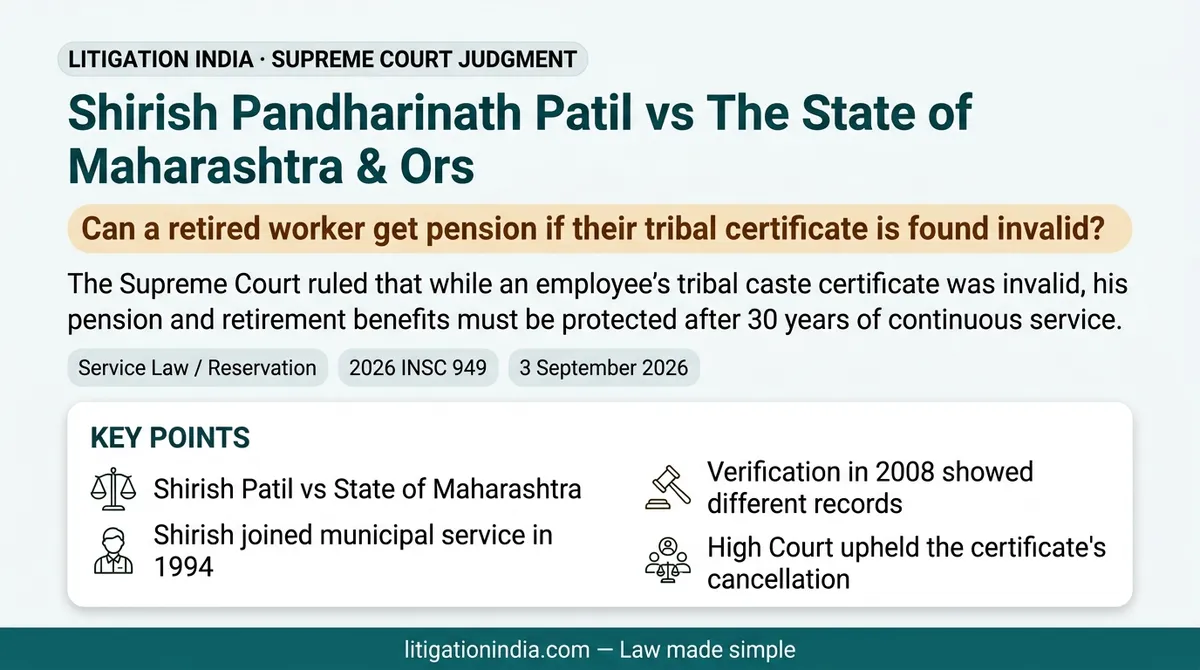
In short
This Supreme Court of India judgment deals with whether a government employee can receive pension and retirement benefits after their Scheduled Tribe (ST) caste certificate is declared invalid. The appellant, Shirish Pandharinath Patil, joined the Municipal Corporation of Greater Mumbai as a Junior Engineer in 1994 using a 'Tokre Koli' Scheduled Tribe certificate. However, during a verification process in 2008, the Police Vigilance Cell discovered old, pre-constitutional family records identifying his ancestors as 'Koli' and 'Hindu Suryawanshi Koli' instead of 'Tokre Koli'. Consequently, the Scheduled Tribe Certificate Scrutiny Committee invalidated and confiscated his certificate in 2020, a decision which was upheld by the Bombay High Court. By the time the matter reached the Supreme Court, the appellant had served for over 30 years and retired in June 2025. He requested the Court to protect his pension and retirement benefits on humanitarian grounds, promising that no other family member would use the caste certificate. The Supreme Court agreed that his caste claim was indeed invalid. However, considering his three decades of continuous service, the Court exercised its special power under Article 142 of the Constitution of India to do 'complete justice'. The Court ordered that his 30-year service be protected solely for calculating and releasing his pension and retiral benefits. It clarified that this does not validate his tribal status, and neither he nor his family can claim any reservation benefits in the future. The employer was ordered to release his pension within six months.
Background
Shirish Patil joined government service in 1994 based on a 'Tokre Koli' Scheduled Tribe certificate. Years later, verification revealed his ancestors' old records listed them as 'Koli', causing the Scrutiny Committee and High Court to cancel his caste certificate.
The Decision
The Supreme Court upheld the cancellation of his tribal status but used its special powers under Article 142 to protect his pension and retirement benefits because he had served for over 30 years before retiring.
Why it matters for you
This judgment shows that while the law strictly punishes false caste claims, the Supreme Court can use its special powers to protect a retired person's livelihood and pension if they have served honestly for decades without their family misusing the reservation.
AI-assisted summary, reviewed and verified by our editorial team.
In the Court's words
“Generally, invalidation of a caste or tribe claim upon verification would have consequences in law.”
“...where equities of the case so warrant, the power under Article 142 of the Constitution of India may be exercised to do complete justice.”
“...the service rendered by the appellant... shall be protected for the limited purpose of computation and release of his retiral and pensionary benefits...”
Need help with your case?
Facing a similar legal challenge in the Supreme Court or High Court? Connect with our pro bono volunteer advocates today.
Related Supreme Court services