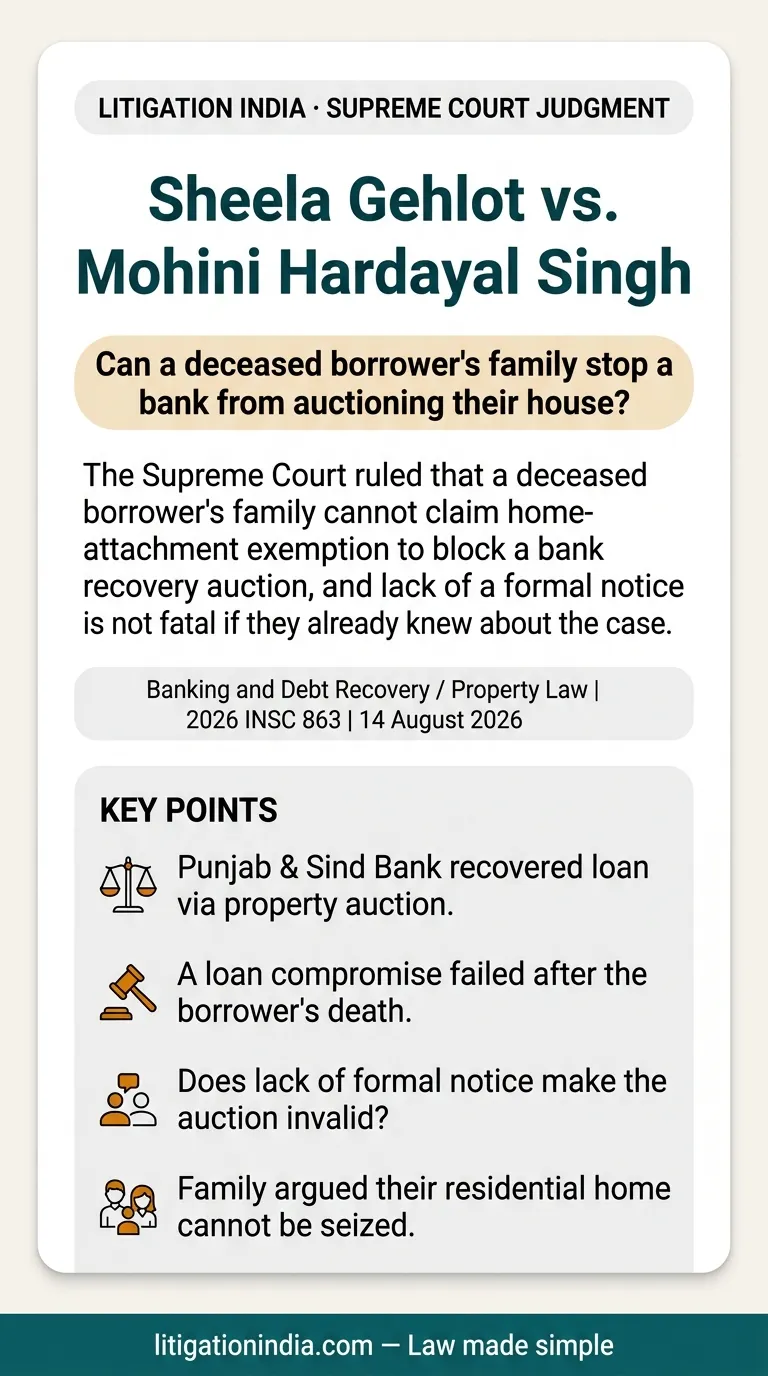
Sheela Gehlot vs. Mohini Hardayal Singh
The big legal question
Can a deceased borrower's family stop a bank from auctioning their house?
“The Supreme Court ruled that a deceased borrower's family cannot claim home-attachment exemption to block a bank recovery auction, and lack of a formal notice is not fatal if they already knew about the case.”
Story Slides
In short
This case is about a bank's right to auction a residential property to recover unpaid loans after the original borrower passes away. A company took loans from Punjab & Sind Bank but failed to repay them. After a compromise failed, the bank started recovery steps to sell a house in Delhi owned by the deceased borrower. The borrower's widow and children objected, claiming they did not receive official recovery notices. They also argued that under a local law (Section 60(1)(ccc) of the Civil Procedure Code), their main residential home was protected from being seized and sold for debt recovery. The High Court ordered a fresh inquiry into these objections. However, the Supreme Court reversed the decision. It held that the family had active knowledge of the case, so minor notice technicalities did not cause them any real harm. Most importantly, the Court ruled that the legal protection keeping a residential house safe from auction is a personal right belonging only to the original borrower. This protection does not automatically pass to the family members (legal heirs) after the borrower's death. Thus, the bank's auction sale of the Delhi property to the third-party buyer was held valid.
Background
A business defaulted on bank loans, and a compromise decree was passed in 1991. The borrower died in 1994, and after subsequent defaults, the bank initiated auction proceedings for his Delhi property. The borrower's widow challenged the auction, claiming she never received proper legal notices and that their residential home was legally protected from being sold.
The Decision
The Supreme Court set aside the High Court's order and validated the auction sale. It held that the exemption protecting a primary residence from being sold belongs only to the original debtor, not their legal heirs, and that minor notice issues do not cancel an auction if the family already had full knowledge of the case.
Why it matters for you
This judgment clarifies that legal protections for primary homes against debt recovery are strictly personal and end with the borrower's death. It also protects honest auction buyers from being dragged into endless court loops over minor technical notice failures when the parties were already fully aware of the legal steps.
AI-assisted summary, reviewed and verified by our editorial team.
Need help with your case?
Facing a property, eviction, or landlord-tenant dispute? Consult our property lawyers for a free initial review.
Related Supreme Court services