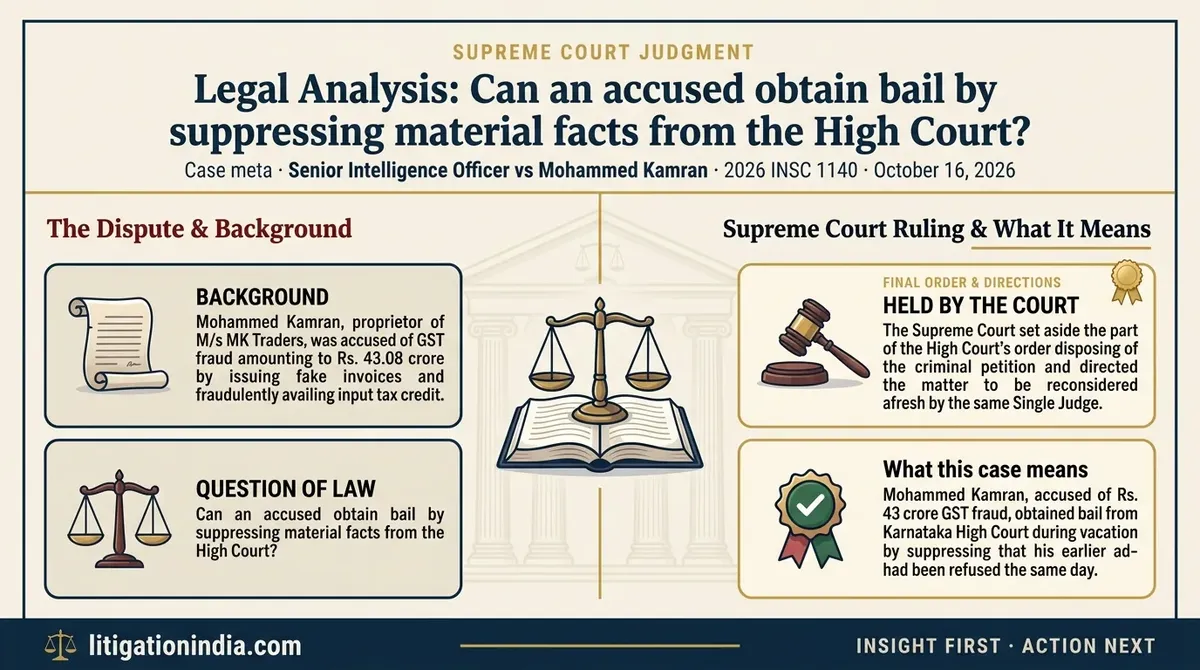
Full text of the judgment
Text extracted from Senior Intelligence Officer vs Mohammed Kamran. For the authoritative version refer to the Supreme Court of India's official website.
2026 INSC 1140
REPORTABLE IN THE SUPREME COURT OF INDIA CRIMINAL APPELLATE JURISDICTION
CRIMINAL APPEAL NO. OF 2026 [ARISING OUT OF SLP (CRL) NO. 7504 OF 2026]
SENIOR INTELLIGENCE OFFICER
MOHAMMED KAMRAN
…RESPONDENT
DIPANKAR DATTA, J. 1. Leave granted. 2. Senior Intelligence Officer, Directorate General of Service Tax Intelligence1, challenges the judgment and order dated 26th December, 20252 of a Single Judge of the High Court of Karnataka3, granting bail to Mohammed Kamran4. 3. What is gleaned from the factual matrix is this. Appellant lodged a private complaint before the Special Court for Economic Offences, Bengaluru5 against the respondent alleging commission of offences
1 appellant 2 in Criminal Petition No. 16884 of 2025 3 High Court 4 respondent 5 trial court Digitally signed by MANIK KUMAR Date: 2026.10.16 17:24:34 IST Reason: Signature Not Verified
under Section 16(2)(b) read with Sections 132(1)(b), 132(1)(c) and 132(1)(f) of the Central Goods and Services Tax Act, 20176, punishable under Section 135 thereof. The allegation in the complaint, inter alia, is that the respondent, being the proprietor of M/s MK Traders, issued invoices without supply of goods, availed fraudulent input tax credit and falsified documents and financial statements and furnished false information to the appellant with an intent to evade payment of tax under the CGST Act, thereby causing a loss of Rs. 43,08,22,936/-. 4. Apart from the challenge on merits to the grant of bail to the respondent, it is the primary contention of the appellant that it was not afforded any opportunity to present its case, much less sufficient opportunity. According to the appellant, the High Court erroneously recorded the name of the Special Public Prosecutor/Senior Standing Counsel as having appeared representing the appellant when he was not present in the country, let alone in the Court, on the relevant date; that a request seeking adjournment, in view of absence of counsel, was rejected by the Court; and that the application for bail was heard and disposed of hurriedly during the winter vacation of the High Court. 5. It has also been alleged on behalf of the appellant that a search was carried out at the declared residential premises of the respondent as well as his actual residence, during which he offered stiff resistance and ultimately fled from the spot. A separate FIR came to be registered for this offence.
6. On 16th September, 2025, the respondent was arrested. Successive bail applications filed by him before the trial court as well as the Additional City Civil and Sessions Judge7 came to be rejected. 7. Respondent then filed the criminal petition before the High Court seeking bail. The petition was listed for the first time on 12th December, 2025; learned counsel for the respondent was directed to serve a copy of the petition upon the Standing Counsel for the appellant; and the appellant was directed to file its statement of objections within two weeks. 8. Though the winter vacation of the High Court commenced from 20th December, 2025, the criminal petition came to be listed promptly on 26th December, 2025 pursuant to a memo moved by the learned counsel for the respondent. A learned counsel for the appellant did appear before the Single Judge. There are conflicting versions of what transpired in Court, which we propose to note hereafter. The petition, however, was allowed by the Single Judge by granting bail to the respondent. The order dated 26th December, 2025 granting bail is the subject matter of challenge in this appeal. 9. We have heard Mr. N. Venkataraman, learned Additional Solicitor General for the appellant and Mr. S. Nagamuthu, learned senior counsel for the respondent. 10. Mr. Venkataraman vehemently contends that the High Court ought not to have heard the criminal petition in the first place, when a request
7 Sessions Court
for adjournment was made on behalf of the appellant citing the absence of its arguing counsel. According to him, the learned counsel who appeared before the Single Judge, though on the panel of the appellant, had no instructions to contest the petition on merits, and thus, had rightly sought an adjournment. Appellant having been denied the opportunity of presenting its case to the fullest, he further contends that principles of natural justice have been brazenly violated in the process. 11. It is additionally brought to our notice by Mr. Venkataraman that on 22nd December, 2025, the respondent had instituted a writ petition8 before the High Court challenging the legality of his arrest and seeking quashing of the complaint filed before the trial court as well as the order taking cognizance of the offences. An interim/ad-interim prayer was also made in the writ petition seeking stay of further proceedings and release on the ground that an application under Section 483 of the Bharatiya Nagarik Suraksha Sanhita, 20239 is not an efficacious remedy. The disclosure made in the writ petition with regard to the criminal petition, which was pending, reads thus: 35. the petitioner has filed Bail Petition for release under Section 483 of BNSS in Cr.P.No.46884/2025 but it is not efficacious and therefore exercise of Jurisdiction under Article 226 of the Constitution to protect Fundamental Right is necessary, otherwise the petitioner will suffer illegal detention which is in violation of Article 21 of the Constitution.
8 Writ Petition No. 38771 of 2025 9 BNSS
12. Mr. Venkataraman submits that not only was the prayer for ad-interim relief refused on 22nd December, 2025, the writ petition was finally dismissed by an order dated 7th July, 2026; however, the respondent never disclosed this fact of refusal of ad-interim relief to the Single Judge on 26th December, 2025. 13. Urging that a litigant like the respondent who left no stone unturned to obtain bail by abusing the process of law should be dealt with firmly, Mr. Venkataraman submits that the order granting bail is liable to be set aside. 14. Per contra, Mr. Nagamuthu submits that the contention regarding absence of the arguing counsel for the appellant was not taken before the Single Judge. According to him, the learned Additional Solicitor has not been appropriately instructed. In fact, the learned counsel appearing before the Single Judge initially, faintly, sought an adjournment; however, later on proceeded to address the Court on the merits of the matter. That apart, the appellant miserably failed to file its statement of objections within two weeks, as directed. Having failed to avail such opportunity, it would be incorrect to claim that the appellant was not adequately represented before the High Court or that it was denied natural justice. 15. On merits, Mr. Nagamuthu submits that having regard to the nature of allegations, the gravity of the offences allegedly committed, the long incarceration of the respondent, the investigation having been completed, the offences being Magistrate triable, and the maximum
punishment that the offences attract is five years, this is not a case where this Court ought to step in to curtail the liberty of an accused; more particularly when in excess of nine months has elapsed since then. 16. Mr. Nagamuthu, thus, prayed for dismissal of the appeal. 17. Ordinarily, we would have been inclined to dismiss the special leave petition at the outset. However, notice was issued having regard to the special facts and circumstances. A grievance had been raised that the appellant was not heard by the High Court. Since the issue between the parties has bearing on the twin questions of judicial propriety and uberimma fides, we prefer to deal with the same. 18. Vide our order dated 10th September, 2026 we permitted the appellant to place on record the true and correct version of facts by filing an additional affidavit, while also permitting a reply thereto to be filed by the respondent. 19. Along with his reply affidavit, the respondent placed on record a pen drive containing the recording of the hearing that took place on the day the impugned order was passed. We have carefully perused the affidavits as well as the video recording and the transcript thereof. 20. There appears to be merit in the submission of Mr. Nagamuthu that the learned counsel representing the appellant, who was present on 26th December, 2025 before the Single Judge, in fact, did advance some submissions concerning the merits of the matter. However, it is equally true that a request had been made by the learned counsel
representing the appellant to adjourn hearing on the ground that the Standing Counsel has been engaged to appear for the appellant. Since adjournment was not granted, it seems that as an officer of the Court, the learned counsel chose to assist the Single Judge by opposing the prayer for bail. Thus, while on the one hand, it would not be entirely correct to claim that the appellant was wholly unrepresented before the Single Judge, on the other it stands to reason that the appellant could not be represented by its Standing Counsel. 21. Having said so, what bothers us is the conduct of the respondent and the manner in which he moved the High Court for an expedited hearing of his criminal petition on 26th December, 2025. In fact, not only has he abused the process of law, he has suppressed material facts from the High Court. There is clear lack of uberimma fides, which is the foundation for invoking the equitable and discretionary jurisdiction for grant of bail. 22. Respondent had filed the criminal petition before the High Court seeking bail on 9th December, 2025. On the day following, viz. 10th December, 2025, he filed a similar application seeking bail before the Sessions Court. Such application came to be rejected at a point of time when the criminal petition before the High Court was pending. Undeterred, on 22nd December, 2025, the respondent challenged the legality of his arrest by filing the writ petition. As noted, not only did he seek quashing of the complaint filed before the trial court, he also sought ad-interim stay of further proceedings and release from
custody stating that the remedy of applying for bail under Section 483, BNSS is not efficacious. Admittedly, a prayer for interim/ad-interim release was made on 22nd December, 2025 in the writ petition before the High Court, which came to be refused. Later in the day, a memo seeking listing of the criminal petition came to be filed. This was allowed and the petition was directed to be listed on 26th December, 2025. Refusal of the prayer for ad-interim release was not disclosed to the Single Judge who, having heard the parties and regard being had to the nature of the case, proceeded to grant the respondent bail. 23. Mr. Venkataraman seems to be fully justified in highlighting that the respondent has been crafty and disingenuous and in urged this Court not to let the respondent off lightly, since he has abused the process of law and suppressed material facts. 24. Two issues of substantial importance do arise in the present circumstances. 25. First, pursuit of parallel remedies before various fora by the respondent. He simultaneously pursued proceedings seeking bail/release before the Sessions Court as well as in his writ petition before the High Court while the criminal petition seeking bail before the High Court was pending consideration. Rejection of the prayer for bail (fourth in the series) by the Sessions Court as well as refusal by the writ court to order release from custody were particularly not brought to the notice of the High Court. The fact that the respondent engaged in forum shopping is evident. Appellant, however, failed to
place relevant materials on record by not filing its objections; may be, the time was too short. Also, in view of the winter vacation that followed and without having notice of the memo moved by the respondent for urgent listing of his criminal petition on 26th December, 2025, neither the appellant nor the learned counsel who appeared on 26th December, 2025 on its behalf could bring all facts to the attention of the Single Judge. Of utmost importance is that the respondent too did not! He indulged in suppressio veri and suggestio falsi. 26. Respondent’s conduct in pursuing such parallel remedies, while keeping all judicial authorities in the dark, must be severely deprecated. It may be a right of the accused to challenge his arrest or to approach a court seeking bail; however, such conduct of pursuing remedies parallelly, particularly without adequate disclosure, clearly amounts to abuse of the process of law. 27. Secondly, the criminal petition before the Single Judge was listed, upon a memo having been moved by the learned counsel for the respondent, post 22nd December, 2025, during the winter vacation of the High Court. Ideally, in view of the earlier direction, the criminal petition should have been listed upon reopening of the High Court after the winter vacation particularly when such petition had not been made returnable on a specific date falling during such vacation or the Single Judge had not directed its listing before the Vacation Bench. To have obtained listing of a petition, without adequate notice to the appellant, was clearly an attempt to steal a march by even misleading the Court.
28. Had it been a case of arrest for a heinous offence, we would have taken a very strict view of the respondent’s conduct. 29. Be that as it may, regard being had to the entire turn of events, we are of the view that though the bail granted by the High Court to the respondent may not be set aside at this stage, certainly the matter needs to be remitted to the Single Judge who had the occasion to deal with the criminal petition on 26th December, 2025 for its fresh consideration. 30. Thus, we set aside that part of the impugned order whereby the criminal petition stood disposed of with the result that the same shall revive on the file of the High Court; and we direct that instead of the bail granted by the Single Judge, the respondent shall continue to remain on interim bail on earlier terms and conditions. Appellant is granted liberty to place all materials on record by filing a counter affidavit within two weeks, peremptorily. Respondent will have a week’s time to file his rejoinder. The Single Judge shall, thereafter, decide the criminal petition on its own merits, preferably by the end of this year. Needless to observe, interim bail granted to the respondent shall be operative till such time further orders are passed by the Single Judge on the criminal petition. 31. The appeal stands disposed of on the above terms. 32. Pending applications, if any, shall stand closed.
33. Before parting, we wish to make certain observations on urgent listing of matters, be it a petition or application or appeal, before a Bench of a high court when the court is on vacation. 34. In cases of the present nature, where a Bench of a high court directs listing of a petition “two weeks hence” and the day following expiry of the period of “two weeks”, in terms of such direction, happens to fall in the midst of a vacation, the period of two weeks should ordinarily be computed by the registry of each such court excluding the period during which the court is on vacation. However, if the petition is made returnable on a specific date by the Bench which falls during the vacation or the Bench directs listing before the Vacation Bench, such petition should ideally be accordingly listed. This, of course, would be subject to the relevant rules framed by the high courts. 35. These observations, aimed at serving the interest of justice better, are essential to secure uniformity as well as to ensure that litigants are not prejudiced due to an inadvertent act of the court.
…………………………………J. DIPANKAR DATTA
..……………………………….J. SHEEL NAGU
New Delhi; October 16, 2026.