Releasing deposit money does not clear a company of stock market fraud
Securities and Exchange Board of India vs. Vedanta Limited & Ors.
The big legal question
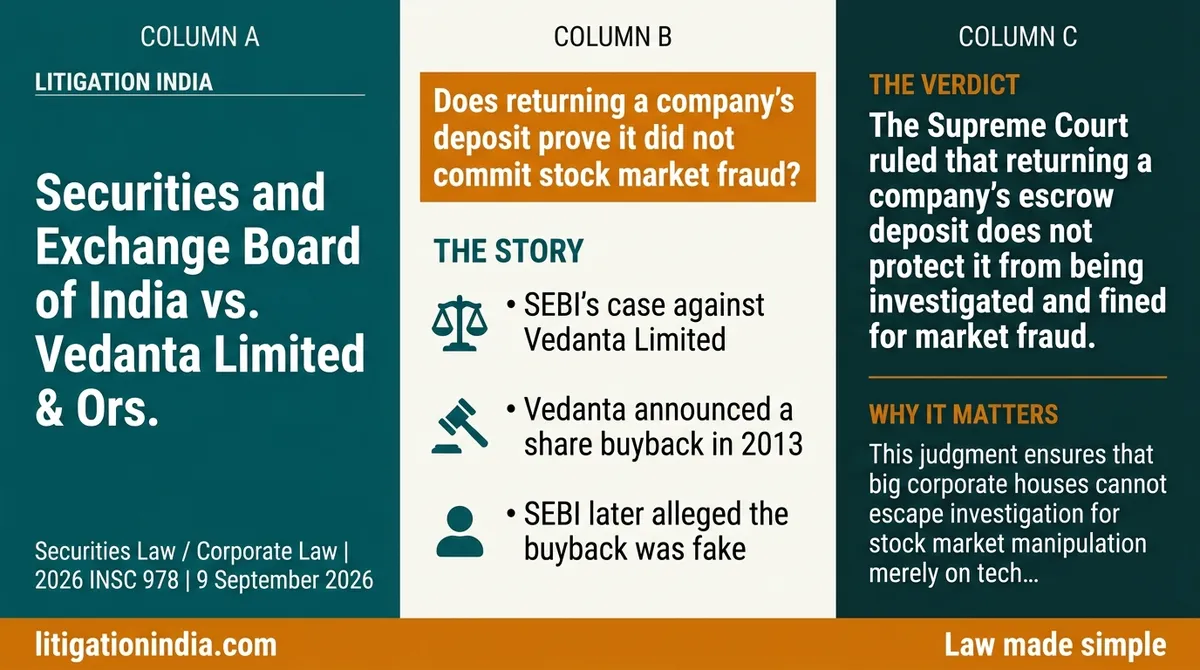
Does returning a company's deposit prove it did not commit stock market fraud?
What this case means
A company failed to complete its promised share buyback, and SEBI returned its deposit money. Later, SEBI fined the company for manipulating share prices through a fake buyback announcement. The Supreme Court ruled that returning deposit money does not shield a company from fraud investigations, ordering a fresh review of the charges.
“The Supreme Court ruled that returning a company's escrow deposit does not protect it from being investigated and fined for market fraud.”
Story Slides
In short
This case involves a dispute between the Securities and Exchange Board of India (SEBI) and Vedanta Limited (formerly Cairn India Limited). In 2013, Vedanta announced a massive plan to buy back 17.09 Crore of its shares from the open market at a maximum price of Rs. 335 per share, earmarking Rs. 5725 Crore for this purpose. As required by law, they deposited 2.5% of this amount (Rs. 143.12 Crore) as security in an escrow account. However, by the end of the six-month buyback period, Vedanta had only bought back 21.48% of the targeted shares, failing to meet the legal minimum of 50%. Since the share prices had risen above their target cap of Rs. 335 for most of the period, SEBI agreed that the failure was due to market conditions beyond their control and released their escrow deposit. Later, SEBI investigated Vedanta for fraud under the Prohibition of Fraudulent and Unfair Trade Practices (PFUTP) Regulations. SEBI's Adjudicating Officer (AO) alleged that Vedanta had made a misleading buyback announcement with no real intention of completing it, just to artificially manipulate the share prices. The AO fined Vedanta Rs. 5.25 Crore and its directors Rs. 15 Lakh each. On appeal, the Securities Appellate Tribunal (SAT) cancelled these penalties, believing that because SEBI returned the escrow deposit, it meant no fraud had occurred. The Supreme Court reversed this part of SAT's logic. It clarified that returning deposit money (escrow) under Buyback Regulations and investigating market fraud under PFUTP Regulations are two completely different things. Getting your deposit back does not mean you are innocent of fraud. However, the Court also found major errors and contradictions in the trading data SEBI used to accuse Vedanta of fraud. Because the Supreme Court does not resolve disputed factual data on appeal, it sent (remanded) the case back to SAT to carefully examine the trading data and decide within six months whether Vedanta actually committed fraud.
Background
In 2013, Vedanta announced a massive plan to buy back its own shares from the public but failed to meet the required 50% target. SEBI returned their security deposit because the market share price rose above their buying limit. However, SEBI later accused the company of making a fake announcement to artificially boost share prices and fined them for fraud.
The Decision
The Supreme Court ruled that returning a company's deposit does not block SEBI from investigating them for market fraud, as the two laws are entirely different. However, because of critical errors and contradictions in the trading data, the Court sent the case back to the Securities Appellate Tribunal to carefully re-examine the facts and make a final decision on the fraud charges within six months.
Why it matters for you
This judgment ensures that big corporate houses cannot escape investigation for stock market manipulation merely on technical grounds or because they complied with minor procedural rules. It protects retail investors by holding companies strictly accountable for misleading public statements that can artificially influence stock prices.
Relevant Legal Provisions
Key Acts and sections cited or relied upon in this judgment
“Lays down the specific conditions under which a company's safety deposit in an escrow account can be returned or forfeited.”
“Requires a company to utilize at least 50% of the money earmarked for buyback to purchase its shares.”
“Prohibits deceptive, misleading, and manipulative practices, including fake public announcements, in the stock market.”
AI-assisted summary, reviewed and verified by our editorial team.
In the Court's words
“The mere release of the escrow does not create an automatic statutory bar to proceedings under the PFUTP Regulations because the release of the escrow is not necessarily equivalent to absence of fraud.”
“It is settled law that notings in the departmental file do not have the sanction of law to be an effective order and that a noting by an officer is essentially an expression of his viewpoint for internal consideration.”
“Fraud must be established on the touchstone of the principle of balance of probabilities, which requires an objective perusal of the evidence on record...”
Need help with your case?
Facing a similar legal challenge in the Supreme Court or High Court? Connect with our pro bono volunteer advocates today.
Request Free Callback