
Can company bosses trade shares using secret information even for a good cause?
Securities and Exchange Board of India v. Rajeev Vasant Sheth & Ors.
Case: Securities and Exchange Board of India v. Rajeev Vasant Sheth & Ors.Citation: 2026 INSC 826Decided on: 11 August 2026
“The Supreme Court ruled that trading shares while holding confidential company information is illegal insider trading, and the reason for selling does not matter under the 2015 rules.”
Story Slides
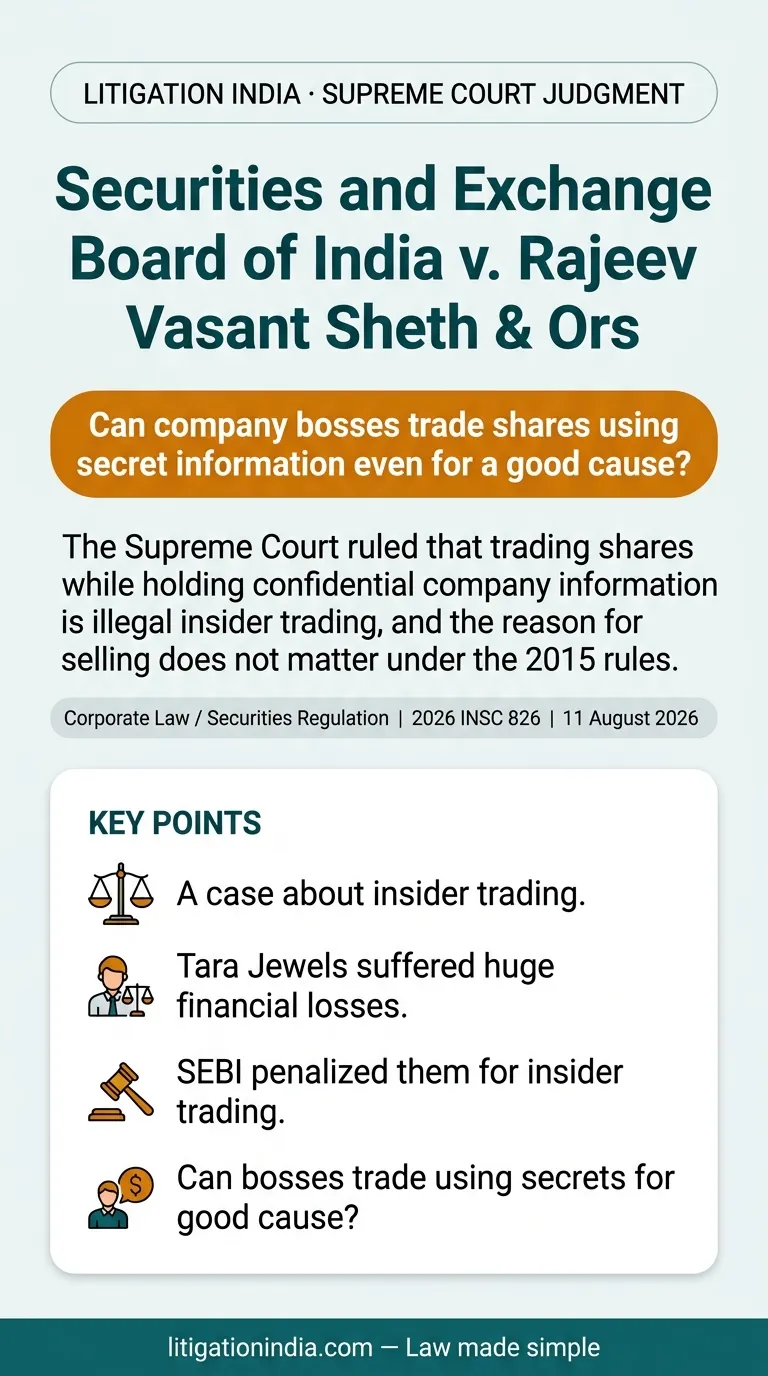
In short
This judgment deals with 'insider trading,' which means buying or selling a company's shares using secret, important information that the general public does not know. The case involved the bosses of Tara Jewels Limited. The company was suffering massive financial losses in late 2017, which was secret information at the time. Knowing this, the Chairman and his daughters quickly sold their shares to avoid losing Rs 1.38 crores. When SEBI (the market regulator) caught and penalized them, the Securities Appellate Tribunal (SAT) cancelled the punishment. SAT accepted their excuse that they sold the shares to help save the company from bank default. However, the Supreme Court reversed SAT's decision. The Supreme Court explained that under the new 2015 Insider Trading Regulations, there is a strict rule: if you have secret, price-sensitive information and you trade shares, the law presumes you did it wrongfully. Under these new rules, your intentions, reasons, or what you did with the money are completely irrelevant. The Court restored SEBI's order requiring them to return the avoided losses of Rs 1.38 crores with 12% interest, though it reduced the father's personal penalty from Rs 25 lakhs to Rs 10 lakhs.
Need clarity on a similar legal issue?
Request free pro bono guidance from a Supreme Court Advocate.
Background
Tara Jewels Limited was facing massive losses in 2017. Before this bad news became public, the company's Chairman and his daughters sold off their shares, saving themselves from a loss of Rs 1.38 crores.
The Decision
The Supreme Court ruled that under the 2015 regulations, the purpose of trading is completely irrelevant if one has secret information. It ordered them to return the Rs 1.38 crores with interest and pay modified penalties.
Why it matters for you
This judgment makes it clear that company insiders cannot use any excuses, even 'saving the company,' to trade shares while holding secret information. It protects ordinary stock market investors from being cheated by powerful company bosses.
AI-assisted summary, reviewed and verified by our editorial team.
Need help with your case?
Facing a similar legal challenge in the Supreme Court or High Court? Connect with our pro bono volunteer advocates today.
Request Free Callback