Sanofi India Ltd. vs Central Bureau of Investigation
The big legal question
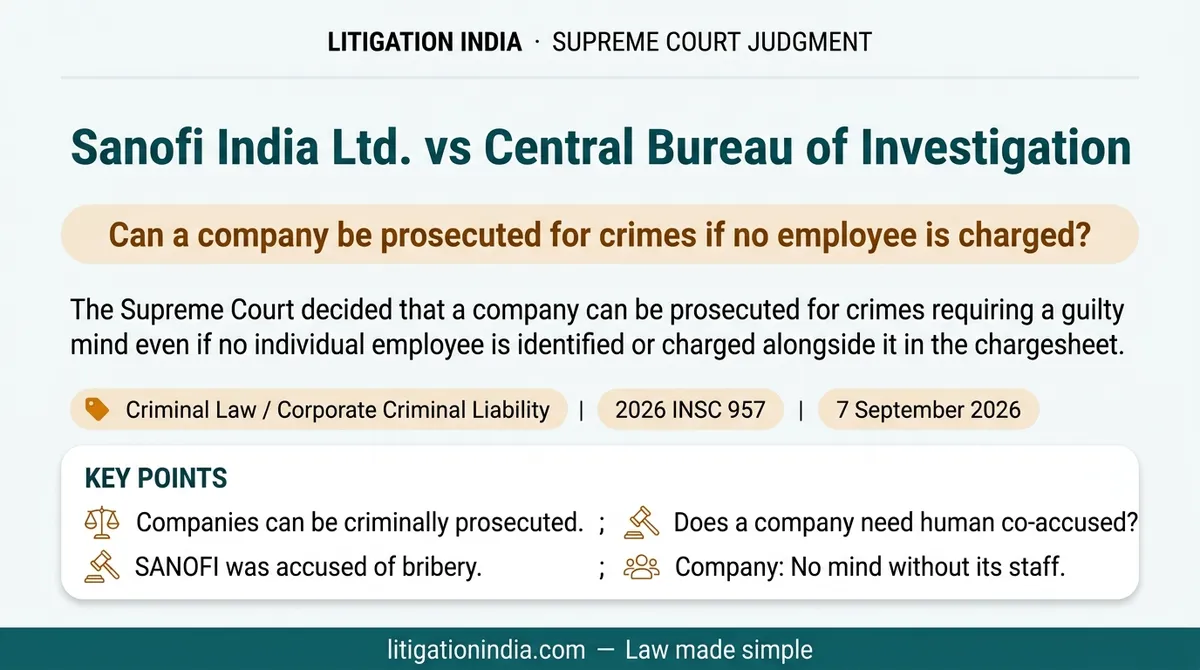
Can a company be prosecuted for crimes if no employee is charged?
“The Supreme Court decided that a company can be prosecuted for crimes requiring a guilty mind even if no individual employee is identified or charged alongside it in the chargesheet.”
Story Slides
In short
This landmark judgment by the Supreme Court of India clarifies how corporate criminal liability works under Indian law, especially for crimes that require a 'guilty mind' (mens rea) like cheating, fraud, or conspiracy. The case arose when the Central Bureau of Investigation (CBI) filed a chargesheet against Sanofi India Ltd. and a government official, alleging a bribery and conspiracy scheme to purchase medicines at inflated prices. The company argued that because it is an artificial legal entity, it cannot think or act on its own; it can only do so through human minds. Since the CBI did not identify or charge any specific employee or director of the company as an accused in the chargesheet, the company argued that the case against it must be quashed immediately under Section 482 of the Criminal Procedure Code (CrPC). The Supreme Court rejected this argument. The Court explained that a company acts through human beings, and its 'guilty mind' is indeed attributed from the people who run it. However, at the very beginning of a case (the threshold stage), the prosecuting agency does not have to specifically name or charge an individual employee alongside the company. The chargesheet only needs to show, on its face, that some natural person acted on behalf of the company and that the overall circumstances suggest a criminal intent. The actual process of finding out exactly whose mind and actions represent the company—known as the rule of attribution—is a deep and detailed factual inquiry that must be done during the trial, not at the starting stage of quashing the case. Therefore, the Supreme Court refused to quash the charges and dismissed the company's appeal, allowing the trial to continue.
Background
The Central Bureau of Investigation filed a chargesheet against Sanofi India Ltd. for allegedly conspiring with a government medical officer to supply medicines at highly inflated rates. SANOFI challenged the chargesheet, arguing that the company cannot be prosecuted for criminal conspiracy when none of its individual employees were charged as accused.
The Decision
The Supreme Court dismissed the appeal and held that a criminal case against a company cannot be quashed at the starting stage simply because no individual employee was charged. The Court established that determining who acted for the company and whether they had a guilty mind is a detailed matter that must be decided during the trial.
Why it matters for you
This judgment prevents companies from escaping criminal prosecution for serious frauds and scams by hiding behind technical arguments. It ensures that businesses can be held legally accountable for corruption or cheating even if the specific corrupt employees are not immediately identified or charged.
AI-assisted summary, reviewed and verified by our editorial team.
In the Court's words
“Non-identification of the natural person does not, by itself, render the allegations incapable of disclosing the corporation’s role in the offence.”
“the ingredient of mens rea can still be disclosed even where no individual has been identified.”
“attribution is not a simple question with a fixed set of answers. It is an intricate inquiry... Consequently, whether attribution ought to occur in a given case is ultimately a matter for trial.”
Need help with your case?
Facing a similar legal challenge in the Supreme Court or High Court? Connect with our pro bono volunteer advocates today.
Related Supreme Court services