Sanjay Kumar vs State of Bihar
The big legal question
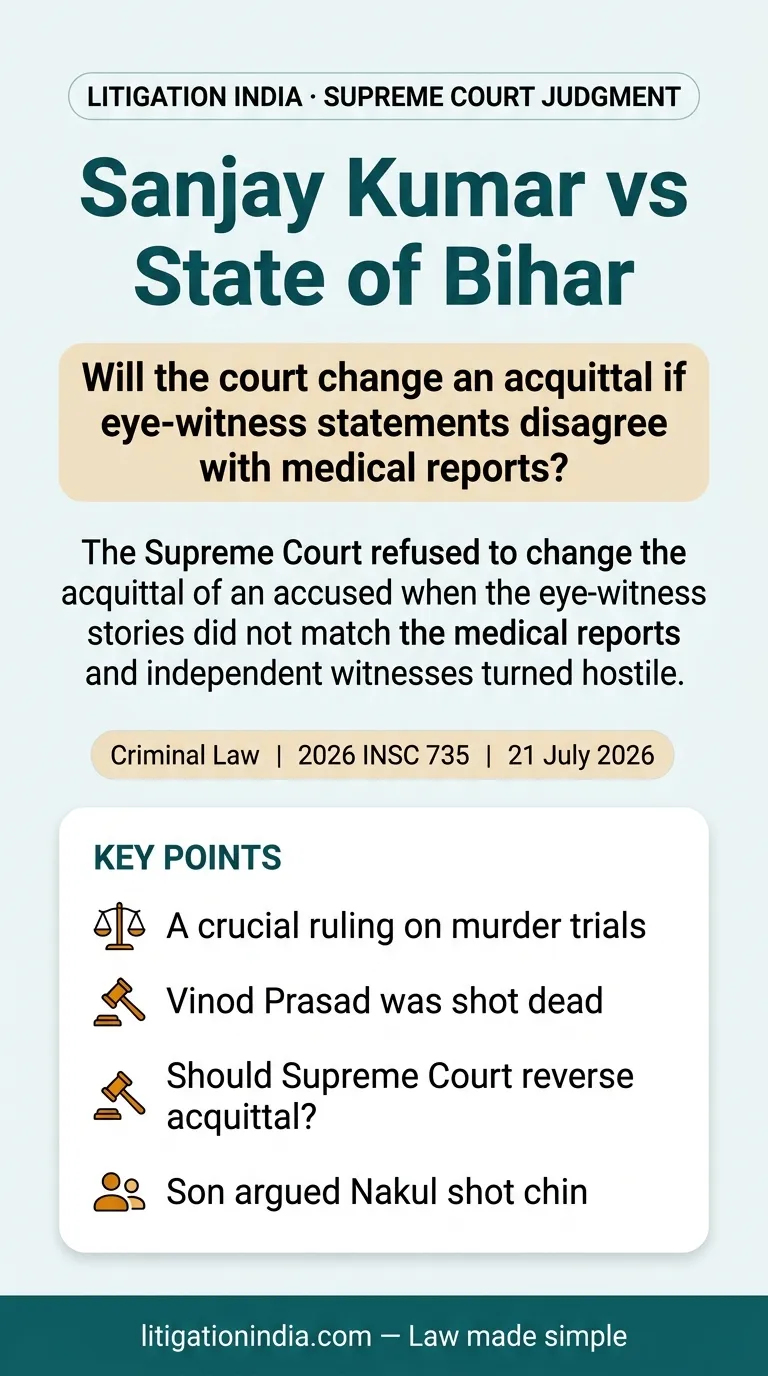
Will the court change an acquittal if eye-witness statements disagree with medical reports?
“The Supreme Court refused to change the acquittal of an accused when the eye-witness stories did not match the medical reports and independent witnesses turned hostile.”
Story Slides
In short
This case is about a murder that took place in 1998 in Bihar. The family of the victim, Vinod Prasad, claimed that four people shot him, including an accused named Nakul Prasad who supposedly shot him in the chin. However, both the Trial Court and the High Court cleared Nakul of all charges and let him go. The victim's son then took the case to the Supreme Court. The Supreme Court looked at all the evidence and decided not to change the decision of the lower courts. The Supreme Court pointed out several weak spots in the prosecution's story. First, while the family said four bullets hit the victim, the doctor’s post-mortem report only found three bullet entry wounds. This created a major mismatch between what the witnesses saw and what the medical science proved. Second, out of five independent neighborhood witnesses, only two were brought to court, and both of them turned hostile, meaning they refused to support the police's story. The remaining witnesses were close relatives of the victim, whose words needed careful checking. The Court held that in criminal cases, a person is innocent until proven guilty. If the lower courts have freed an accused based on logical doubts, the Supreme Court will not step in just to suggest a different opinion.
Background
In October 1998, a man named Vinod Prasad was shot dead in a village market in Bihar. His family claimed that Nakul Prasad and others surrounded him and shot him multiple times. However, the trial court and the High Court found many doubts in this story and cleared Nakul of all charges.
The Decision
The Supreme Court dismissed the appeal and agreed with the lower courts to keep the accused free. It stated that because the witness statements did not match the doctor's report and independent witnesses did not support the case, there was reasonable doubt.
Why it matters for you
This judgment highlights that criminal cases cannot be won purely on the words of family members if science and independent witnesses do not support them. It protects innocent citizens by confirming that an acquittal by lower courts will not be easily reversed unless there is a huge, obvious mistake.
AI-assisted summary, reviewed and verified by our editorial team.
Need help with your case?
Facing a similar legal challenge in the Supreme Court or High Court? Connect with our pro bono volunteer advocates today.
Related Supreme Court services