Sandeep S. Ghandat & Ors. vs. Reserve Bank of India & Ors.
The big legal question
Can RBI remove a cooperative bank's board for more than six months?
“The Supreme Court ruled that the Reserve Bank of India (RBI) can suspend the board of a multi-state cooperative bank for up to five years to protect depositors, and this power is not limited by the constitutional six-month rule or the board's original term.”
Story Slides
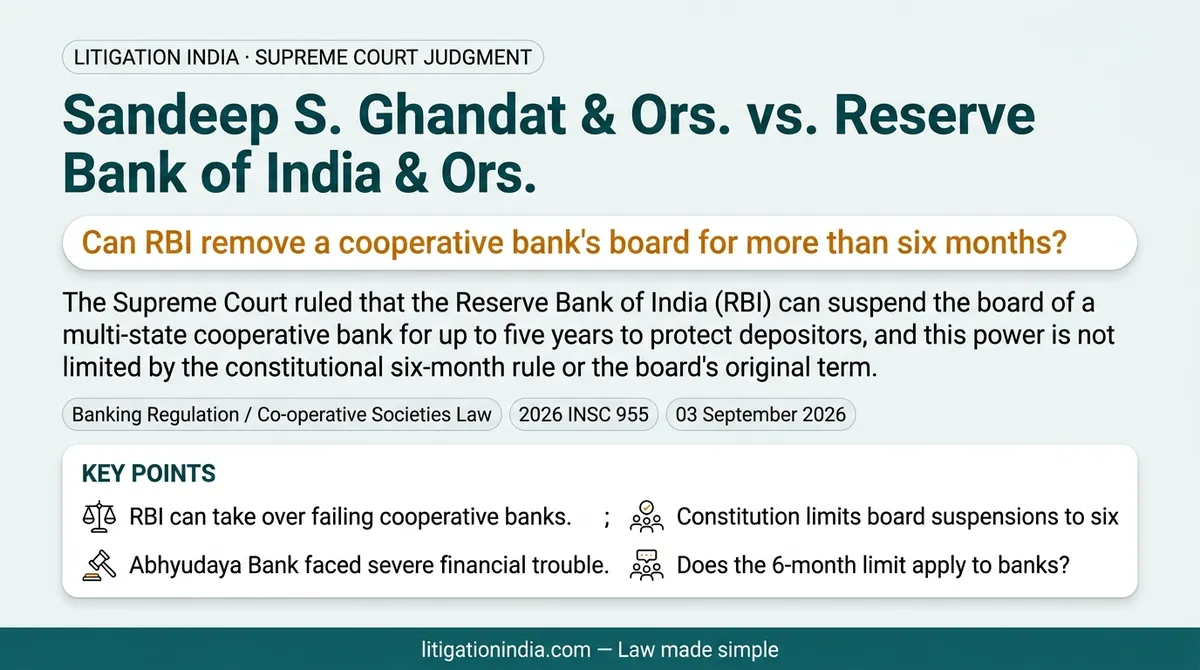
In short
This case deals with the powers of the Reserve Bank of India (RBI) to take control of cooperative banks when they are in bad financial health. The Board of Directors of Abhyudaya Co-operative Bank was removed (superseded) by the RBI in November 2023 because of its failing finances, and an Administrator was appointed to run it. The former board members challenged this, arguing that under Article 243ZL of the Constitution of India, a cooperative society's board cannot be suspended for more than six months. They also argued that since their original five-year elected term ended in May 2024, the RBI could not keep extending the suspension, and fresh elections should have been held immediately. The Supreme Court rejected these arguments. The Court explained that banking is different from ordinary cooperative activities because it involves the hard-earned money and savings of lakhs of common citizens. To protect these depositors, the Banking Regulation Act, 1949 gives the RBI special regulatory powers. Under Section 36AAA of this Act, the RBI can suspend a failing bank's board for up to five years in total to nurse the bank back to health. The Court held that the Constitution itself allows the Banking Regulation Act to apply to cooperative banks, meaning the strict six-month suspension limit does not apply to them. Furthermore, the Court ruled that the original board's term has no impact on this power. Once a board is suspended, it ceases to exist, and the Administrator can continue managing the bank until the RBI's suspension period ends (within the five-year maximum limit), after which new elections will be held. Lastly, the Court confirmed that the RBI does not need to consult state governments before suspending multi-state cooperative banks.
Background
The RBI suspended the Board of Directors of Abhyudaya Co-operative Bank in November 2023 for one year due to its dangerous financial condition and appointed an Administrator. The former directors challenged this decision in court, arguing that the suspension violated constitutional limits and could not be extended after their original five-year tenure expired.
The Decision
The Supreme Court dismissed the appeals, holding that the RBI has the legal right to suspend the board of a multi-state cooperative bank for up to five years in public interest. The Court clarified that this power is not limited by the constitutional six-month rule or the expiration of the old board's tenure.
Why it matters for you
This judgment protects the hard-earned savings of ordinary bank depositors by ensuring that the RBI can step in and run distressed cooperative banks using professional experts. It prioritizes financial safety and depositor protection over the political or administrative tenure of a bank's elected board members.
AI-assisted summary, reviewed and verified by our editorial team.
In the Court's words
“the power of RBI to supersede BoD of a multi-State co-operative bank under Section 36AAA(1) of BR Act is not circumscribed by the 6-month limit prescribed in Article 243ZL(1) of the Constitution.”
“the order of supersession passed under Section 36AAA(1) of BR Act can be extended beyond the term of office for which the BoD of a multi-State co-operative bank had originally been elected.”
Need help with your case?
Facing a similar legal challenge in the Supreme Court or High Court? Connect with our pro bono volunteer advocates today.
Related Supreme Court services