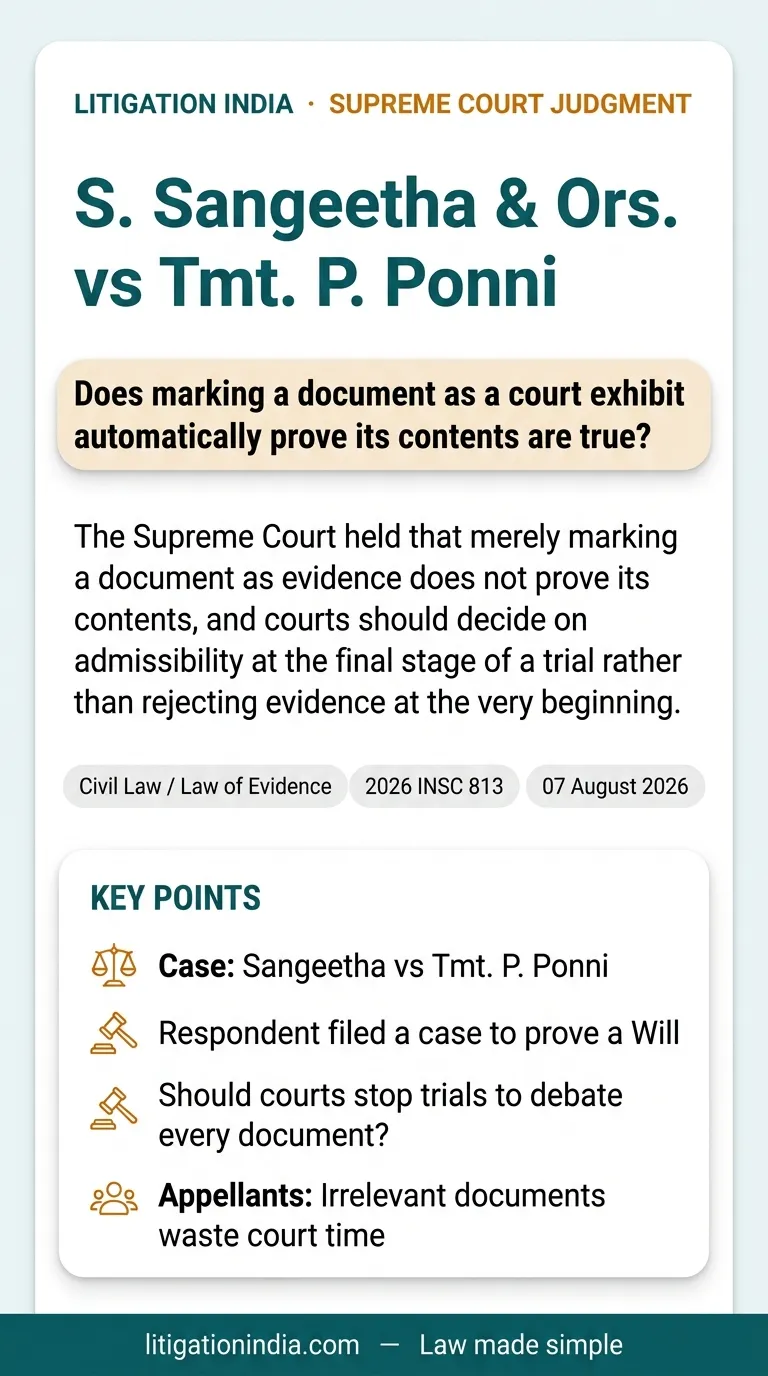
S. Sangeetha & Ors. vs Tmt. P. Ponni
The big legal question
Does marking a document as a court exhibit automatically prove its contents are true?
“The Supreme Court held that merely marking a document as evidence does not prove its contents, and courts should decide on admissibility at the final stage of a trial rather than rejecting evidence at the very beginning.”
Story Slides
In short
This case arose from a dispute over a Will. The respondent filed a probate suit (a case to prove a Will) in the Madras High Court and submitted a detailed written statement (proof affidavit) along with several documents as evidence. The appellants asked the court to completely throw out this affidavit and the documents, arguing they were irrelevant. The High Court refused to do so (except for some photocopies), and the appellants appealed to the Supreme Court. The Supreme Court dismissed the appeal and clarified two important rules of trial. First, simply marking or numbering a document as an 'exhibit' in court does not mean its contents are proven or true. The party presenting the document must still prove its truth during the trial according to law. Second, the court reiterated that judges should not reject evidence at the very start of a trial because of objections. Instead, to avoid delaying cases, the trial court should note down the objection, mark the document tentatively, and make the final decision on its admissibility during the final judgment. The Supreme Court confirmed that the trial should proceed quickly without stopping to resolve every small objection mid-way.
Background
The dispute began when one party filed a case to prove a deceased person's Will, submitting a proof affidavit with documents. The opposing party asked the court to reject these documents at the very beginning, claiming they were irrelevant.
The Decision
The Supreme Court dismissed the appeal, allowing the trial to proceed. It ruled that photocopies without originals were rightly rejected, but other documents must be tentatively marked and their truth proved later during the trial.
Why it matters for you
This judgment prevents parties from using constant objections over minor evidence to delay court trials. It clarifies that merely presenting a document in court does not automatically make it true, ensuring a fair trial for both sides.
AI-assisted summary, reviewed and verified by our editorial team.
Need help with your case?
Facing a similar legal challenge in the Supreme Court or High Court? Connect with our pro bono volunteer advocates today.
Request Free Callback