Rutvij Bhagat Singh Wakhare vs The State of Maharashtra & Ors.
The big legal question
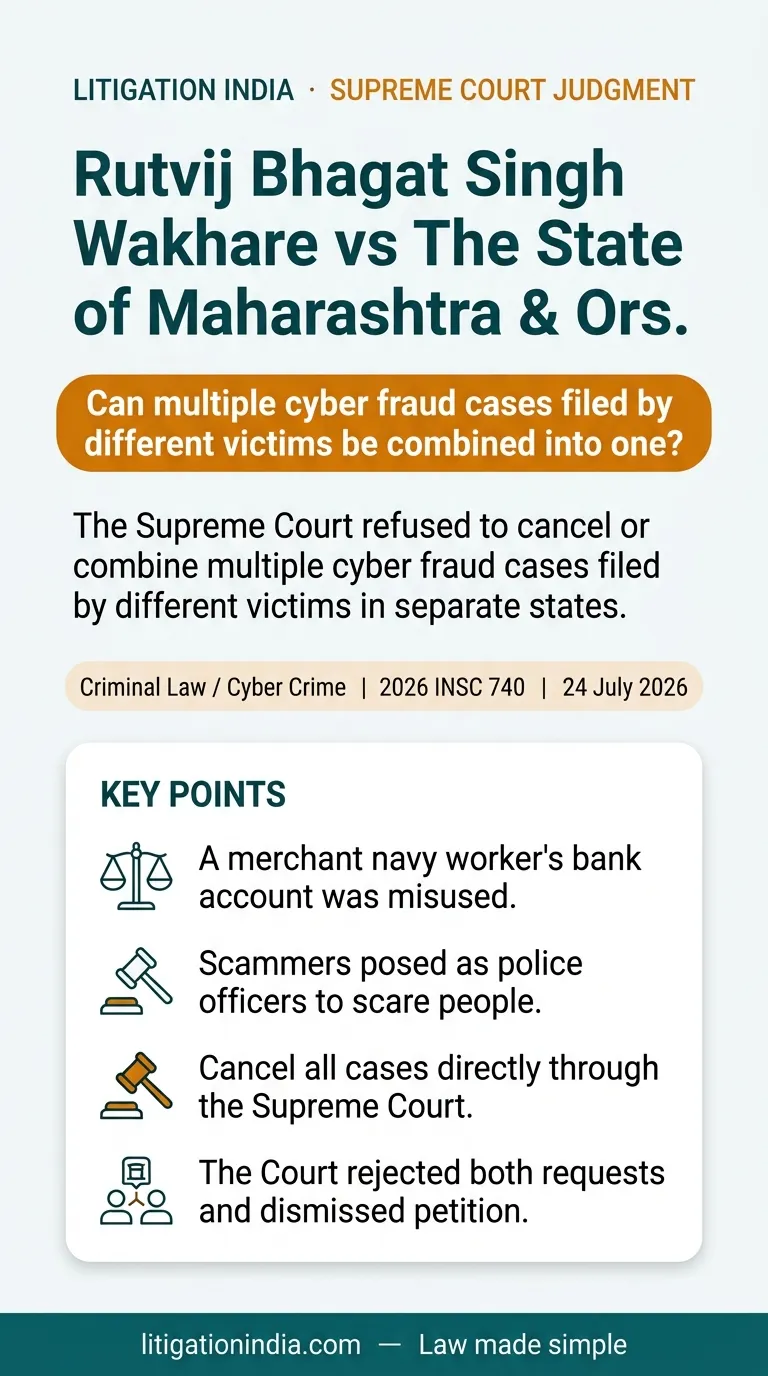
Can multiple cyber fraud cases filed by different victims be combined into one?
“The Supreme Court refused to cancel or combine multiple cyber fraud cases filed by different victims in separate states.”
Story Slides
In short
The Supreme Court of India dismissed a petition filed by Rutvij Bhagat Singh Wakhare, who wanted the court to either cancel or combine four separate police complaints (FIRs) filed against him in Maharashtra, Karnataka, and Odisha. The cases involved cyber fraud where scammers pretended to be police officers and tricked innocent people into sending money to a bank account owned by the petitioner. The petitioner argued that he was innocent, as he had let a friend use his account, and asked the Supreme Court to combine all cases into one because they used the same bank account. The Supreme Court rejected both requests. First, the Court explained that people should generally approach their state High Court to cancel a case before coming to the Supreme Court under Article 32, unless their basic rights are severely violated. Second, the Court ruled that these cyber fraud cases cannot be joined together because they involved different victims, happened at different times, and were completely separate transactions. Even though the scammers used the same bank account and similar tricks, each victim’s loss was an independent crime. The Court noted that combining them would make it very hard for victims, especially from villages, to get justice and would disturb the police investigations, which are still in their early stages.
Background
The petitioner's bank account was used by online scammers to receive money stolen from several victims across three states. Scammers posing as police officers had terrified victims into transferring huge sums of money. Since his account was linked to the scams, multiple police complaints (FIRs) were registered against it.
The Decision
The Supreme Court dismissed the petition and refused to quash or club the cases. It ruled that because the crimes involved different victims and occurred on separate occasions, they must be investigated and tried individually. However, the Court allowed the petitioner to approach the respective High Courts for relief.
Why it matters for you
This judgment protects cybercrime victims, especially from rural areas, by ensuring they do not have to travel to other states to pursue their cases. It also clarifies that criminals cannot escape separate investigations in different states simply because they used a single bank account or a similar trick.
AI-assisted summary, reviewed and verified by our editorial team.
Need help with your case?
Facing a similar legal challenge in the Supreme Court or High Court? Connect with our pro bono volunteer advocates today.
Related Supreme Court services