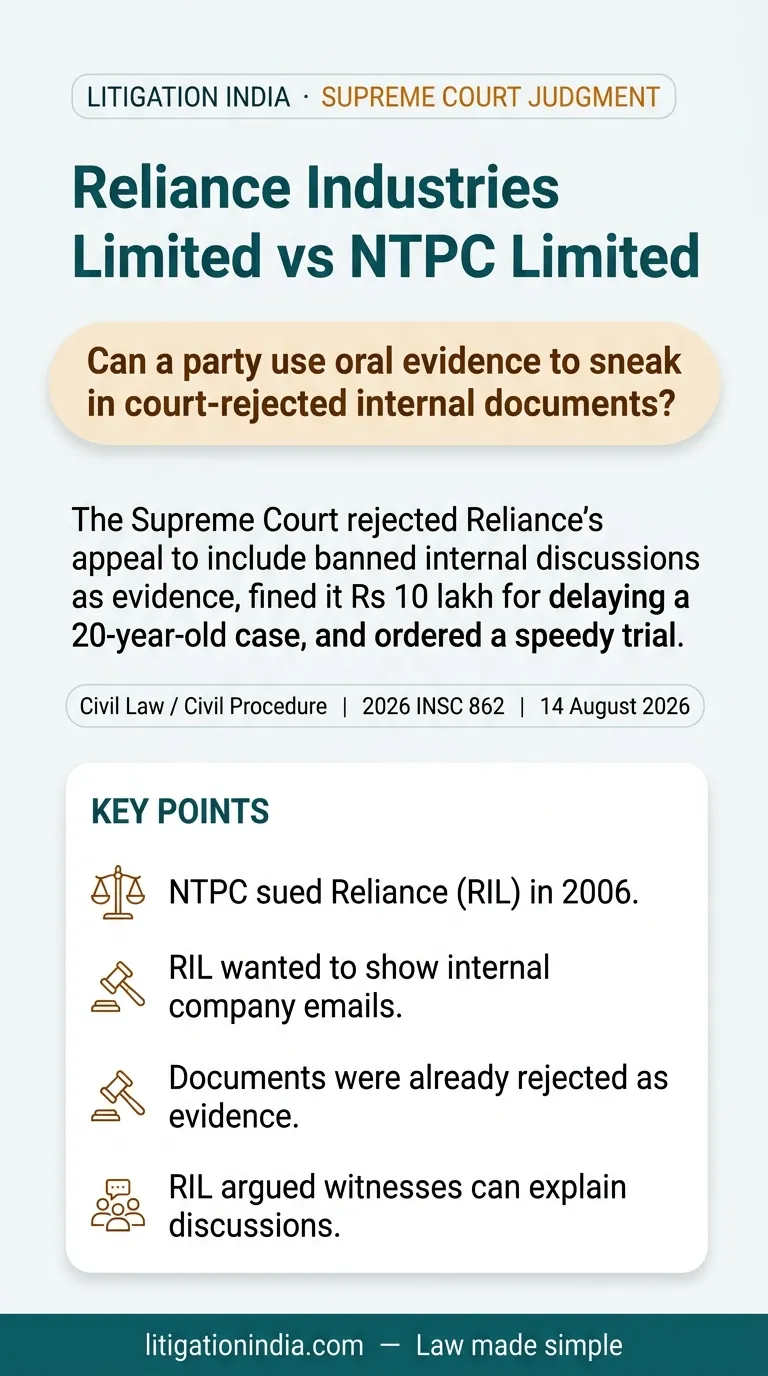
Reliance Industries Limited vs NTPC Limited
The big legal question
Can a party use oral evidence to sneak in court-rejected internal documents?
“The Supreme Court rejected Reliance's appeal to include banned internal discussions as evidence, fined it Rs 10 lakh for delaying a 20-year-old case, and ordered a speedy trial.”
Story Slides
In short
In this case, the Supreme Court of India dealt with a long-running dispute from 2006 between NTPC Limited and Reliance Industries Limited (RIL) regarding a gas supply agreement. Over the years, RIL made multiple attempts to bring internal company emails and meeting notes into the court records. Earlier, the courts ruled that these internal, unilateral documents were irrelevant for deciding if a final contract existed. Having failed to submit these documents directly, RIL attempted to introduce their contents indirectly by having their witness talk about them during oral testimony. In 2019, the Supreme Court clearly held that what cannot be done directly cannot be done indirectly; since the internal documents were barred, oral evidence about their contents was also inadmissible. Following this direction, the Bombay High Court carefully reviewed the witness's written statements (affidavits) and removed (redacted) the portions that referred to those barred internal emails. RIL challenged this removal. The Supreme Court dismissed RIL's appeal, praising the High Court's careful screening. The Supreme Court expressed deep concern that a commercial dispute from 2005-2006 was still stuck at the trial stage due to continuous procedural objections. To discourage such delaying tactics, the Court fined RIL Rs 10 lakh and ordered the trial court to finish the case as quickly as possible.
Background
In 2006, NTPC sued Reliance (RIL) for failing to supply natural gas as agreed. RIL repeatedly tried to delay the case by asking to bring in internal company emails and meeting notes as evidence.
The Decision
The Supreme Court dismissed Reliance's appeal and upheld the High Court's action of removing inadmissible parts from the witness's statement. It also fined Reliance Rs 10 lakh for delaying the case for 20 years and ordered an immediate trial.
Why it matters for you
This judgment shows that rich litigants cannot use their endless resources to delay court cases forever. It establishes that if a document is rejected by a court, a party cannot bypass this rule by making a witness talk about it.
AI-assisted summary, reviewed and verified by our editorial team.
Need help with your case?
Facing a similar legal challenge in the Supreme Court or High Court? Connect with our pro bono volunteer advocates today.
Request Free Callback