
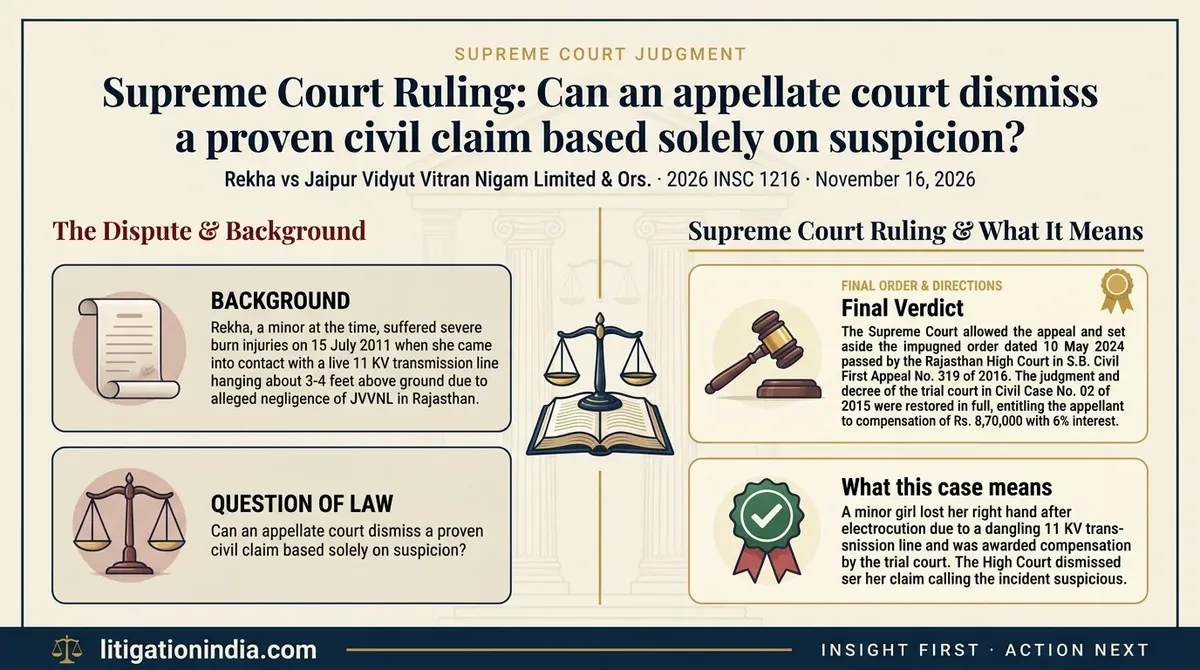
Full text of the judgment
Text extracted from Rekha vs Jaipur Vidyut Vitran Nigam Limited & Ors.. For the authoritative version refer to the Supreme Court of India's official website.
2026 INSC 1216
Page 1 of 9 REPORTABLE
IN THE SUPREME COURT OF INDIA CIVIL APPELLATE JURISDICTION
CIVIL APPEAL NO. OF 2026 (ARISING OUT OF SPECIAL LEAVE PETITION (CIVIL) DIARY NO. 42323 OF 2025)
…APPELLANT(S) VERSUS JAIPUR VIDYUT VITRAN NIGAM LIMITED & ORS.
...RESPONDENT(S)
J U D G M E N T SHREE CHANDRASHEKHAR, J.
Delay condoned. 2. Leave granted. Against the judgment and decree in a civil suit instituted by the appellant seeking compensation, the Jaipur Vidyut Vitran Nigam Limited (in short, “JVVNL”) filed S.B. Civil First Appeal No. 319 of 2016 which was allowed and the suit for compensation filed by the appellant was dismissed. Aggrieved thereby, the appellant challenges the decision of the Digitally signed by NISHA KHULBEY Date: 2026.11.16 17:23:07 IST Reason: Signature Not Verified
Page 2 of 9 Single Judge of the Rajasthan High Court mainly on the ground that the decision of a Court of law cannot be based on a mere doubt raised by the Court regarding happening of a certain event. 3. The High Court acting as the appellate Court has held as under: “11. When electricity wire of 11000 KV was hanging at 3-4 feet and PW-1 Rekha passed under such wire and she did not suffer any electric shock when her head touched the wire, it shows that there is something which is unbelievable. Unless there is miracle it does not happen. PW-1 Rekha suffered electric shock when she removed the electric wire from her head by hand. Moreover just after the incident the matter was not reported either to police or to defendants-appellants. Even the treatment for electricity current was not established from any of evidence of medical expert. 12. This is a civil case and the trial court must realize that mere tendering any document in evidence is not enough. PW-2 Jagdish has exhibited the documents but they are not proved from mere exhibition. Therefore the incident is not established. The incident, on face of record is suspicious and the delay fortify the suspicion. The trial court has committed serious and grave error while allowing such frivolous claim. Therefore the issue Nos. 1 and 2 were wrongly decided in favour of plaintiff. The plaintiff was not entitled for any compensation as the incident alleged by the plaintiff was not proved from any angle either oral or documentary evidence. Principle of absolute or strict liability is attracted when incident is established but when incident itself is suspicious, then the principle is not applicable. We are a court of law and it is expected from the Trial Court to satisfy itself from the facts first before arriving at any conclusion. Therefore the findings on issue Nos. 1 and 2 are liable to be set aside.”
4. Civil Case No. 02 of 2015 was instituted on behalf of the appellant who was a minor on the relevant date. She set up a case that she sustained injuries by electrocution at around 7:00 A.M on 15th July 2011 due to negligence of the respondents. She stated that the transmission lines passing from village Phunthpura to village Harivansh ka Pura-Pathaur ka Pura had loosened over last few days and the electric wires came close to the ground, about 3-4 feet from the ground. While passing through village Harivansh ka
Page 3 of 9 Pura-Pathaur ka Pura, she tried to ward off the electric wires falling on her way but it was a live wire and a major part of her body was badly burnt due to electric shocks. She was taken to Primary Health Centre at Basedi and then to Dr. Ramvilas at Badi for treatment but her condition did not improve. After four days, she was taken to Agra for further treatment where her right hand was amputated and she was rendered permanently handicapped. According to the appellant, a Daily Diary Report was recorded on 18th August 2011 at Basedi police station but no action thereon was taken by the police. In the written statement, the respondents took a stand that the appellant’s story of electrocution was imaginary and concocted for claiming compensation. They put up a defence that the appellant could not have survived, inasmuch as, any person coming in contact with 11 KV electric line would die on the spot due to electric shock. They denied that any 11 KV electric line was hanging above surface near the place of incident or that there was any negligence on their part to maintain the transmission lines. They further pleaded that there was no LT electric line passing through Harivansh Ka Pura-Pathaur ka Pura coming in contact with which the appellant could have got burn injuries due to electrocution. 5. In the trial, the appellant examined herself and narrated the incident in sufficient details and with clarity. The respondents put a suggestion to her that she suffered electric shocks at home while removing the Jumper wire but she denied such suggestion and stood by her stand that she suffered
Page 4 of 9 serious burn injuries on account of negligence of the respondents who failed to take reasonable care and did not maintain the transmission lines in proper condition. The witnesses examined by her stated about the incident and affirmed in the dock that complaints were made about the transmission lines falling dangerously towards the ground. The respondents, in their turn, examined an employee of the JVVNL who reproduced in the Court the respondents’ version and stated that the appellant received electric shocks at home. But he admitted in the cross-examination that he was not a witness to the incident and he was not even on duty on the day of the incident. He further admitted in the Court that it was the responsibility of the respondents to maintain the transmission lines. 6. Civil Case No. 02 of 2015 was decreed and the respondents were directed to pay Rs. 8,70,000/- as compensation to the appellant with interest at the rate of 6%, until the payment is made. 7. In the First Appeal, the High Court held that the appellant’s witnesses were not on the same page inasmuch as there were contradictions in their testimony as to hanging of the electric wires. The High Court observed that there was delay in lodging a report to the police and such delay was not explained by the victim. It further held that the incident on the face of records was suspicious and the delay in lodging a police report fortifies the suspicion. The High Court, therefore, interfered with the judgment and decree in Civil Case No. 2 of 2015 holding that the appellant’s story is unbelievable.
Page 5 of 9 8. In our opinion, the High Court committed serious errors in law and has interfered with a well-considered judgment on mere ipse dixit. A civil suit should be decided on the basis of evidence produced by the parties and not by merely raising a doubt on the claim made by the plaintiff. The question whether the appellant suffered injuries by coming into contact with live electric wire was decided by the trial Court on the basis of evidence laid by the parties. The principle which governs the proceedings in the appellate Court is that the findings of fact recorded by the trial Judge should normally prevail when it comes to appreciation of evidence by the appellate Court, unless the trial Judge has missed out some vital defects in the testimony of a witness. In a full-fledged trial, the respondents had an opportunity to elicit truth and such material facts from the appellant’s witnesses which could have shattered the credibility of her witnesses. This is the real purpose of offering an opportunity under sections 146 and 155 of the Indian Evidence Act, 1872 to cross-examine the witness of the other side in the trial. Section 146 of the Evidence Act permits cross-examination of a witness (i) to test his veracity, (ii) to discover certain facts about him such as his identity, position in life, etc., or (iii) to shake his credit by injuring his character which may follow certain consequences. The credit of a witness may be impeached by the adverse party or by the party calling him as a witness, with the consent of the Court, by (i) producing a person who testifies that he believes the witness unworthy of credit, or (ii) leading proof that the witness has been bribed or any other corrupt inducement to give evidence, or (iii) proof of
Page 6 of 9 former statement inconsistent with any part of his evidence which is liable to be contradicted. It was also open to the respondents to challenge the incident itself by leading positive evidence to the effect that the transmission lines were in good shape and that the electric wires were hanging at proper place. However, the defence sought to be put forth by the respondents through their witness turned out to be hearsay and they could not lead any other evidence that they were not responsible for the incident. 9. The rules of evidence enable the Courts to determine the truthfulness in the case set up by the parties. The respondents tested the veracity of the appellant’s case and tried to impeach the credit of her witnesses. But such attempts were confined to insignificant issues. As perceived in common parlance, it is really impossible to prove a truthful witness unworthy of credit and reliance. There was, in fact, no real effort on the part of the respondents to challenge the incident except putting a suggestion to the appellant that she suffered injuries while coming into contact with the Jumper wire. Such a suggestion was not made to the appellant on the basis of a proven fact or a fact emerging from any document. In fact, the respondents’ witness admitted in the Court that it was the responsibility of the respondents to maintain the transmission lines. On the other hand, the evidence produced on behalf of the appellant to support her claim remained unshaken and intact. Her witnesses stood by her claim for compensation and supported her case on all material aspects.
Page 7 of 9 10. The principle of preponderance of probability which is the test in a civil case requires the Court to assess the degree of possibility of the plaintiff’s case being true. The preponderance of probability does not mean a mere possibility rather it connotes a higher degree of possibility of existence of a fact or happening of an event. The evidence laid by the plaintiff before the Court need not prove the case beyond reasonable doubt but it must demonstrate a fair degree of certainty. The trial Judge applied the correct test and has held in favour of the appellant that she is entitled for compensation. 11. However, the High Court overlooked a fundamental rule that it is not every inconsistency or omission in the testimony of a witness which assumes materiality in a civil trial. The High Court disbelieved the whole case on the ground that the incident appears to be suspicious. It was a grave error in law that the High Court has committed while observing that “there is something which is unbelievable”. Section 4 of the Indian Evidence Act says that the Court may either record a fact as proved if such presumption is provided by the Act, or may call for proof of it until and unless it is disapproved. There is no provision in law which authorizes the Court to disbelieve the incident without recording a finding that the witnesses were unreliable or were found lying in the Court. The High Court was required to keep in mind that whether the appellant suffered permanent disability on account of electrocution is also a question of fact. The appellant’s witnesses made positive statements in this regard and it was proved as a fact that the appellant received injuries
Page 8 of 9 due to electrocution. Notwithstanding that, the High Court held that the incident was not established because the documents were merely tendered and not proved. On the contrary, the case of the appellant primarily rests on the testimony of witnesses and the medical records etc. were produced as supporting materials. 12. Except a statutory presumption in law, no Court is entitled to assume a fact which is either not spoken by the witnesses or cannot be inferred from the testimony of witnesses or any document. Section 3 of the Indian Evidence Act provides that a fact is said to be “proved” when, after considering the matters before it, the Court either believes it to exist, or considers its existence so probable that a prudent man, under the circumstances of the particular case, shall act upon the supposition that it exists. The trial Court believed the witnesses produced by the appellant and held that the appellant is entitled for compensation for the injuries suffered by her on account of negligence of the respondents. In the circumstances of this case, the High Court had no jurisdiction to interfere in the matter by nurturing a suspicion over the appellant’s case that the occurrence did not happen. The appellate Court can interfere with the judgment of the Court of first instance if it suffers from material irregularity, or is based on inadmissible evidence or a misreading of the evidence. But the appellate Court is not entitled to interfere with a judgment merely on the ground of suspicion without weighing truthfulness of the witnesses. If a witness is
Page 9 of 9 found truthful then the Court is required to separate chaff from grain and render a judgment by applying correct principles in law. This is no ground to spurn a judgment delivered by a Court of competent jurisdiction that there was a delay in lodging the claim or a complaint, or that there is some inconsistency in the evidence produced by the plaintiff. The appellate Court should not embark upon a fault-finding expedition and interfere in the matter on mere showing of some mistake in the judgment under challenge. 13. In our opinion, the High Court should not have interfered in this matter which attracts strict liability of the respondents. Accordingly, the impugned order dated 10th May 2024 passed in S.B. Civil First Appeal No. 319 of 2016 is set aside. The judgment and decree passed by the trial Court in Civil Case No. 02 of 2015 are restored. The appeal is allowed in aforesaid terms. Pending applications stand disposed of.
………...………….……………………….., J. (PRASHANT KUMAR MISHRA)
………...………….……………………….., J. (SHREE CHANDRASHEKHAR)
NEW DELHI; NOVEMBER 16, 2026.