Reji Baby vs Subi Mary & Ors.
The big legal question
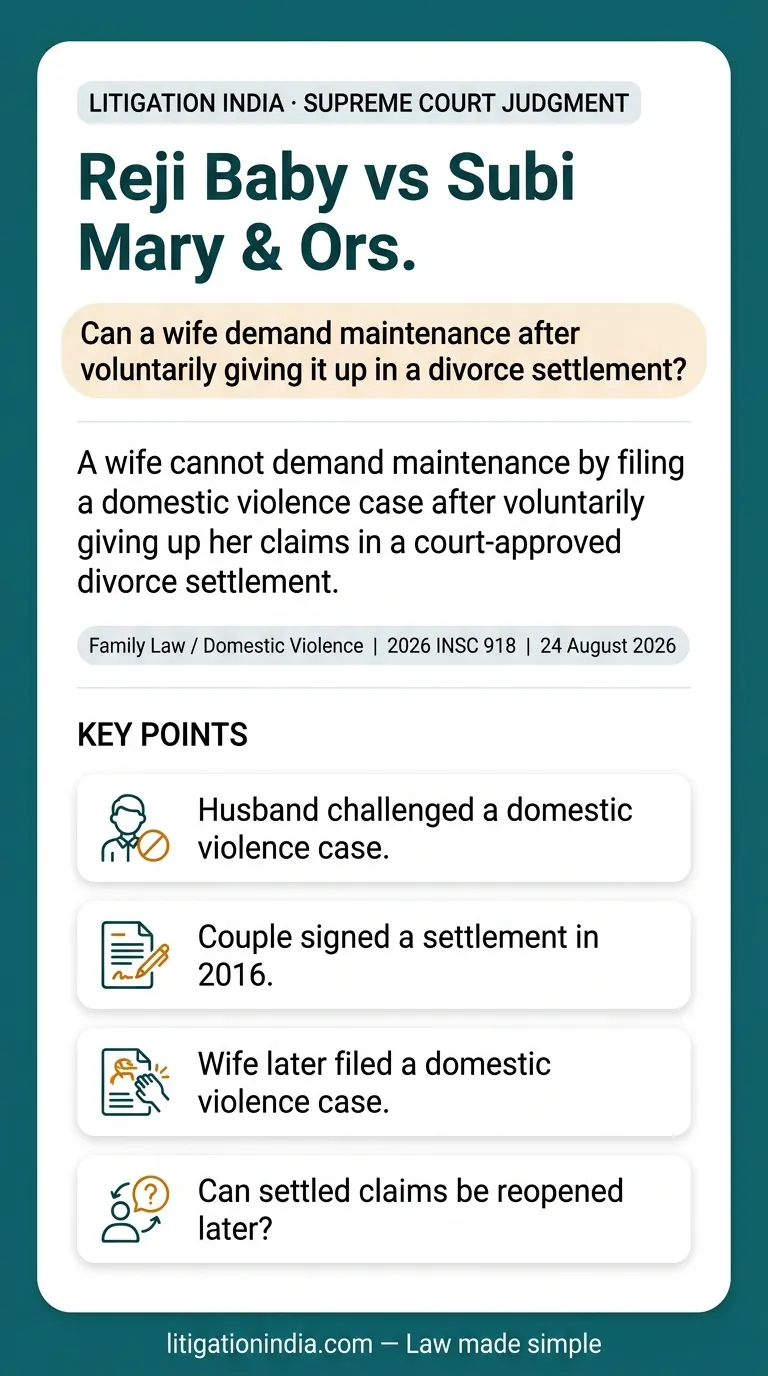
Can a wife demand maintenance after voluntarily giving it up in a divorce settlement?
“A wife cannot demand maintenance by filing a domestic violence case after voluntarily giving up her claims in a court-approved divorce settlement.”
Story Slides
In short
The Supreme Court of India ruled that filing a domestic violence case after voluntarily settling all disputes during a mutual divorce is an abuse of the legal process. In this case, the husband and wife signed a settlement agreement in 2016, where the wife voluntarily gave up all future maintenance and monetary claims. They subsequently obtained a mutual divorce in 2017. Later, the wife and their adult daughter filed a complaint under the Protection of Women from Domestic Violence Act, seeking monetary relief. The wife claimed she signed the agreement under pressure because she wanted a quick divorce to move to the USA. The Supreme Court rejected her claim, noting that both parties were educated and had confirmed the settlement through court affidavits without ever legally challenging the agreement itself. The Court held that once a party voluntarily enters a settlement, they cannot reopen the same dispute. However, the Court highlighted that the adult daughter was not a party to this agreement. Therefore, while the domestic violence case against the husband was dismissed, the daughter retains the legal right to file a fresh case to claim monetary support from her father.
Background
A husband and wife settled their disputes in 2016 and got a mutual divorce in 2017, with the wife agreeing not to claim any maintenance. Later, she and her adult daughter filed a domestic violence case demanding money. The husband challenged this in court, saying she could not reopen settled issues.
The Decision
The Supreme Court dismissed the domestic violence case, ruling that the wife was bound by her voluntary settlement. However, the Court clarified that the adult daughter, who did not sign the agreement, is free to file a fresh case for financial support.
Why it matters for you
This judgment ensures that court-approved settlements are respected and prevents people from filing false or repeated cases after taking a divorce. It also protects the independent financial rights of children who are not part of their parents' divorce agreements.
AI-assisted summary, reviewed and verified by our editorial team.
Need help with your case?
Facing a similar legal challenge in the Supreme Court or High Court? Connect with our pro bono volunteer advocates today.
Related Supreme Court services