Reena vs. The Managing Director, KSRTC
The big legal question
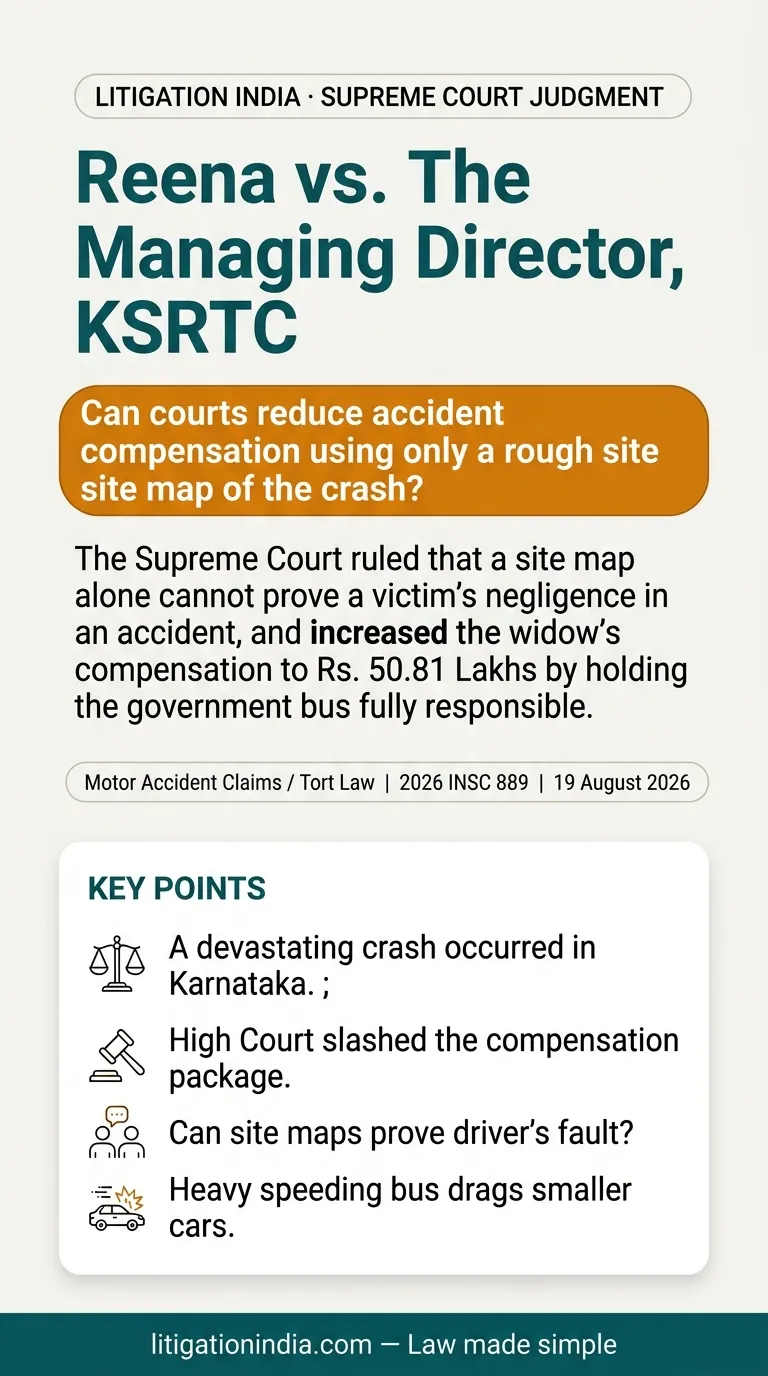
Can courts reduce accident compensation using only a rough site map of the crash?
“The Supreme Court ruled that a site map alone cannot prove a victim's negligence in an accident, and increased the widow's compensation to Rs. 50.81 Lakhs by holding the government bus fully responsible.”
Story Slides
In short
This case arose from a tragic road accident in 2005, where a Karnataka State Road Transport Corporation (KSRTC) bus collided with a car. The crash killed Nandan Shet (a software engineer and entrepreneur), his mother, and a friend, while his wife, Reena, survived with serious injuries. The Motor Accident Claims Tribunal blamed the bus driver entirely. However, the High Court cut the compensation by 50%, claiming Nandan was also responsible ('contributory negligence') based on a rough site map showing the car's final position. It also refused to accept new documents showing Nandan's actual income, stating they were submitted too late. The Supreme Court corrected these errors. It ruled that a site map showing where a smaller car stopped after being hit by a heavy bus cannot prove the car driver's fault, because a large vehicle naturally drags a smaller one. The Court emphasized that civil accident claims are decided on probabilities, and a driver's acquittal in a criminal case does not automatically clear them of civil liability. Furthermore, the Court allowed Reena to submit new financial documents, noting that as a newlywed in deep shock and trauma, she could not collect them earlier. Based on proof of her husband's qualifications and business, the Court increased his estimated income from Rs. 20,000 to Rs. 70,000 per month. It held KSRTC 100% liable and awarded Reena Rs. 50.81 Lakhs with 6% interest.
Background
In 2005, a newly married software engineer, Nandan Shet, and his mother died when a KSRTC bus collided with their car. His wife, Reena, survived with injuries and filed for accident compensation. The High Court cut her compensation by half, blaming her deceased husband for the accident based on a rough police sketch of the crash site.
The Decision
The Supreme Court set aside the High Court's order and held the KSRTC bus driver 100% responsible for the accident. It ruled that a site map of a crash scene cannot be used to blame the driver of a smaller vehicle. The Court allowed new income proof and enhanced the compensation for the husband's death to Rs. 50.81 Lakhs with 6% interest.
Why it matters for you
This judgment protects accident victims from unfair reduction of compensation based on flimsy police sketches. It clarifies that a victim's family can submit new financial evidence even at a later stage if they were delayed due to trauma or shock.
AI-assisted summary, reviewed and verified by our editorial team.
Need help with your case?
Need help securing compensation under the Motor Vehicles Act? Our accident claims advocates can guide you.
Related Supreme Court services