Ras Al Khaimah Investment Authority v. Matrix Pharmacorp Private Limited & Anr.
The big legal question
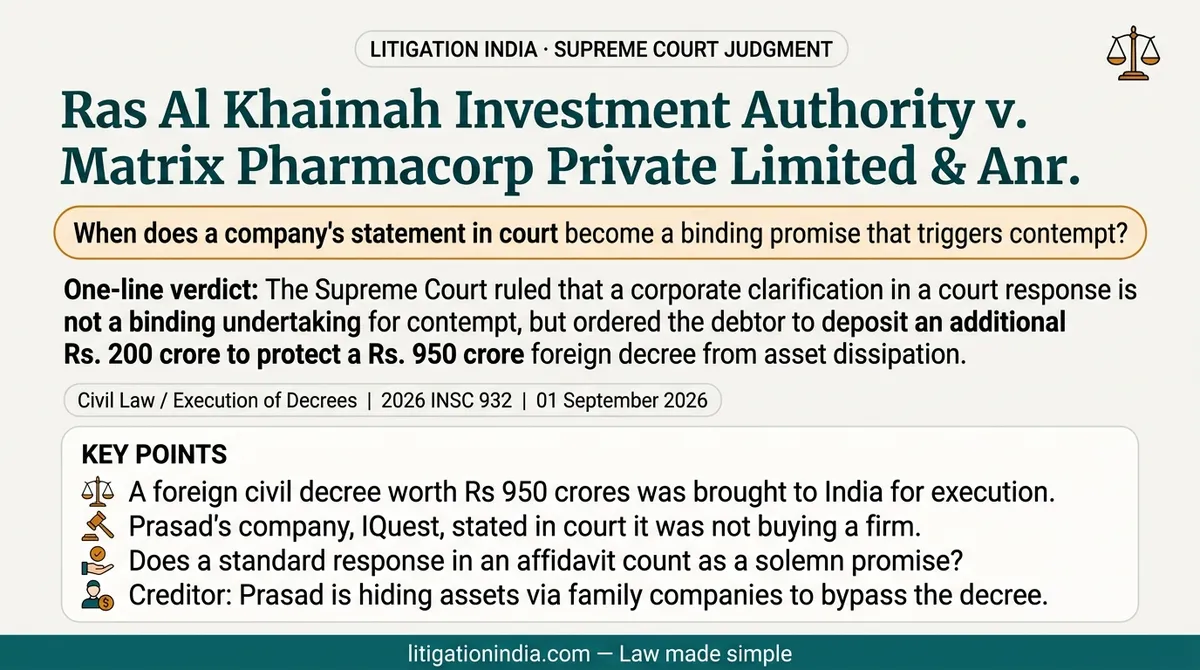
When does a company's statement in court become a binding promise that triggers contempt?
“The Supreme Court ruled that a corporate clarification in a court response is not a binding undertaking for contempt, but ordered the debtor to deposit an additional Rs. 200 crore to protect a Rs. 950 crore foreign decree from asset dissipation.”
Story Slides
In short
This case is about the enforcement of a massive foreign court decree in India. The Appellant, Ras Al Khaimah Investment Authority (RAKIA), a public entity from the UAE, successfully won a civil lawsuit in UAE courts against the respondent, Nimmagadda Prasad (NP), for misappropriating funds. The decree directs Prasad to pay approximately Rs. 543 crores, which with interest has risen to over Rs. 949 crores. Since India and UAE have a reciprocal legal enforcement treaty under Section 44A of the Code of Civil Procedure (CPC), RAKIA filed execution petitions before Indian commercial courts to recover the money. However, RAKIA accused Prasad of trying to camouflage and dissipate his assets through a complex web of family-controlled companies (such as IQuest, Matrix, and Tianish) to avoid paying the debt. When one of these companies, IQuest, stated in a previous court response that it would not go ahead with a business acquisition, RAKIA claimed this was a solemn promise (undertaking) to the court. When another family-linked company later completed the deal, RAKIA filed contempt of court proceedings. The Supreme Court ruled that the company's statement was merely a clarification and not an unconditional court undertaking, so there was no contempt of court. However, the Court recognized that there was a real risk of Prasad shifting and hiding his assets to leave RAKIA with a useless paper decree. Consequently, the Supreme Court ordered Prasad and his companies to deposit an additional Rs. 200 crores in cash security with the court registry within two weeks. Crucially, the Supreme Court directed the Commercial Courts in Hyderabad and Ranga Reddy to expedite the entire execution proceedings and decide all pending issues, including the corporate veil arguments, within a strict timeline of four months.
Background
Ras Al Khaimah Investment Authority (RAKIA) won a Rs 543 crore civil decree against Nimmagadda Prasad in UAE. RAKIA filed execution proceedings in India to recover this amount, which now exceeds Rs 949 crore with interest. RAKIA alleged that the debtor was routing and hiding his assets using various family-controlled companies to defeat the decree.
The Decision
The Supreme Court held that the statement made by the respondent's company in court was only a clarification, not a binding undertaking, and dismissed the contempt charges. However, to protect the foreign decree from asset dissipation, the Court ordered the respondents to deposit an additional Rs. 200 crore as security within two weeks. The execution courts were ordered to finalize the case within four months.
Why it matters for you
This judgment clarifies that ordinary statements in court filings do not automatically constitute binding undertakings for contempt proceedings. It also shows that Indian courts will actively step in to protect decree holders and prevent debtors from using shell companies or family networks to escape their financial liabilities.
AI-assisted summary, reviewed and verified by our editorial team.
In the Court's words
“An undertaking given to the Court has the same force as an order of the Court and breach thereof would amount to contempt in the same manner as a breach of an injunction.”
“the Respondent NP is attempting to camouflage his assets and is engaged in dissipating them with a view to defeating the execution of the decree.”
“there has been continuous act of the Respondent entities together with NP in one form or the other to change control/modify active control of the group companies... which gives rise to a genuine apprehension... they may be left with a paper decree.”
Need help with your case?
Facing a similar legal challenge in the Supreme Court or High Court? Connect with our pro bono volunteer advocates today.
Request Free Callback