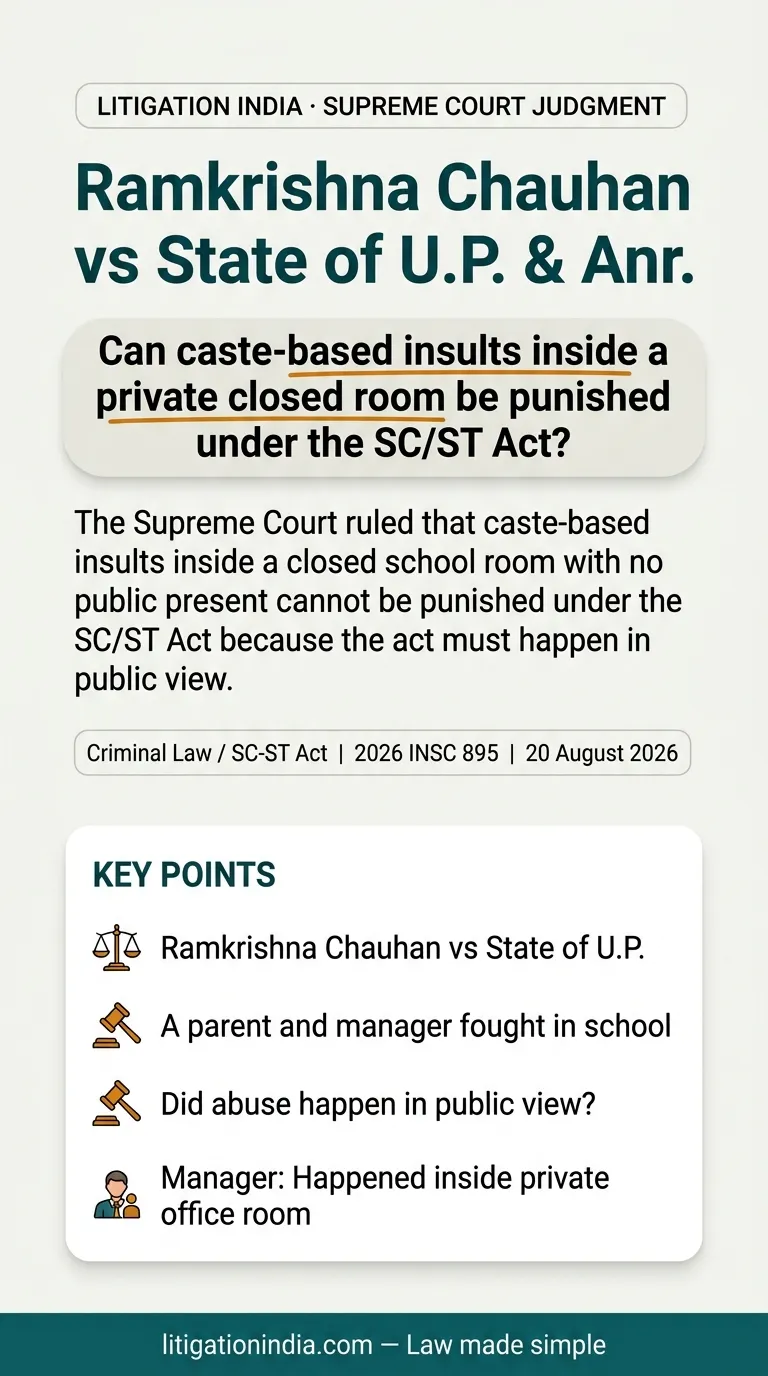
Ramkrishna Chauhan vs State of U.P. & Anr.
The big legal question
Can caste-based insults inside a private closed room be punished under the SC/ST Act?
“The Supreme Court ruled that caste-based insults inside a closed school room with no public present cannot be punished under the SC/ST Act because the act must happen in public view.”
Story Slides
In short
In this case, a school manager (the appellant) was accused of abusing and assaulting a parent (the respondent) and using caste-based slurs inside the school's office. A counter-case was also filed by the manager's wife, claiming the parent had assaulted her first. The parent filed an FIR under the Indian Penal Code (IPC) and Sections 3(1)(r) and 3(1)(s) of the SC/ST Act. The High Court refused to dismiss the charges. However, the Supreme Court reversed this decision and quashed the SC/ST Act charges. The Court explained that for these specific charges to apply, the insult must happen in 'public view'—meaning in an open space where the public can easily see or hear it. Since the school's site plan showed the incident occurred inside an enclosed office room with no public access, and none of the witness teachers stated they actually heard the caste slurs, the 'public view' requirement was not met. General, vague allegations of caste abuse without specific details are not enough. Thus, while the general IPC criminal charges for fighting will go on, the severe charges under the SC/ST Act cannot stand.
Background
A school manager and a parent got into a fight in the school office over a student's injury. The parent filed a case alleging caste-based insults, while the manager's wife filed a counter-case alleging the parent assaulted her first.
The Decision
The Supreme Court dismissed the SC/ST Act charges against the manager because the incident occurred inside a closed office room where no public was present. The court ruled that the other ordinary criminal charges for the physical scuffle will continue in the lower court.
Why it matters for you
This judgment clarifies that every argument involving a member of a Scheduled Caste or Tribe does not automatically become an SC/ST Act offense. It ensures the law is not misused for private fights inside closed, non-public spaces.
AI-assisted summary, reviewed and verified by our editorial team.
Need help with your case?
Facing a similar legal challenge in the Supreme Court or High Court? Connect with our pro bono volunteer advocates today.
Related Supreme Court services