
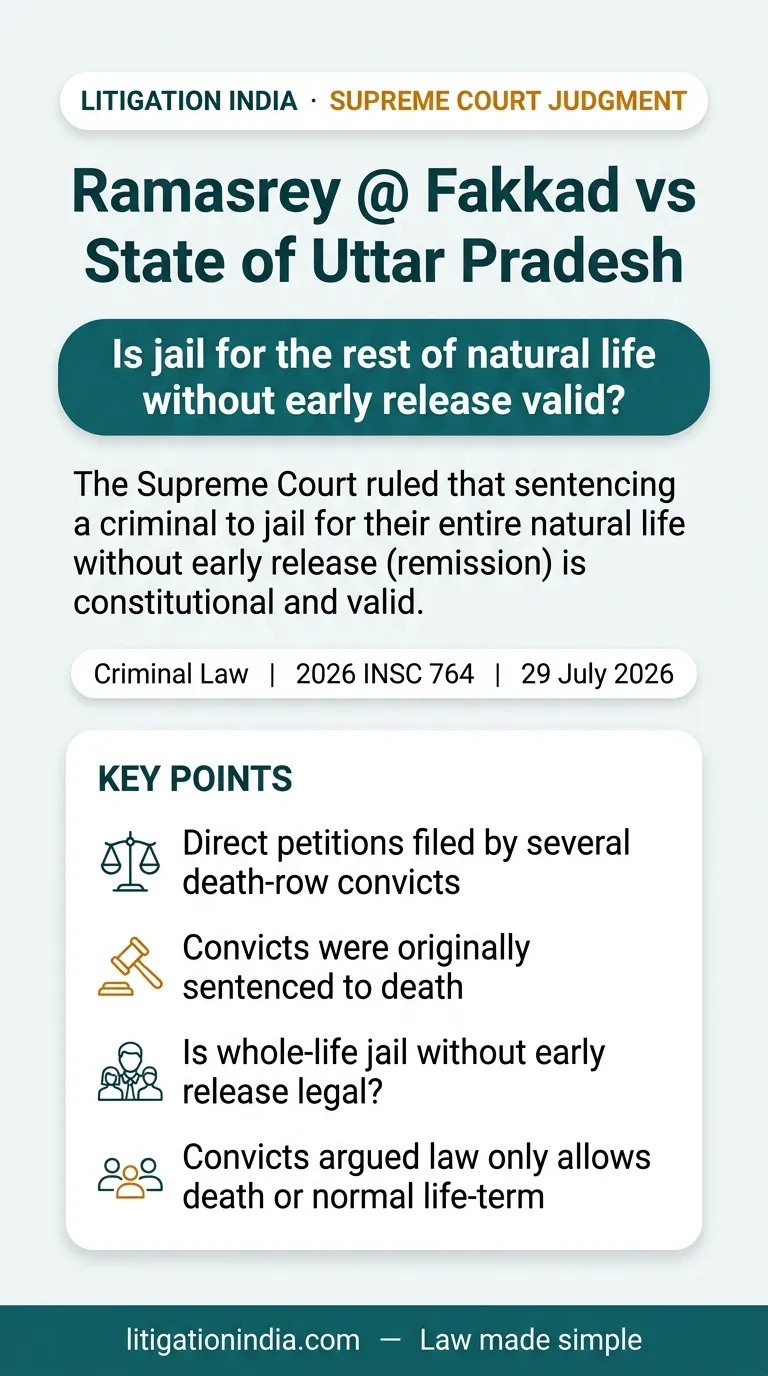
Is jail for the rest of natural life without early release valid?
Ramasrey @ Fakkad vs State of Uttar Pradesh
Case: Ramasrey @ Fakkad vs State of Uttar PradeshCitation: 2026 INSC 764Decided on: 29 July 2026
“The Supreme Court ruled that sentencing a criminal to jail for their entire natural life without early release (remission) is constitutional and valid.”
Story Slides
In short
This judgment decided whether courts can sentence a convict to spend the rest of their natural life in prison without the possibility of early release (remission). Several convicts, who had originally been sentenced to death, had their punishments changed either by High Courts or by the President of India (under mercy petitions) to 'life imprisonment for the remainder of natural life without remission.' The convicts filed direct petitions to the Supreme Court under Article 32, claiming that the law only allows ordinary life imprisonment (where they can ask for release after 14 years) or the death penalty, making a 'whole life' sentence unconstitutional. The Supreme Court dismissed their petitions. It clarified that a five-judge Constitution Bench had already ruled that a sentence for the remainder of natural life is completely legal. Legally, 'life imprisonment' means staying in prison until one's last breath. The Court can create a special category of whole-life sentence as a middle ground to avoid giving the death penalty in extremely serious cases. The Court also held that the President's power to grant or modify pardons has very wide scope, and courts can only interfere in rare cases of extreme unfairness or bias, which were not present here. Therefore, the direct petitions were rejected as a misuse of the court's process.
Need clarity on a similar legal issue?
Request free pro bono guidance from a Supreme Court Advocate.
Background
Several convicts sentenced to death for grave crimes had their sentences modified to life imprisonment for the rest of their natural lives without early release. They directly challenged this whole-life sentence in the Supreme Court, arguing it was unconstitutional and bypassed their right to seek early release.
The Decision
The Supreme Court dismissed the petitions, confirming that sentencing a convict to prison for the remainder of their natural life without early release is fully constitutional. It also ruled that the President's decision to modify a death sentence to whole-life imprisonment cannot be easily interfered with by courts.
Why it matters for you
This judgment makes it clear that for extremely serious crimes, a convict can be kept in jail until their last breath without any hope of early release. It also warns litigants that they cannot use direct petitions to the Supreme Court as a shortcut to bypass normal legal procedures.
AI-assisted summary, reviewed and verified by our editorial team.
Need help with your case?
Facing a similar legal challenge in the Supreme Court or High Court? Connect with our pro bono volunteer advocates today.
Related Supreme Court services
Related Questions of Law
- Can a murder conviction stand on unreliable eyewitnesses and incomplete circumstantial evidence?
- Can a person be convicted of murder if the police investigation is highly careless
- Can helpers escape a murder conviction if they did not fire the fatal shot?
- Do normal family fights mean a husband forced his wife to commit suicide?
- Can courts convict someone based on electronic evidence that lacks a legal certificate?