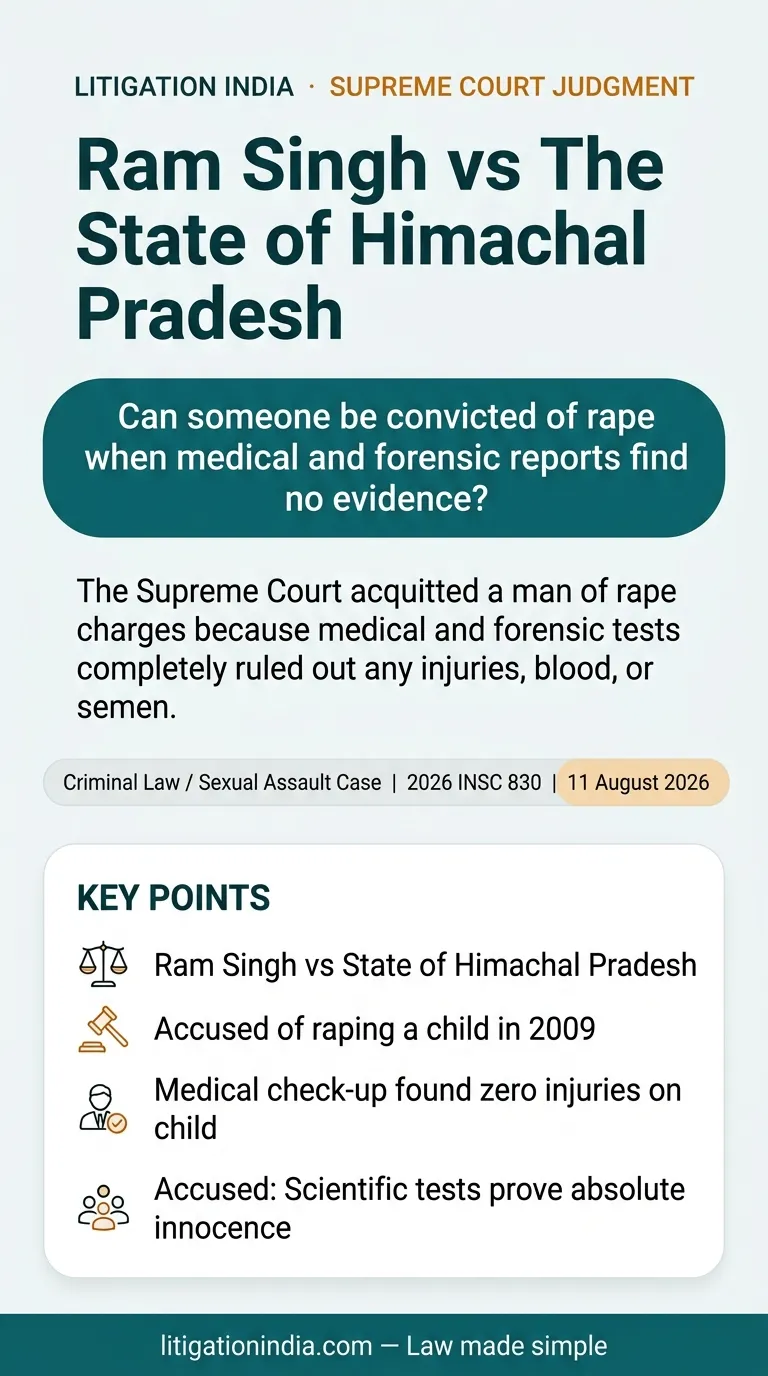
Ram Singh vs The State of Himachal Pradesh
The big legal question
Can someone be convicted of rape when medical and forensic reports find no evidence?
“The Supreme Court acquitted a man of rape charges because medical and forensic tests completely ruled out any injuries, blood, or semen.”
Story Slides
In short
This case involves Ram Singh, who was accused of raping a four-and-a-half-year-old girl in 2009. The girl's mother claimed she found bloodstains on her daughter's clothes after the incident. Initially, the Trial Court acquitted Ram Singh because the medical examination of the child showed absolutely no injuries, and the forensic tests of her clothes and the crime scene showed no traces of blood or semen. However, the Himachal Pradesh High Court overturned this acquittal and sentenced him to ten years of rigorous imprisonment, choosing to believe the oral statements of the mother and child over scientific evidence. On appeal, the Supreme Court of India set aside the High Court's decision and restored Ram Singh's acquittal. The Supreme Court emphasized that courts cannot ignore vital scientific reports. The child's medical examination was conducted within twelve hours of the incident, yet the doctor found no injuries, redness, or signs of penetration. Furthermore, the Forensic Science Laboratory performed chemical tests (including the Benzidine test) and found no blood or semen on the girl's clothes, the accused's clothes, or the mats at the scene. There were also major contradictions regarding where the incident took place. Since the prosecution failed to prove its case beyond a reasonable doubt, the Court gave the benefit of the doubt to Ram Singh.
Background
In 2009, Ram Singh was accused of raping a 4.5-year-old girl in Himachal Pradesh. The Trial Court acquitted him because medical and forensic tests showed no signs of sexual assault, but the High Court reversed this decision and sentenced him to ten years in prison based solely on oral statements.
The Decision
The Supreme Court set aside the High Court's conviction and restored the Trial Court's acquittal. It ruled that when scientific evidence completely contradicts verbal allegations, the case is full of doubt, and the accused must be set free.
Why it matters for you
This judgment highlights that courts cannot convict a person based on verbal stories when solid scientific evidence like forensic and medical reports proves the contrary. It protects innocent people from wrongful convictions in serious crimes.
AI-assisted summary, reviewed and verified by our editorial team.
Need help with your case?
Facing a similar legal challenge in the Supreme Court or High Court? Connect with our pro bono volunteer advocates today.
Request Free Callback