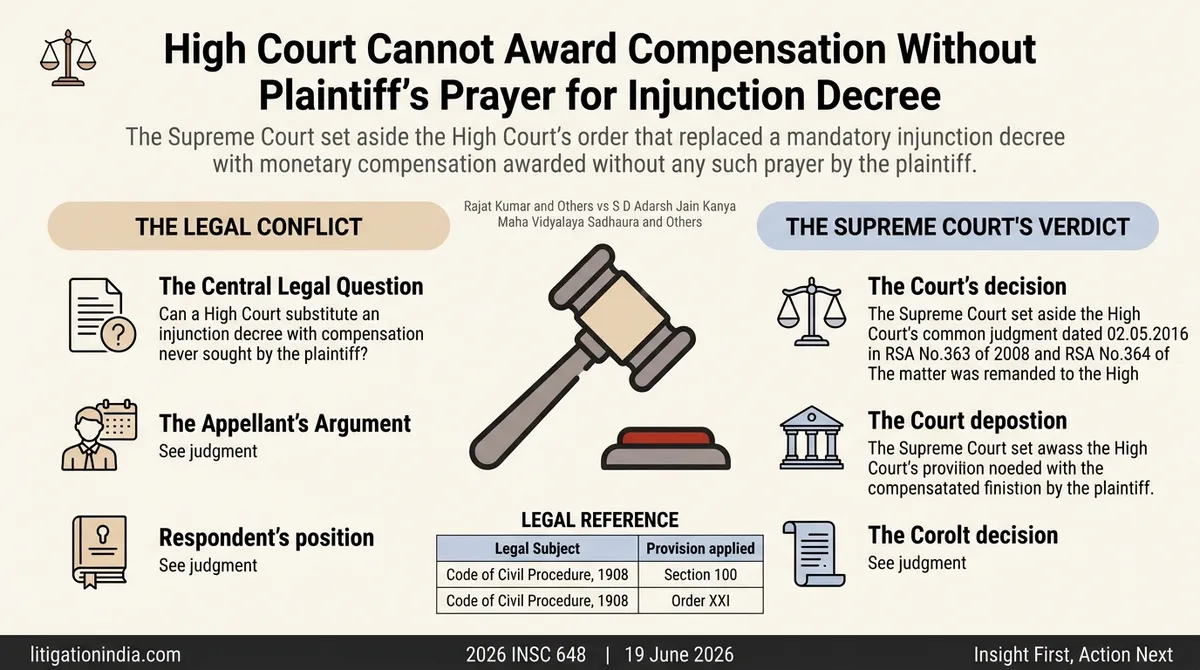
Full text of the judgment
Text extracted from Rajat Kumar and Others vs S D Adarsh Jain Kanya Maha Vidyalaya Sadhaura and Others. For the authoritative version refer to the Supreme Court of India's official website.
2026 INSC 648
Civil Appeal Nos.19552-19553 of 2017
Page 1 of 10
IN THE SUPREME COURT OF INDIA CIVIL APPELLATE JURISDICTION
CIVIL APPEAL NOS.19552-19553 OF 2017
RAJAT KUMAR AND OTHERS APPELLANTS
S D ADARSH JAIN KANYA MAHA RESPONDENTS VIDYALAYA SADHAURA AND OTHERS
J U D G M E N T
ATUL S. CHANDURKAR, J 1. The appellants are the legal heirs of the original plaintiff- Om Parkash. The original plaintiff filed Civil Suit No.426 of 1996 against the respondents-original defendants seeking mandatory injunction for removal of alleged illegal encroachment in the form of a wall constructed by them on the common open space beyond the plaintiff’s house. He further sought permanent injunction seeking to restrain the defendants from raising any further construction thereon. The Digitally signed by LOKESH ARORA Date: 2026.06.19 14:26:19 IST Reason: Signature Not Verified
Civil Appeal Nos.19552-19553 of 2017
Page 2 of 10
Trial Court on 06.02.2006 decreed the suit and directed the defendants to remove the encroachment committed by raising the said walls. It also restrained them from raising any further construction over the said walls.
Regular Civil Appeal No.137 of 2006 preferred by the defendants was dismissed on 05.09.2007 and the decree passed by the Trial Court was upheld.
The defendants being aggrieved preferred Regular Second Appeal No.364 of 2008 before the Punjab and Haryana High Court1. By the judgment dated 25.11.2011, the High Court disposed the Second Appeal with a direction to the defendants to pay an amount of ₹10,000/- with interest @ 12% per annum being half the amount of expenditure incurred on construction of the walls in question. It further held that on making such payment, the wall would be treated as ‘common’ between the parties. The legal heirs of the plaintiff challenged the reversal of the decree before this Court, reference to which would be made a bit later.
1 For short, ‘the High Court’
Civil Appeal Nos.19552-19553 of 2017
Page 3 of 10
2. The original plaintiff also filed another Civil Suit being CS No.148 of 2000 against the same defendants, this time with a prayer for mandatory injunction for removal of lintel of the school building that had been erected by the defendants on the wall of the plaintiff’s house. The Trial Court by its judgment dated 08.11.2004 decreed the said suit and directed the defendants to remove the lintel of the school building from the said wall. The defendants were also restrained from putting any lintel on any wall of the plaintiff’s house.
Being aggrieved, the plaintiff preferred Regular Civil Appeal No.143 of 2004 which came to be dismissed by the first Appellate Court on 05.09.2007. Being aggrieved, the defendants preferred Regular Second Appeal No.363 of 2008 before the High Court. The Second Appeal was decided on 25.11.2011 and a similar decree directing the defendants to pay an amount of ₹7,000/- being half of the amount spent on construction of the wall with interest @ 12% per annum was passed. It was further directed that on making such payment, the wall would be treated as ‘common’ between the parties.
Civil Appeal Nos.19552-19553 of 2017
Page 4 of 10
3. The legal heirs of the original plaintiff being aggrieved by the reversal of the aforesaid decrees by the High Court filed appeals before this Court. By order dated 13.09.2013 passed in Civil Appeal Nos.8203 of 2013 and 8281 of 2013, it was held that the modification of the decrees by the High Court without entering into the merits of the controversy was impermissible. No substantial questions of law had been framed while deciding the Second Appeals. On these counts, the judgments delivered in the Second Appeals by the High Court were set aside and the proceedings were remanded for fresh consideration in accordance with law. 4. On remand, the High Court was of the view that the construction of the wall had been raised long back. There was no valuation report on record and the claim alleged to be put forth by the plaintiff had not been proved. By observing that the other party could be compensated in terms of money that could be assessed by a valuer and with a view to do justice between the parties, it directed the Executing Court to assess the value of the construction. The defendants were accordingly directed to deposit such amount in the Executing
Civil Appeal Nos.19552-19553 of 2017
Page 5 of 10
Court to be paid to the legal heirs of the plaintiff. With these directions, the decree passed by the Trial Court as affirmed by the first Appellate Court came to be set aside.
The legal heirs of the original plaintiff are aggrieved by the reversal of the said decrees and have, thus, preferred the present appeals. 5. Despite service, there has been no appearance on behalf of the respondents since 23.04.2019. After hearing Ms. Sangeeta Kumar, learned counsel for the appellants and on perusal of the record, we are of the view that the High Court committed an error in reversing the decrees passed by the Trial Court and affirmed by the first Appellate Court on irrelevant considerations. We say so for the following reasons: a) The initial suit filed by the original plaintiff was essentially for a decree for mandatory injunction seeking removal of the alleged encroachment undertaken at the behest of the defendants on the common open space beyond the construction of the plaintiff. According to the original plaintiff, such construction interfered with the right of the plaintiff to enjoy air and light through the ventilators as well
Civil Appeal Nos.19552-19553 of 2017
Page 6 of 10
as obstructed the passing of water through the common path. It found that the defendants could not prove any right, title or interest on the land on which they had erected the wall. The decree was, thus, passed to remove the wall illegally erected by them. In the other suit, the Trial Court found that the defendants had put up a lintel of the school building on the wall of the plaintiff’s house illegally. A decree directing removal of the same and restraining the defendants from doing so in the future was passed. Both these decrees were upheld by the first Appellate Court. There was no prayer whatsoever made by the original plaintiff seeking any damages or compensation from the defendants for the encroachment committed by them. In absence of any such relief sought by the original plaintiff, the decree passed in his favour could not have been set aside by the High Court by compelling his legal heirs to accept compensation that was directed to be assessed by a valuer. The legal heirs of the plaintiff did not consent for such course to be followed. The High Court, therefore, could not have undertaken such exercise of seeking to compensate one party at the cost of the other without any prayer being made in that regard.
Civil Appeal Nos.19552-19553 of 2017
Page 7 of 10
b) The High Court by the impugned judgment reversed the decree for mandatory injunction for removal of encroachment passed by the Trial Court which was upheld by the first Appellate Court. It, however, directed the Executing Court to assess the value of the offending wall put up by the defendants so as to compensate the plaintiff in terms of money. Once the decrees passed by the Trial Court in favour of the plaintiff were set aside, there would be no occasion for the Executing Court to proceed with the execution proceedings since there would be no decree holding the field for being executed. In such a situation, directing the Executing Court to assess the value of the wall in question would be requiring it to undertake an exercise not supported by any decree whatsoever. Indeed, the course adopted by the High Court does not find support under Order XXI of the Code of Civil Procedure, 19082. c) The High Court ought to have been mindful of the fact that a similar exercise undertaken by it earlier while deciding the respective Second Appeals and directing the payment of
2 For short, ‘the Code’
Civil Appeal Nos.19552-19553 of 2017
Page 8 of 10
compensation to the original plaintiff was set aside by this Court. The High Court, on remand however again committed the same error, this time by directing the Executing Court to undertake valuation of the wall in question so as to compensate the legal heirs of the plaintiff in monetary terms. There being no prayer made by the original plaintiff in the suit for grant of any compensation nor any consent having been offered by the legal heirs of the plaintiff in that regard, the High Court could not have imposed such a direction on them, especially when there was a decree operating in their favour. d) The impugned order of the High Court proceeds on a factually wrong premise that the Trial Court in Civil Suit No.426 of 1996 had recorded a finding that the wall in question was a common wall. No such finding was recorded by the Trial Court. In fact, a decree for removal of the offending wall came to be passed by the Trial Court. Further, though the High Court has referred to three questions in the impugned judgment and has stated that the defendants urged the Court to frame the said questions as ‘substantial questions of law’, the impugned order does not indicate that
Civil Appeal Nos.19552-19553 of 2017
Page 9 of 10
the said questions were treated as substantial questions of law. However, the order concludes by observing that the substantial questions were answered in favour of the defendants and the decree passed in favour of the original plaintiff was set aside. It is, thus, clear that without an available question of law for consideration and also by making out a new prayer, the decrees passed in favour of the original plaintiff have been set aside. The legal heirs of the plaintiff have been required to accept monetary relief for which a prayer was never made. Such course has resulted in miscarriage of justice. 6. For all the aforesaid reasons, we find the judgment of the High Court to be unsustainable. Accordingly, the common judgment dated 02.05.2016 passed in RSA No.363 of 2008 and 364 of 2008 by the High Court is set aside. Since the appeals have not been adjudicated on merits, there is no option but to request the High Court to re-consider both the appeals in accordance with Section 100 of the Code and decide the same on their own merits. Considering the fact that
Civil Appeal Nos.19552-19553 of 2017
Page 10 of 10
the Second Appeals are of the year 2008, we request the High Court to consider the same expeditiously. 7. The Civil Appeals are allowed in aforesaid terms with no order as to costs.
………..……………………..J. [ S.V.N. BHATTI ]
….…..………………………..J. [ ATUL S. CHANDURKAR ]
NEW DELHI, JUNE 19, 2026.