Rahul vs State of Uttar Pradesh
The big legal question
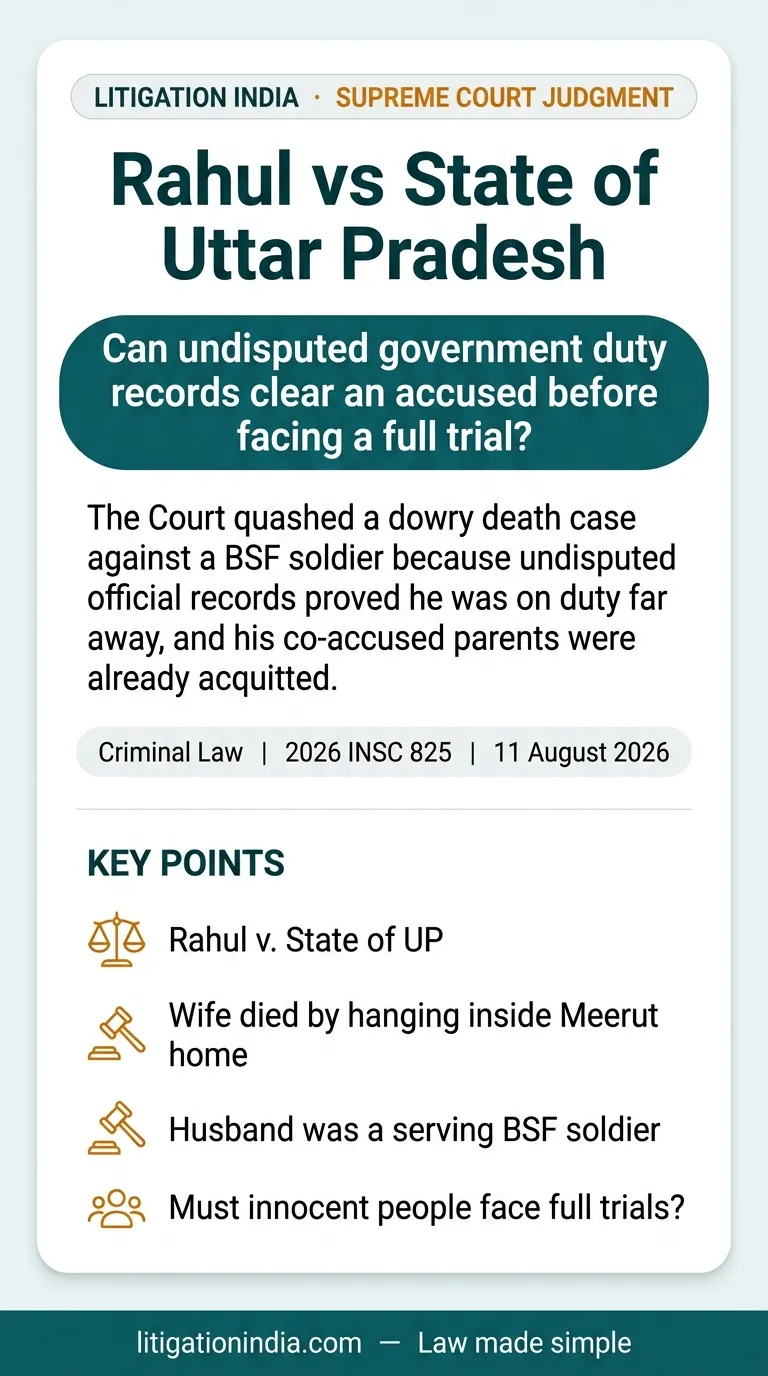
Can undisputed government duty records clear an accused before facing a full trial?
“The Court quashed a dowry death case against a BSF soldier because undisputed official records proved he was on duty far away, and his co-accused parents were already acquitted.”
Story Slides
In short
The Supreme Court cleared a BSF soldier, Rahul, of dowry death charges under Sections 498-A and 304-B of the IPC. His wife had tragically died by suicide in Meerut. Her family filed an FIR alleging dowry harassment against Rahul and his parents. However, Rahul was a BSF soldier on active duty stationed at the Indo-Bangladesh border in Meghalaya, and later Delhi, during the incident. Undisputed BSF official duty certificates clearly proved his absence from the scene of the incident. Further, the room and the house were locked from the inside, indicating suicide rather than murder. Crucially, Rahul’s parents had already been tried and acquitted on the exact same evidence, as the prosecution failed to prove any dowry demands or cruelty. The High Court had refused to quash Rahul's case, holding that his absence (plea of alibi) could only be proved during a full trial. Reversing this, the Supreme Court ruled that while an alibi based on private affidavits requires a trial, an undisputed official record from a government authority (like the Armed Forces) can be considered at the initial stage to quash a case. Forcing an innocent soldier to undergo a long, painful trial when the prosecution’s case had already collapsed would be a complete abuse of the court process.
Background
Rahul, a BSF soldier, was charged with dowry death after his wife died by hanging in Meerut. He claimed he was away on active duty in Meghalaya and Delhi, presenting official BSF service certificates to prove his location.
The Decision
The Supreme Court allowed the appeal and quashed the entire criminal proceedings against Rahul. It held that continuing the trial would be an abuse of the court's process since undisputed army records proved his absence and his parents were already acquitted.
Why it matters for you
This judgment protects innocent people from facing long, stressful trials when they have solid, unquestionable government evidence proving they were not at the crime scene. It clarifies that courts can use reliable official records to throw out false cases at the very beginning.
AI-assisted summary, reviewed and verified by our editorial team.
Need help with your case?
Facing a similar legal challenge in the Supreme Court or High Court? Connect with our pro bono volunteer advocates today.
Related Supreme Court services