Rafikmiya Ahmedmiya Malek vs. State of Gujarat
The big legal question
Can a government worker be jailed for corruption if a bribe demand isn't proved?
“The Supreme Court ruled that a government official cannot be convicted of taking a bribe unless the prosecution first proves beyond doubt that a bribe was actually demanded.”
Story Slides
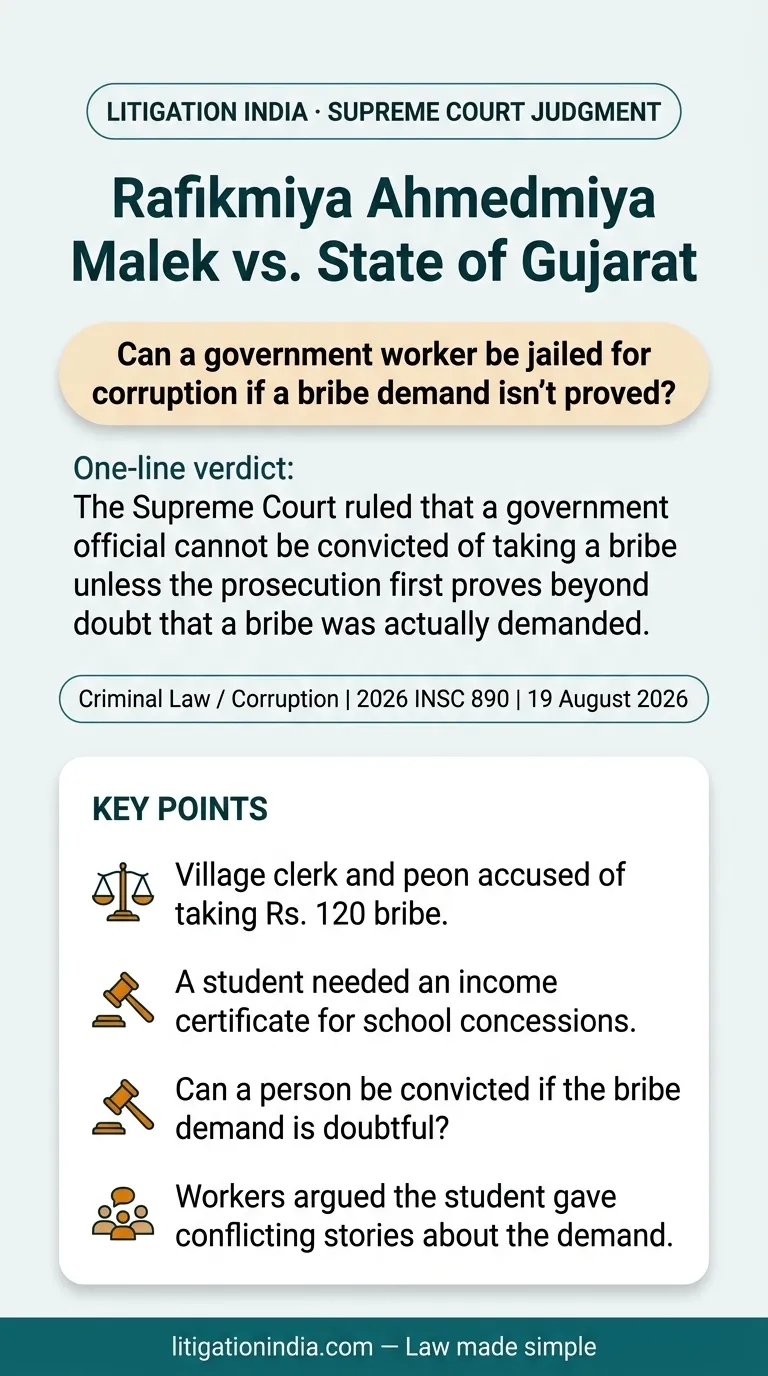
In short
This case is about two village-level government workers in Gujarat: a clerk (Talati-cum-Mantri) and a peon. A student who needed an income certificate claimed that the clerk demanded a bribe of Rs. 120 (Rs. 100 for the clerk and Rs. 20 for the peon). The student set a trap with the police. On the day of the trap, the student got his certificate and gave a Rs. 20 note to the peon, who put it in his pocket. No money was given to the clerk. Both workers were convicted of corruption by the lower courts. The Supreme Court cleared both workers of all charges. The Court explained that in corruption cases, the police must first prove that a bribe was actually demanded. If the demand itself is doubtful, just finding money in someone's pocket does not prove they are guilty. Here, the student gave conflicting stories about the money, and the peon never asked for any bribe. The peon’s defense that the Rs. 20 was a festive holiday gift for Eid was highly likely. Additionally, the Court found that the permission to prosecute the clerk was given by an officer who did not have the authority to remove him, making the permission invalid. The Court highlighted that mere recovery of money cannot replace solid proof of a bribe demand.
Background
A student applied for an income certificate in Gujarat. He claimed a village clerk and a peon demanded a bribe of Rs. 120 to issue it. The police set a trap, and the student gave Rs. 20 to the peon, leading to their arrest and conviction.
The Decision
The Supreme Court set aside the conviction and acquitted both workers. It held that the prosecution failed to prove that any bribe was actually demanded, making the recovery of money irrelevant. It also found that the legal permission to prosecute the clerk was invalid.
Why it matters for you
This judgment protects public servants from false or suspicious corruption charges. It clarifies that simply finding money on an officer is not enough for a conviction; the police must clearly prove that the officer demanded the bribe.
AI-assisted summary, reviewed and verified by our editorial team.
Need help with your case?
Facing a similar legal challenge in the Supreme Court or High Court? Connect with our pro bono volunteer advocates today.
Request Free Callback