Temporary service before permanent job counts for old pension scheme
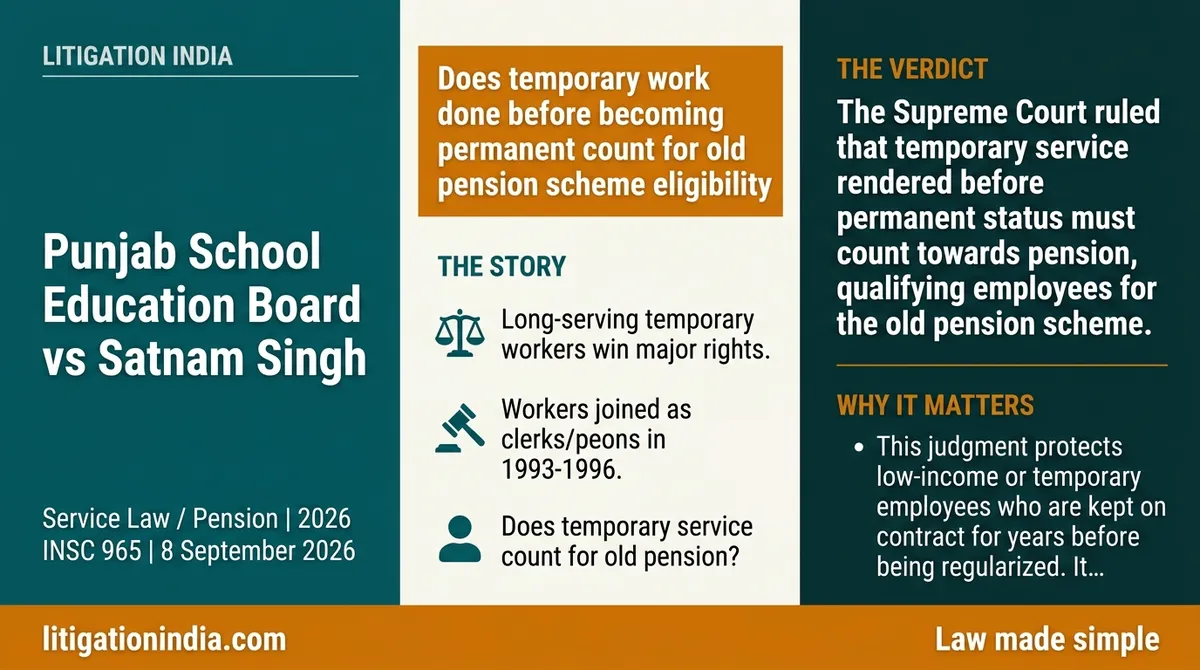
Punjab School Education Board vs Satnam Singh
The big legal question
Does temporary work done before becoming permanent count for old pension scheme eligibility
What this case means
This case decided if temporary or contract service counts toward pension after an employee is made permanent. The Supreme Court ruled that this early service must be counted for the Old Pension Scheme. This ensures long-serving workers do not lose their retirement security due to artificial breaks on paper.
“The Supreme Court ruled that temporary service rendered before permanent status must count towards pension, qualifying employees for the old pension scheme.”
Story Slides
In short
This case was filed by the Punjab School Education Board (PSEB) against its employees who were hired as clerks and peons between 1993 and 1996. Initially, these employees worked on a temporary, ad-hoc, or contract basis. Although they worked continuously, the Board kept giving them short breaks in service on paper to prevent them from claiming permanent status. Finally, in August 2004, the Board regularized their services (made them permanent). After becoming permanent, the employees requested that their temporary service years (from the 1990s to 2004) be counted to calculate their pension. Since their overall service started well before January 1, 2004 (the date when the New Contributory Pension Scheme was introduced), they argued they should be under the Old Pension Scheme (GPF), which is much more beneficial. The Board and the State Government rejected this, saying they were 'newly appointed' in August 2004, after the cutoff date, and must accept the new scheme. The High Court ruled in favor of the employees, and the Board appealed to the Supreme Court. The Supreme Court dismissed the Board's appeal. It held that pension is a deferred wage for past services, not a charity. When an employee has served for a very long time and is ultimately made permanent, the employer cannot use minor technicalities or artificial paper breaks to deny pension. The Court confirmed that the substance of the job matters more than what is written on paper. Since the employees actually started working before 2004, they must be allowed to choose the Old Pension Scheme, and their pre-regularization years must be counted as qualifying service.
Background
Employees were hired on a temporary/contract basis by the Punjab School Education Board between 1993 and 1996. They faced several artificial breaks in service but continued working until they were made permanent in August 2004. The Board refused to count their temporary years for pension and wanted to put them under the New Pension Scheme.
The Decision
The Supreme Court dismissed the Board's appeal and confirmed that the employees' temporary service before 2004 must be counted as qualifying service. They are entitled to choose the beneficial Old Pension Scheme because their actual service started before the 2004 cutoff date.
Why it matters for you
This judgment protects low-income or temporary employees who are kept on contract for years before being regularized. It ensures that employers cannot use technical paper breaks to snatch away their pension and post-retirement security.
Relevant Legal Provisions
Key Acts and sections cited or relied upon in this judgment
“These rules state that pension is calculated based on 'qualifying service' which includes all continuous work without unfair interruptions.”
“These provisions guarantee equal treatment before the law and a dignified life, which includes receiving a fair pension for past services.”
AI-assisted summary, reviewed and verified by our editorial team.
In the Court's words
“pension is neither a bounty nor ex-gratia payment but a payment for the past service rendered.”
“When an employee has rendered long and continuous service, and stands ultimately regularized, denial of pensionary benefits based on technicalities or artificialities is generally unjustified.”
“The breaks in service were either 'notional' or artificial/administrative breaks... They must be ignored and the service should be treated as continuous.”
Need help with your case?
Facing a similar legal challenge in the Supreme Court or High Court? Connect with our pro bono volunteer advocates today.
Related Supreme Court services