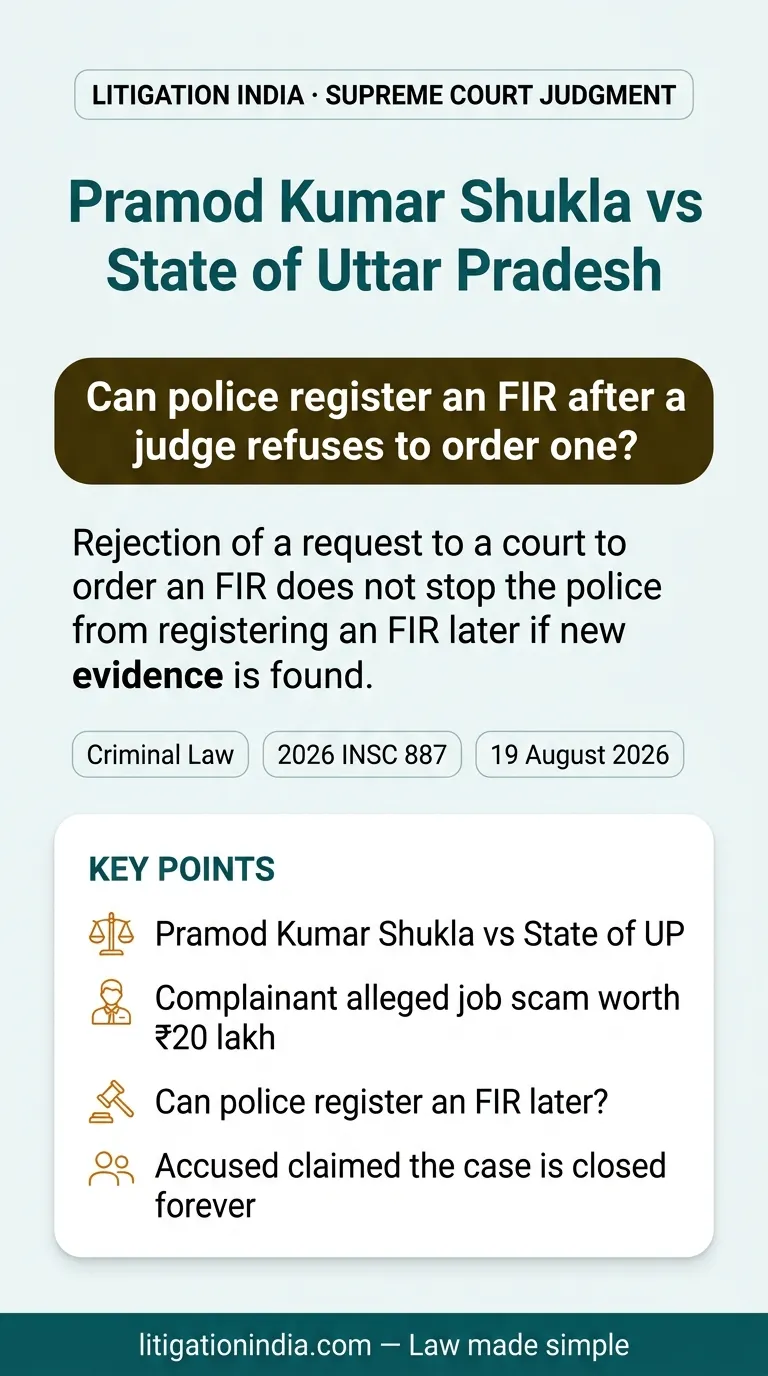
Pramod Kumar Shukla vs State of Uttar Pradesh
The big legal question
Can police register an FIR after a judge refuses to order one?
“Rejection of a request to a court to order an FIR does not stop the police from registering an FIR later if new evidence is found.”
Story Slides
In short
This case decided whether police can register an FIR based on a complaint when a local magistrate had previously rejected an application under Section 156(3) of the Criminal Procedure Code (CrPC) asking for an FIR on similar allegations. The complainant accused the appellant, Pramod Kumar Shukla, of taking Rs 20 lakh under the false promise of securing government clerk jobs for his son and grandson. Initially, the magistrate rejected the complainant's request to order an FIR, relying on a preliminary police report suggesting a land dispute instead. Later, the complainant went directly to the police with fresh evidence, including bank statements, an audio recording, and fake admit cards. The police registered FIR No. 405/2024. The appellant challenged this in the Allahabad High Court, claiming that the magistrate's rejection of the earlier application stopped any future FIR (using the principle of 'res judicata' or finality of decisions). The High Court refused to cancel the FIR. On appeal, the Supreme Court upheld the High Court's decision. It ruled that a magistrate's decision not to order an investigation is not a final trial on merits. Therefore, it does not prevent the police from performing their independent duty to register and investigate an FIR when clear evidence of a serious crime is presented.
Background
The complainant accused Pramod Kumar Shukla of taking Rs 20,00,000 to get clerk jobs for his son and grandson. A local magistrate refused to order an FIR, thinking it was a civil land dispute, but the complainant later went to the police directly with fresh evidence.
The Decision
The Supreme Court dismissed the appeal and refused to quash the FIR. It held that the police have an independent duty to register an FIR and investigate when a cognizable offense is disclosed, even if a magistrate had earlier rejected a petition to order one.
Why it matters for you
It ensures that victims of fraud can still get justice and have their cases investigated by police if they find fresh proof, even if their initial court applications were dismissed at an early stage. It stops criminals from escaping investigation using technical legal loopholes.
AI-assisted summary, reviewed and verified by our editorial team.
Need help with your case?
Facing a similar legal challenge in the Supreme Court or High Court? Connect with our pro bono volunteer advocates today.
Related Supreme Court services