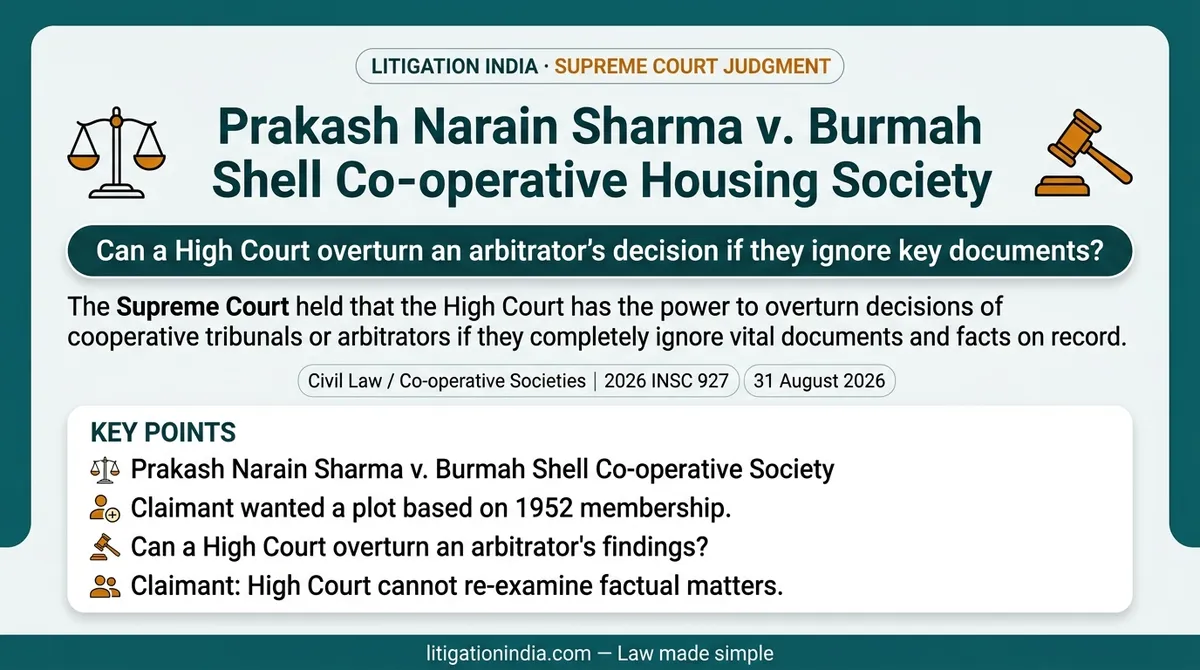
Prakash Narain Sharma v. Burmah Shell Co-operative Housing Society
The big legal question
Can a High Court overturn an arbitrator's decision if they ignore key documents?
“The Supreme Court held that the High Court has the power to overturn decisions of cooperative tribunals or arbitrators if they completely ignore vital documents and facts on record.”
Story Slides
In short
This case arose from a dispute between Prakash Narain Sharma (the legal heir of the original claimant, S.N. Sharma) and the Burmah Shell Co-operative Housing Society regarding the allotment of a residential plot. Sharma claimed his father was a member of the society since 1952. The society, however, maintained that he had resigned from his membership in 1951, and his share was transferred to another person. Although an Arbitrator and the Delhi Co-operative Tribunal ruled in Sharma's favor by assuming he was a member, the Delhi High Court set aside their decisions, pointing out that both authorities ignored key documents showing his resignation and subsequent membership rejections. The main issue before the Supreme Court of India was whether the High Court went beyond its supervisory powers (writ of certiorari under Articles 226 and 227 of the Constitution) by reversing these concurrent findings. The Supreme Court explained that while a High Court's supervisory power is limited and it does not sit as an appeal court to re-weigh all evidence, it has a duty to step in if a lower court's decision is 'perverse'. A decision is perverse and contains an 'error of law' when it is reached without any evidence or by completely ignoring vital written documents. Since the Arbitrator and Tribunal failed to look at clear records showing that Sharma was never accepted as a member after 1951, their decisions were highly flawed. Therefore, the Supreme Court dismissed the appeal and upheld the High Court's order, confirming that Sharma's family is not entitled to any plot allotment.
Background
The original claimant, S.N. Sharma, demanded a residential plot from the housing society, claiming membership since 1952. The society proved he had resigned in 1951 and his subsequent membership applications were rejected, but lower authorities still ruled in his favor based on assumptions.
The Decision
The Supreme Court dismissed the appeal, upholding the High Court's decision. It confirmed that because S.N. Sharma had resigned in 1951 and was never re-admitted, he was not a member and his family has no claim to a plot.
Why it matters for you
This judgment protects organizations and co-operative societies from groundless claims by reinforcing that arbitrators cannot ignore vital written evidence. It also clarifies that High Courts can and must strike down lower-court decisions that are made without supporting proof.
AI-assisted summary, reviewed and verified by our editorial team.
In the Court's words
“The jurisdiction to issue writ of certiorari is supervisory and not appellate.”
“A finding of fact which is not supported by any evidence would be perverse and in fact would constitute an error of law enabling the writ court to interfere.”
Need help with your case?
Facing a similar legal challenge in the Supreme Court or High Court? Connect with our pro bono volunteer advocates today.
Related Supreme Court services