Judicial decisions relying on fake, AI-generated precedents are null and void in the eyes of law
Pooja Ramesh Singh vs Jammu and Kashmir Bank Ltd. & Anr.
The big legal question
Can a judicial decision stand if its reasoning relies on fake, non-existent precedents generated by Artificial Intelligence?
What this case means
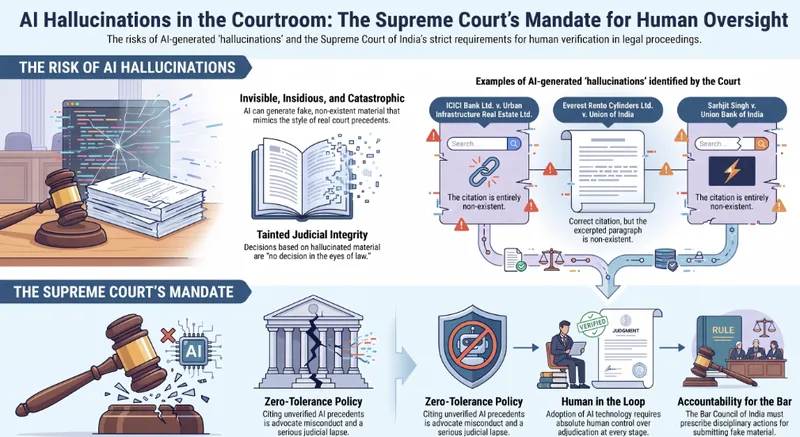
This landmark case addresses the severe threat of AI "hallucinations" in the legal system. The Supreme Court ruled that any judgment relying on fake, AI-generated precedents is a nullity and must be set aside immediately. It establishes a strict zero-tolerance policy for both the Bench and the Bar to preserve judicial integrity
“The Supreme Court rules that any judicial or tribunal decision incorporating fake, AI-generated legal precedents is a nullity and must be set aside.”
Story Slides
In short
In an appeal against NCLT and NCLAT orders, the Supreme Court discovered that the NCLT had relied on six fake, non-existent case precedents in its judgment . These citations were apparently generated via Artificial Intelligence . Holding that a decision tainted by hallucinated material is "no decision in the eyes of law," the Supreme Court set aside both rulings and restored the case to NCLT for fresh, expeditious disposal on its merits . The Court declared a strict zero-tolerance policy for unverified AI-generated content and directed the Bar Council of India to establish guidelines and disciplinary protocols for the Bar
Background
The appellant, Pooja Ramesh Singh, was a suspended director of Essel Infraprojects Ltd. (EIL) . EIL served as the corporate guarantor for loan facilities availed by Pan India Utilities Distribution Company Ltd. (PIUDCL) from Jammu and Kashmir Bank Ltd. (Respondent No. 1) . Upon PIUDCL's default, Respondent No. 1 filed a Section 7 application under the Insolvency and Bankruptcy Code (IBC) before NCLT Mumbai to initiate the Corporate Insolvency Resolution Process (CIRP) against EIL . The NCLT admitted the petition, and the NCLAT subsequently dismissed the appellant's appeal, noting that the corporate guarantee remained valid despite internal corporate adjustments . Crucially, the NCLT's decision relied on six case citations to reject the debtor's contentions—citations that the appellant's senior counsel, Ms. Madhavi Divan, successfully demonstrated were fake and non-existent
The Decision
The Supreme Court set aside the judgments of NCLT and NCLAT and restored the Section 7 IBC application to the NCLT for fresh, expeditious disposal on its merits within two weeks, directing status quo in the interim . The Court held that relying on fake AI-generated precedents subverts the rule of law and renders a decision entirely unsustainable . Declaring a zero-tolerance policy, the Court ruled that even an iota of fake material entering the process invalidates the decision, regardless of whether it had a direct impact on the outcome . Furthermore, the Court directed the Bar Council of India to establish a committee within its body to deliberate on lawyers presenting hallucinated AI precedents and to prescribe strict disciplinary actions for such misconduct
Why it matters for you
This case is a landmark intervention on legal technology regulation. The Court compared AI hallucinations to "the release of methyl isocyanate in the province of law and justice: invisible, insidious, and catastrophic by the time anyone notices" . While supporting technological integration in courts, the ruling firmly asserts that judicial decision-making must maintain "total and absolute control" with a "human in the loop" at every stage . It shifts the direct burden of verifying citations onto both judges and advocates, establishing severe professional and disciplinary consequences for negligence, referencing global warnings like the UK Pinsent Masons AI controversy
Photos
Need help with your case?
Facing a similar legal challenge in the Supreme Court or High Court? Connect with our pro bono volunteer advocates today.
Related Supreme Court services