
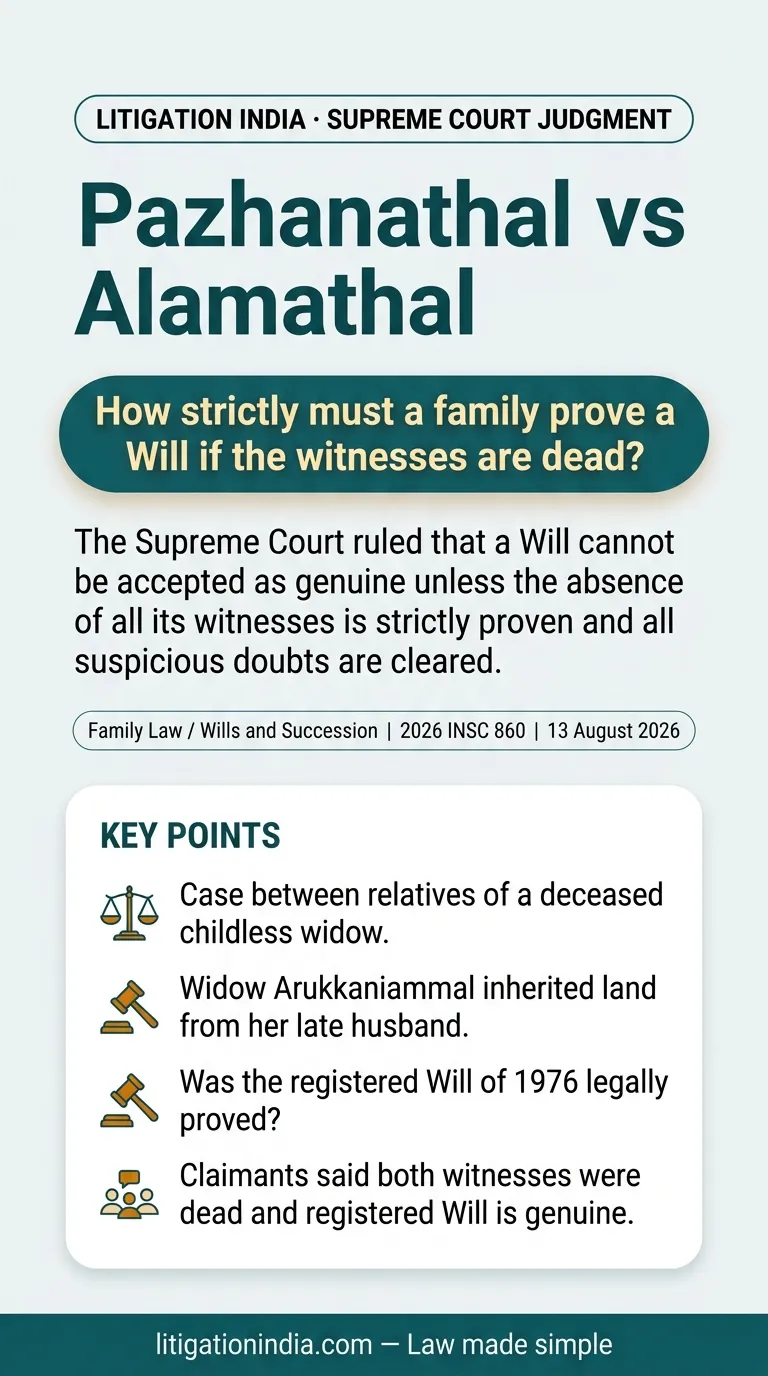
How strictly must a family prove a Will if the witnesses are dead?
Pazhanathal vs Alamathal
Case: Pazhanathal vs AlamathalCitation: 2026 INSC 860Decided on: 13 August 2026
“The Supreme Court ruled that a Will cannot be accepted as genuine unless the absence of all its witnesses is strictly proven and all suspicious doubts are cleared.”
Story Slides
In short
This case involves a dispute over family property left by a childless widow, Arukkaniammal. One side (the appellants) claimed the property should be shared equally among all the daughters of her husband's other wives, as she died without a Will. The other side (the respondents) claimed she left a registered Will giving the entire land to only one branch. Since both witnesses to the Will had allegedly died, the respondents tried to prove the Will using a special legal exception (Section 69 of the Evidence Act) by proving the handwriting of one witness and the widow's thumb impression. The Supreme Court held that the Will was not validly proved. The Court clarified that to use the special exception, the party must first strictly prove that both witnesses are dead or cannot be found. Merely making a statement is not enough. Here, the death of the second witness, Avanashi, was not properly proven. Furthermore, the scribe (the person who wrote the document) cannot be counted as a witness unless he signed with the clear intention of being a witness. Finally, there were too many suspicious details—like incorrect family relationships and wrong property descriptions—that the family failed to explain. Therefore, the property must be divided among all heirs of the husband.
Need clarity on a similar legal issue?
Request free pro bono guidance from a Supreme Court Advocate.
Background
A childless widow inherited property from her husband. After her death, some relatives claimed she left her land to them through a Will, while others argued she died without a Will and the property should be shared among all family branches.
The Decision
The Supreme Court set aside the High Court's order and restored the trial court's judgment. It declared the Will invalid because the death of one witness was not proven, the scribe was not a valid witness, and key suspicious doubts were never cleared.
Why it matters for you
This judgment teaches us that registering a Will does not automatically make it genuine in court. If you rely on a Will, you must carefully preserve proof of its execution and be ready to strictly prove that your witnesses are unavailable if they pass away.
AI-assisted summary, reviewed and verified by our editorial team.
Need help with your case?
Facing a similar legal challenge in the Supreme Court or High Court? Connect with our pro bono volunteer advocates today.
Related Supreme Court services