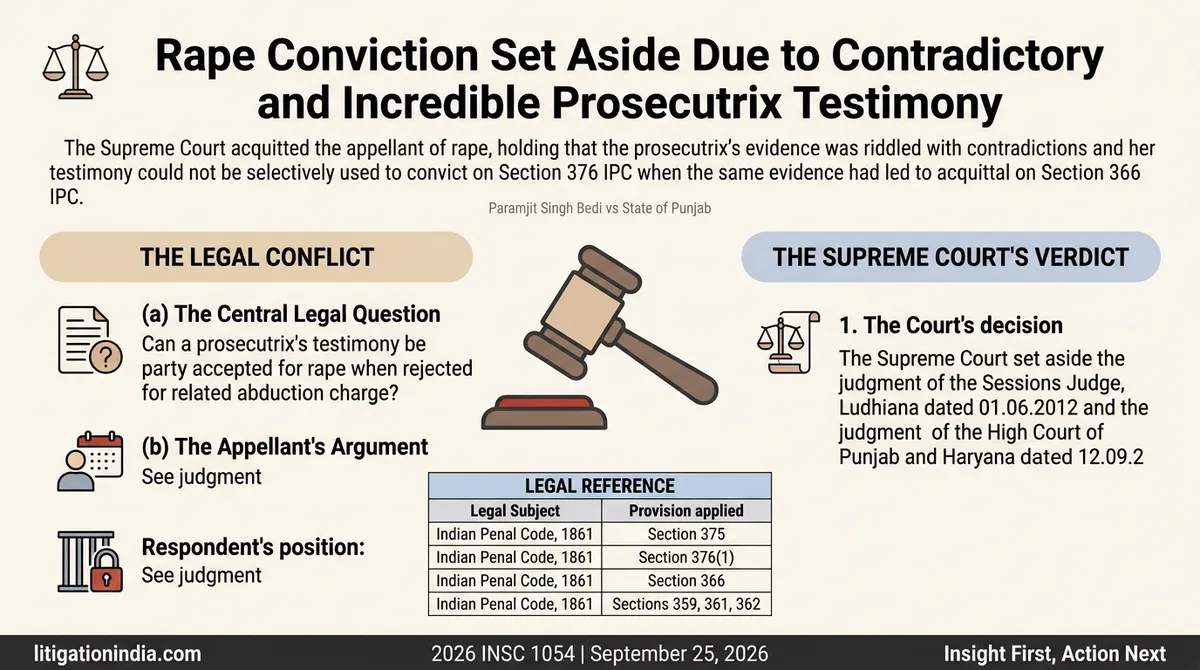
Full text of the judgment
Text extracted from Paramjit Singh Bedi vs State of Punjab. For the authoritative version refer to the Supreme Court of India's official website.
2026 INSC 1054 1
IN THE SUPREME COURT OF INDIA CRIMINAL APPELLATE JURISDICTION
CRIMINAL APPEAL NO. 203 OF 2015
PARAMJIT SINGH BEDI …APPELLANT(S)
VERSUS STATE OF PUNJAB
....RESPONDENT(S) J U D G M E N T
UJJAL BHUYAN, J.
This appeal is directed against the judgment and order dated 12.09.2013 passed by the High Court of Punjab and Haryana at Chandigarh (briefly ‘the High Court’ hereinafter) dismissing the criminal appeal filed by the appellant and affirming the judgment and order dated 01.06.2012 passed by the learned Sessions Judge, Ludhiana convicting the appellant under Section 376 of the Indian Penal Code, 1861 (‘IPC’ for short) and sentencing him to undergo rigorous imprisonment (RI) for a period of 10 years and to pay fine of Rs. 5,000.00 with a default stipulation. Digitally signed by ABHINAV KUMAR Date: 2026.09.25 11:52:14 IST Reason: Signature Not Verified
Relevant facts may be briefly noted. 3.
According to the prosecution, the prosecutrix PW-1 is the daughter of Ranjit Singh, PW-2. At the relevant point of time, she was studying in class VIII in the Government High School, Manjit Nagar, Ludhiana. 3.1. On 19.06.2009 at around 07:30 PM, PW-1 left her house to buy some kirana articles from the neighbourhood shop. On her way, she was accosted by the appellant who told her that he wanted her to meet his daughter Nancy. As Nancy was a friend of PW-1, she agreed to the proposal. Appellant made her sit in his Maruti car where two boys were already sitting. 3.2. Appellant took PW-1 in the vehicle to the LIG Flats, Ludhiana. From there, the said two boys came back in the car. 3.3. According to PW-1, the appellant kept her in the flat for two days where he had sexual intercourse with her against her will. On 22.06.2009, appellant took PW-1 to Malerkotla on his scooter where he kept her confined in a room in an abandoned factory. According to PW-1, there also appellant had
sexual intercourse with her against her will. When she objected, appellant threatened to kill her. 3.4. On 25.06.2009, the appellant came back to Ludhiana with PW-1 on train. From the railway station, appellant took PW-1 through Railway Colony No. 5 on foot. There they were intercepted by PW-2 (father of PW-1) and police officials. Though the appellant tried to flee, the police officials overpowered and apprehended him. 3.5. Thereafter, FIR No. 142/2009 was registered before Ludhiana Division No. 5 police station under Sections 363, 366A and 376 IPC. 4.
On completion of investigation, police filed chargesheet against the appellant under Sections 366 and 376 IPC. 5.
In the trial, prosecution examined 11 witnesses whereafter statement of the appellant as the accused was recorded under Section 313 of the Code of Criminal Procedure, 1973 (Cr.P.C.).
At the end of the trial, learned Sessions Judge Ludhiana came to the conclusion that the prosecution had failed to prove the charge under Section 366 IPC. Accordingly, appellant was given the benefit of doubt and was acquitted of the charge framed under Section 366 IPC. In so far the charge under Section 376 IPC is concerned, learned Sessions Judge held that the prosecution was able to prove beyond reasonable doubt that the accused (appellant herein) had sexual intercourse with PW-1 against her will. Hence the accusedappellant was held guilty of committing an offence under Section 376 IPC. 6.1. Vide the judgment and order dated 01.06.2012, learned Sessions Judge convicted the appellant under Section 376 IPC and sentenced him to undergo RI for a period of 10 years and to pay fine of Rs. 5,000.00 with a default stipulation. 7.
As noted supra, appellant assailed his conviction and sentence before the High Court in Criminal Appeal No. 2009-SB of 2012. Vide the judgment and order dated 12.09.2013, the High Court dismissed the appeal and affirmed the conviction
and sentence of the appellant passed by the learned Sessions Judge. 8.
This Court issued notice on the special leave petition as well as on the prayer for bail on 28.02.2014. By the subsequent order dated 30.01.2015, leave was granted and taking note of the fact that appellant had already undergone incarceration for almost 6 years out of the total period of 10 years, he was ordered to be released on bail. 9.
Mr. Rajiv Kataria, learned counsel for the appellant submits that both the trial court and the High Court failed to appreciate that appellant was falsely implicated because there were existing civil dispute(s) between the parties. PW-2 i.e. father of PW-1 had borrowed Rs.1,50,000.00 from the appellant but did not return the same. When the appellant insisted for return of the money, he was threatened that he would be implicated in some criminal case. 9.1. Appellant was a tenant of the premises belonging to one Major Singh, who is a close relative of PW-2. When PW-2 wanted to distance himself from Major Singh by saying that he
was not his relative, his own sister, PW-3 Sarabjit Kaur, admitted in evidence that Major Singh is a relative. There is a civil suit going on between the appellant and Major Singh over the tenanted premises. Therefore, appellant has been falsely implicated in the criminal case by PW-2. 9.2. Learned Sessions Judge had returned clear findings that the prosecutrix PW-1 was a major during the period when the alleged incident had occurred and that it was neither a case of kidnapping nor abduction. Therefore, appellant was acquitted of the charge under Section 366 IPC. This finding of the learned Sessions Judge has neither been challenged by the informant nor by the State. It has thus attained finality. 9.3. When the trial court accepted the contention advanced on behalf of the defence that the prosecutrix was with the appellant firstly at the LIG Flats in Ludhiana for two days from 19.06.2009 till 22.06.2009, then proceeded to Malerkotla on scooter and stayed there upto 25.06.2009 without the prosecutrix raising any hue and cry or alarm, learned Sessions Judge went completely wrong in drawing adverse inference of
commission of rape by the appellant on the prosecutrix on the same set of evidence. That apart, during the train journey on 25.06.2009 from Malerkotla to Ludhiana also, the prosecutrix did not raise any alarm. In such circumstances, the trial court committed a grave error in convicting the appellant under Section 376 IPC. The High Court also completely overlooked this aspect of the matter in affirming such conviction. 9.4. Learned counsel submits that from the facts and circumstances of the case it is evident that the prosecutrix was a consenting party. That apart, the medical evidence did not disclose signs of any injury suffered by the prosecutrix because of alleged forceful intercourse by the appellant; as per the medical evidence, no internal or external injury was found on the person of the prosecutrix. 9.5. To buttress his above submission that prosecutrix was a consenting party, learned counsel submits that as per the prosecution itself clothes of the prosecutrix were recovered from the dicky of the scooter which clearly goes to show that the prosecutrix came out of her home well prepared to stay outside
for a couple of days and the consenting nature of the occurrence. 9.6. That being the position, learned counsel submits that the trial court committed a manifest error in convicting the appellant under Section 376 IPC and the High Court also mechanically affirmed the conviction, thereby causing serious miscarriage of justice. 9.7. In these circumstances, he submits that the conviction and sentence imposed on the appellant, as affirmed by the High Court, may be set aside and the appellant be acquitted of the charge of committing an offence under Section 376 IPC. 10. On the other hand, Ms. Nupur Kumar, learned counsel for the State of Punjab submits that conviction of the appellant under Section 376 IPC is fully justified and no interference is called for. 10.1. From the evidence tendered by the prosecution, it is fully established that appellant had subjected the prosecutrix to sexual intercourse without her consent. Therefore, the
learned trial court has rightly convicted the appellant for the said offence which has also been affirmed by the High Court. 10.2. She also submits that as per the school certificate, the age of the prosecutrix on the day of occurrence was about 15 years. Therefore, subjecting the prosecutrix, being a minor, to sexual intercourse with or without her consent is immaterial. This fact has been duly considered by the High Court. That apart, the appellant could not discharge the burden of presumption under Section 114A of the Evidence Act, 1872. 10.3. She therefore submits that there is no merit in the appeal which is liable to be dismissed. 11. Submissions made by learned counsel for the parties have received the due consideration of the Court. We have also perused the materials on record including the evidence tendered. 12. Though the learned Sessions Judge had acquitted the appellant of the charge under Section 366 IPC, since the two charges i.e. charge under Section 366 IPC and charge under Section 376 IPC, as it stood then, are intricately connected in
the factual matrix of the case, it would be apposite to deal with the scope and ambit of Section 366 IPC as well. Section 366 IPC is extracted hereunder: 366. Kidnapping, abducting or inducing woman to compel her marriage, etc. - Whoever kidnaps or abducts any woman with intent that she may be compelled, or knowing it to be likely that she will be compelled, to marry any person against her will, or in order that she may be forced or seduced to illicit intercourse, or knowing it to be likely that she will be forced or seduced to illicit intercourse, shall be punished with imprisonment of either description for a term which may extend to ten years, and shall also be liable to fine; and whoever, by means of criminal intimidation as defined in this Code or of abuse of authority or any other method of compulsion, induces any woman to go from any place with intent that she may be, or knowing that it is likely that she will be, forced or seduced to illicit intercourse with another person shall be punishable as aforesaid.
12.1. Thus, as per Section 366 IPC, whoever kidnaps or abducts any woman with the intent to compel her to marry any person against her will or for the purpose of forcing or seducing her to illicit intercourse would fall foul of Section 366 IPC and would suffer punishment of imprisonment of either description
for a term which may extend to 10 years and shall also be liable to pay fine. So, there are two expressions here: kidnapping and abduction. 12.2. Kidnapping is defined in Section 359 IPC. In this case, we are concerned with kidnapping from lawful guardianship which is dealt with in Section 361 IPC. It says that whoever takes or entices any minor under 16 years of age, if a male, or under 18 years of age, if a female, or any person of unsound mind, out of the keeping of the lawful guardian of such minor or person of unsound mind without the consent of such guardian is said to kidnap such minor or person from lawful guardianship. 12.3. On the other hand, abduction is defined in Section 362 IPC which says that whoever by force compels or by any deceitful means induces any person to go from any place is said to abduct that person. 12.4. Therefore, it will be a case of kidnapping in the case of a female if she is under 18 years of age if she is taken or enticed away from her lawful guardian without the consent of
such guardian. On the other hand, it will be abduction if a person applies force or deceitful means to compel or induce any person to go from any place. 13. Section 376 IPC had undergone major amendment in 2013. The incident or series of incidents with which the present appeal is concerned relates to the period from 19.06.2009 to 25.06.2009. Therefore, Section 376 as it stood prior to 2013 would be applicable. Section 376 (1), as it stood prior to its amendment in 2013, reads as under: 376. Punishment for rape. – (1) Whoever, except in the cases provided for by sub-section (2), commits rape shall be punished with imprisonment of either description for a term which shall not be less than seven years but which may be for life or for a term which may extend to ten years and shall also be liable to fine unless the women raped is his own wife and is not under twelve years of age, in which cases, he shall be punished with imprisonment of either description for a term which may extend to two years or with fine or with both:
Provided that the court may, for adequate and special reasons to be mentioned in the judgment, impose a sentence of imprisonment for a term of less than seven years.
13.1. Rape is defined in Section 375. Prior to 2013, as per Section 375, a man is said to commit rape except in the cases excepted if he has sexual intercourse with a woman under the circumstances falling under any of the six descriptions mentioned thereunder. Basically, as per the descriptions, sexual intercourse with a woman has to be against her will; without her consent; by obtaining her consent under fear or duress etc. including with or without her consent when the woman is under 16 years of age. 14. Let us now examine the evidence of the prosecutrix. 15. In her evidence-in-chief, PW-1 prosecutrix stated that she was a student of class VIII and that she knew Paramjit Singh Bedi, the accused-appellant who used to visit their house. Earlier, he was residing in their neighbourhood. His daughter Nancy was her friend. 15.1. On 19.06.2009, at about 07:30 PM, she had gone out to purchase some kirana articles. On way, she was accosted by the appellant who was accompanied by two unidentified boys. Appellant told her that he would like her to meet his daughter
Nancy. Appellant took PW-1 in a car to the LIG Flats at Ludhiana. The two boys came back in the car. Appellant kept her (PW-1) in the said flat for two days. On 22.06.2009, the appellant took her on his scooter to an abandoned factory in Malerkotla. There, he kept her in a room and committed rape on her. According to PW-1, she was kept in that room upto 25.06.2009. When she objected to the acts of the appellant, he threatened to kill her. According to PW-1, during this period upto 25.06.2009 no one came to the room. 15.2. Appellant brought PW-1 back to Ludhiana from Malerkotla in a car on 25.06.2009. When they reached Railway Colony No. 5 at Ludhiana, a police party alongwith the father of PW-1 (PW-2) were present and they apprehended the two. Appellant tried to flee. In the process, he fell down and received injuries. 15.3. In her cross-examination, PW-1 stated that she was enlisted as a voter but she had no voter card. She further stated that she had gone to purchase ration from the kirana shop after taking Rs. 5.00 only from her sister Poonam. She could not tell
the number and colour of the car in which she was allegedly taken by the appellant. She also could not tell the names of the two persons who allegedly accompanied the appellant in the car. Strangely enough, she stated that she could not remember the date, month and the year in which the case was registered against the appellant. 15.4. In her cross-examination, she stated that as she was going in the car to the LIG Flats, there was rush in the bazaars; there were many intersections on the way which were brightly lit. 15.5. She further stated that appellant took her to Malerkotla on 25.06.2009 on a scooter. Appellant was driving the scooter and she was the pillion rider. There was rush on the road. They crossed many intersections on their way from Ludhiana to Malerkotla which were brightly lit. She did not try to get down from the scooter whenever the scooter was stopped by the appellant on those intersections; neither did she try to run away. She also did not raise any hue and cry. The journey from Ludhiana to Malerkotla took about one and a half hours.
15.6. PW-1 contradicted herself when she stated that she and appellant came back from Malerkotla to Ludhiana on 25.06.2009 on a train which they had boarded at the railway station in Malerkotla. Both of them travelled ticketless. There was rush in the said train with passengers in the compartment in which they were travelling. She stated that she did not disclose about the occurrence to any of the passengers who were sitting near her in the train. She did not raise any hue and cry. She requested the appellant to drop her home. She reached home on 25.06.2009 whereafter she never visited Malerkotla again. This is in complete contradiction to what she had deposed in her examination-in-chief where she had stated that they (she and the appellant) had come back from Malerkotla to Ludhiana in a car and at Railway Colony No. 5 they were apprehended. If this is accepted, what happened to the scooter? 15.7. Interestingly, in her long cross-examination, PW-1 stated that while she was in the one room at Malerkotla, she had raised hue and cry but there was nobody to hear her shouts. She admitted that appellant was residing in her
neighbourhood on rent in the house of Major Singh. Appellant was not paying rent to Major Singh for which a case was pending. All the persons of the locality were aware about the case. PW-1 stated that she knew the appellant for the last about one year. 16. We will analyze the evidence of PW-1 the prosecutrix more in detail a little later. In the meanwhile, let us see what the medical evidence stated. 17. PW-6 is Dr. Hatinder Kaur, Medical Officer (Radiologist) in the Civil Hospital, Ludhiana. She had conducted the ossification test on PW-1 for age determination. She opined that the radiological age of PW-1 was between 17 to 19 years. She had prepared the original report which she proved. In her cross-examination, she stated that there could be variation of two years of age. Though the patient (PW-2) has disclosed her age to be 15 ½ years, she had not seen any document regarding the age of the patient. She finally stated in her crossexamination that PW-2 may be more than 18 years of age but less than 19 years of age at the time of her examination.
18. Lastly, we may examine the evidence of PW-7 Dr. Ananjit Kaur, who served as the Medical Officer in the Civil Hospital at Ludhiana. She stated that on 26.06.2009, she had examined PW-1. She found no external mark of injury on her body. She had her menarche three years back. 18.1. In her cross-examination, she stated that she did not see any document of PW-1 regarding her birth or age. Therefore, she had sent her for ossification test for the purpose of age determination. She reiterated that there was no external injury mark on the body of the prosecutrix and that there was no injury on her private parts as well. 19. Let us now examine how the trial court dealt with the charge under Section 366 IPC. 20. Learned Sessions Judge observed that the charge punishable under Section 366 IPC in the context of the present case is two-fold: (a) Kidnapping of any woman to marry her off to any person against her will or that she may be forced or seduced to illicit intercourse;
(b) Abduction of a woman with intention to marry her off to any person against her will or that she may be forced or seduced to illicit intercourse. 20.1. Learned Sessions Judge proceeded thereafter by observing that in order to prove kidnapping, the prosecution had to prove that on the day the prosecutrix was kidnapped, she was less than 18 years of age. After examining the documentary evidence exhibited as well as the oral testimony of the informant PW-2, PW-3 (Sarabjit Kaur, aunt of the prosecutrix) and PW-11 (Swaran Kaur, ex-Head Mistress of the school), learned Sessions Judge came to the conclusion that the oral and documentary evidence failed to prove beyond reasonable doubt that the date of birth of the prosecutrix is 13.03.1994 which was the case of the prosecution. Thereafter, learned Sessions Judge examined the deposition of PW-6, Dr. Hatinder Kaur who had carried out the ossification test on the prosecutrix and opined that age of the prosecutrix was between 17 to 19 years at the material time. Learned Sessions Judge accepted the age of the prosecutrix to be 19 years.
20.2. Therefore, the learned Sessions Judge held that the prosecution failed to prove that the age of the prosecutrix at the material time was less than 18 years. Hence, the accusedappellant could not be held guilty of the offence of kidnapping. 20.3. Insofar abduction is concerned, learned Sessions Judge after examining the evidence tendered by the prosecutrix (PW-1) opined that it is doubtful if the accused ever took the prosecutrix to any place without her consent. Learned Sessions Judge noticed that when the prosecutrix was taken to the LIG Flats at Ludhiana in the car, there was rush in the bazaars with many intersections on the way which were brightly lit. Again, as per the prosecutrix herself, she was taken to Malerkotla from Ludhiana on a scooter by the accused. After closely examining her evidence, learned Sessions Judge observed that it is apparent that if the prosecutrix had not consented to accompanying the accused-appellant to the places under reference, she could easily has disembarked the scooter on their journey to Malerkotla from Ludhiana when the scooter was stopped at several places due to rush of people. When she
herself stated that when was confined in the room, she had raised hue and cry, therefore, when she was being taken on the scooter through the crowded streets and she did not raise any alarm, it raises a serious question mark over the credibility of the version of the prosecutrix. Therefore, learned Sessions Judge held that had she not consented to accompanying the accused, she could have easily run away from him. The fact that she did not do so only strengthened the views of the learned Sessions Judge that her consent in accompanying the accusedappellant was not missing. In the circumstances, learned Sessions Judge held that the prosecution had miserably failed to prove that the accused was guilty of the offence under Section 366 IPC and accordingly he was acquitted of the charge framed under Section 366 IPC. 21. In our view, the analysis and findings of the learned Sessions Judge, insofar the charge under Section 366 IPC is concerned, stand to reason. Such observations and findings of the learned Sessions Judge were neither challenged by the State nor by the informant before the High Court. Therefore, such
observations and findings of the learned Sessions Judge qua Section 366 IPC against the appellant has attained finality. 22. After rightly disbelieving the testimony of the prosecutrix PW-1 insofar the charge under Section 366 IPC against the appellant is concerned, surprisingly learned Sessions Judge held that as regards the charge under Section 376 IPC is concerned, the prosecution was able to prove beyond reasonable doubt that the accused-appellant had raped the prosecutrix. In this regard, learned Sessions Judge referred to the evidence of the prosecutrix and noted with approval that when she was in the room at Malerkotla, she had raised hue and cry but there was nobody around to hear her cries. PW-2, her father, deposed that his daughter PW-1 had gone missing during the material time and was recovered from the company of the accused-appellant on 25.06.2009. Reference was also made to the evidence of PW-3 Sarabjit Kaur, aunt of PW-1, who stated that around the time PW-1 went missing, she saw her in the company of the accused-appellant. Adverting to the testimony of Dr. Ananjit Kaur, PW-7, learned Sessions Judge
held that the medical report showed presence of spermatozoa on the vagina of PW-1. Applying the theory of last seen together, learned Sessions Judge came to the conclusion that when all the circumstances are put together, it becomes abundantly clear that the version of PW-1 that she was raped by the accused-appellant is true. 22.1. Learned Sessions Judge then put a question to himself with regard to his findings as regards Section 366 IPC that on the one hand he took the view that the prosecutrix who as a major had gone with the accused-appellant willingly and then when it came to Section 376 IPC, he accepted the version of the prosecutrix PW-1 that she was raped by the accusedappellant. Observing that such findings may appear to be contradictory, he was however of the view that such contradiction was not improbable. Thereafter, he explained on the basis of his own value judgment that ‘some daring women also choose to travel to far off places in the company of men’. According to him, agreeing to accompany a man and even
agreeing to spending a night with him, yet not consenting to have sex with him is possible. 23. We are afraid the learned Sessions Judge has gone completely wrong while justifying the conviction of the accusedappellant under Section 376 IPC. The High Court also fell in error in accepting such convoluted logic. High Court adverted to Section 114A of the Evidence Act, 1872 and held that when the prosecutrix had denied being a consenting party, presumption has to be drawn that she did not consent to sexual intercourse. 24. Let us now analyze the evidence of the prosecutrix, PW-1. As noticed supra is noticed, PW-1’s version is a bundle of contradictions. In her cross-examination, she had stated that she had come out of her house at around 07:30 PM to purchase some articles from the nearby kirana shop. For that, she had taken Rs. 5.00 from her sister Poonam. She went with the appellant in a car to the LIG Flats at Ludhiana where they stayed for two days. From there, they went to Malerkotla on 22.06.2009 on a scooter. They stayed in an abandoned factory
at Malerkotla. They had passed through bazaars and brightly lit intersections, particularly when they travelled on a scooter. No alarm was raised by PW-1. As noticed by the learned Sessions Judge, she also did not disembark from the scooter. If at all she was kept confined by the appellant against her wishes, she should have raised hue and cry or alighted from the scooter seeking help from the crowd. She did neither. Therefore, her statement that she had raised hue and cry in the flat at Malerkotla does not make any sense. In the absence of any such hue and cry made by her on the streets and intersections while travelling, learned Sessions Judge rightly held that PW-1 had accompanied the appellant on her own volition; there was no compulsion. In their return journey from Malerkotla to Ludhiana, her statements are contradictory. In her evidence in chief, she stated that she and the appellant had come back by car but in her cross-examination, she stated that the two of them travelled back on a train, travelling ticketless. Either way, no hue and cry was raised by PW-1 in the entire journey back. This is unbelievable. Therefore, the testimony of the prosecutrix cannot be said to be credible and worthy of acceptance.
25. From an analysis of the evidence of the prosecutrix PW-1, it is evident that she had willingly accompanied the accused-appellant firstly to the LIG Flats at Ludhiana by travelling in a car, stayed there for two days, and then travelling in a scooter with the accused-appellant from Ludhiana to Malerkotla. Despite passing through busy streets and intersections, she did not raise any hue and cry. Neither did she make any attempt to alight from the scooter to escape from the accused-appellant. Learned Sessions Judge rightly pointed out that if she had not voluntarily gone with the accused-appellant, she could have easily raised a hue and cry or disembarked from the scooter. PW-1 did not do so. Therefore, her statement that she had raised hue and cry when she was in the room at Malerkotla is extremely difficult to accept. Her evidence is riddled with contradictions. Mere presence of spermatozoa in the vaginal swab of the prosecutrix would not prove rape given the surrounding circumstances. 26. Prosecutrix’s denial of consent must be seen in the overall context of her testimony. If her evidence is taken as a whole,
certainly a view can be taken that her version that the accusedappellant had sexual intercourse with her forcibly without her consent does not merit acceptance. The version of the prosecutrix is not believable at all. 27. While the example given by the learned Sessions Judge that a lady may travel with a man to a far-off place and even spend a night with him but may not consent to having sex with him (though the use of the word ‘daring’ prefixing ‘women’ is totally uncalled for) may be true, the context is different. In the present case, PW-1, the prosecutrix, had absented herself from home for 5/6 days, only to travel all around with the accused-appellant voluntarily and stayed with him. It is therefore difficult to accept that accused-appellant had forcible intercourse with PW-1 without her consent. 28. While it is true that on the basis of the sole testimony of the prosecutrix, an accused can be convicted of rape but for such a conviction, it would also require that such statement of the prosecutrix must inspire the confidence of the court. There cannot be partial rejection of the evidence of the prosecutrix for
the purpose of Section 366 IPC and partial acceptance of the very same statement for the purpose of proving the charge under Section 376 IPC. If the evidence of the prosecutrix is of unimpeachable character, it has to be accepted in its entirety. There cannot be part acceptance and part rejection of the statement of the prosecutrix. It is for this reason that we had analysed the materials for record qua the charge under Section 366 IPC though the accused-appellant was acquitted of the said charge considering its inter-twinedness with the charge under Section 376 IPC. 29. When the learned Sessions Judge had disbelieved the prosecution version insofar the charge under Section 366 IPC is concerned, the very same prosecution version could not have been accepted to convict the accused-appellant under Section 376 IPC. While the conduct of the appellant may be immoral and unethical, that by itself would not justify a conviction under Section 376 IPC without any clinching evidence. Such a charge must be proved on the basis of hard evidence and not on the basis of the surmises and conjectures based on the value
judgment of the presiding judge. Immorality of an act sans credible evidence cannot justify a conviction. 30. For all the aforesaid reasons, the conviction and sentence of the appellant under Section 376 IPC by the learned Sessions Judge and affirmed by the High Court cannot be sustained. Consequently, we set aside the judgment and order dated 01.06.2012 passed by the learned Sessions Judge, Ludhiana as well as the judgment and order dated 12.09.2013 passed by the High Court of Punjab and Haryana. Resultantly, the appellant is cleared of the charge under Section 376 IPC. 31. Criminal Appeal is accordingly allowed.
…...…………………………J.
[UJJAL BHUYAN]
…..….………………………J. [ATUL S. CHANDURKAR]
NEW DELHI; SEPTEMBER 25, 2026.