Parag Kishore Satoskar vs State of Jharkhand
The big legal question
Can you file a cheating case for a business contract dispute?
“The Supreme Court ruled that a normal business dispute over money or goods cannot be turned into a criminal case of cheating or breach of trust.”
Story Slides
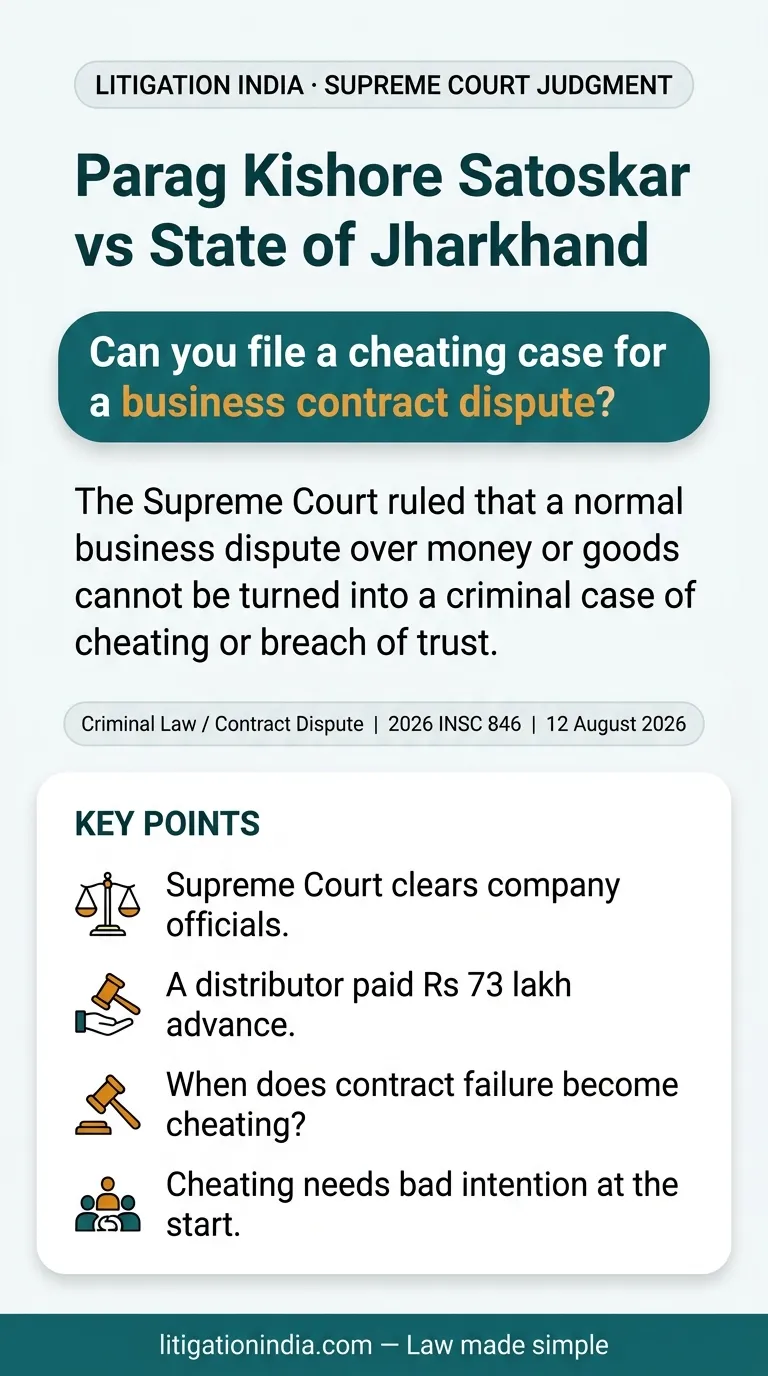
In short
The Supreme Court of India cleared five officials of a camphor manufacturing company of criminal charges, emphasizing that business disputes should not be converted into criminal cases. A distributor in Jharkhand had filed a police complaint (FIR) accusing the company officials of cheating and criminal breach of trust under the new Bharatiya Nyaya Sanhita, 2023 (BNS). The distributor claimed he paid an advance of Rs 73 lakh, but the company only supplied goods worth about Rs 31.5 lakh and refused to return the remaining Rs 41.5 lakh after a dispute arose over prices. The High Court refused to cancel the FIR, so the company officials appealed to the Supreme Court. The Supreme Court explained that for 'cheating' to occur, there must be a dishonest intention from the very start of the business deal. In this case, the company had actually supplied a large portion of the goods, which showed they intended to fulfill the contract initially. Additionally, the court stated that advance money paid for goods belongs to the supplier under a contract and cannot be called 'entrusted property,' which rules out 'criminal breach of trust.' The Court called the criminal case an abuse of the legal system and ruled that the distributor should have filed a civil lawsuit for his money instead of using the police to pressure the company. Consequently, the Supreme Court cancelled the FIR.
Background
A distributor paid Rs 73 lakh advance to a camphor company, but the company stopped supply after a price dispute and did not return Rs 41.5 lakh. The distributor then filed a criminal police complaint (FIR) for cheating against the company's directors and staff.
The Decision
The Supreme Court cancelled the FIR against the company officials. It held that the dispute was purely commercial in nature, and using criminal law to recover business dues is an abuse of the court's process.
Why it matters for you
This judgment protects business owners and managers from being dragged into criminal cases over simple contract breaches or price disputes. It clarifies that a failure to return advance money is a civil matter, not a police case.
AI-assisted summary, reviewed and verified by our editorial team.
Need help with your case?
Facing a similar legal challenge in the Supreme Court or High Court? Connect with our pro bono volunteer advocates today.
Related Supreme Court services