
Can the government regulator force teacher training colleges to submit annual performance reports?
NCTE vs. Association of NCTE Approved Colleges Trust
Case: NCTE vs. Association of NCTE Approved Colleges TrustCitation: 2026 INSC 953Decided on: 3 September 2026
“The Supreme Court ruled that the National Council for Teacher Education (NCTE) has the legal authority to mandate teacher training colleges to submit annual performance appraisal reports and pay a processing fee.”
Story Slides
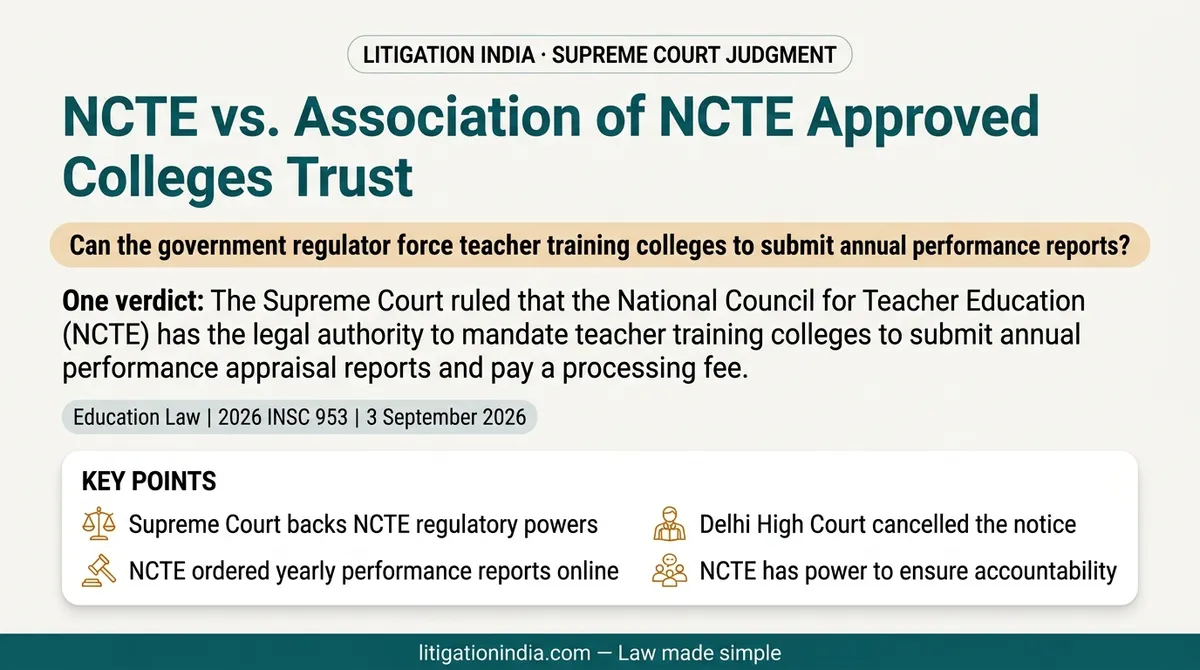
In short
This case involves the regulatory powers of the National Council for Teacher Education (NCTE). Under the National Council for Teacher Education Act, 1993, and in line with the Right to Education (RTE) Act, 2009, the NCTE issued an important public notice in September 2019. This notice directed all Teacher Education Institutions (TEIs)—which are colleges that train schoolteachers—to mandatorily submit an annual Performance Appraisal Report (PAR) online. It also required a processing fee of Rs. 5,000 for government colleges and Rs. 15,000 for private colleges. The training colleges challenged this requirement in court, arguing that the Member Secretary of the NCTE’s Executive Committee did not have the proper legal authority to issue such a notice. The Delhi High Court agreed with these colleges and cancelled the notice, calling it unauthorized and invalid. However, the Supreme Court completely reversed this decision. The Supreme Court explained that under Section 12(k) of the NCTE Act, the Council has broad regulatory powers to set up performance appraisal systems to enforce accountability on these institutions. The Court held that the Executive Committee and its Member Secretary are the active administrative hands of the Council, fully empowered to implement Council decisions. Ensuring quality teacher education is closely linked to children's fundamental right to free education. Therefore, asking for annual performance reports and a reasonable fee is an essential, incidental, and valid part of the regulator's duty to ensure high standards and transparency across all teacher training colleges.
Need clarity on a similar legal issue?
Request free pro bono guidance from a Supreme Court Advocate.
Background
In 2019, the NCTE issued a public notice asking all teacher training colleges to submit an annual performance report and pay a fee to ensure they are meeting proper standards. The colleges challenged this in court, arguing that the official who issued the notice did not have the proper authority. The Delhi High Court agreed with the colleges and cancelled the notice, prompting the NCTE to appeal to the Supreme Court.
The Decision
The Supreme Court allowed the appeal and declared the NCTE's public notice completely legal and valid. The Court ruled that both the Council and its Executive Committee have full authority to demand performance reports and processing fees from training colleges to maintain education standards.
Why it matters for you
This judgment ensures that institutions training our future schoolteachers remain highly accountable and strictly regulated. It prevents private colleges from avoiding standards and highlights that children's right to quality education depends on well-monitored teacher training colleges.
AI-assisted summary, reviewed and verified by our editorial team.
In the Court's words
“The Council as well as the Executive Committee is within its jurisdiction to call TEIs to upload Performance Appraisal Report.”
“Accountability in itself is an essential principle of administrative law.”
“Courts cannot adopt a technical or a pedantic view of the action taken by the regulators.”
Need help with your case?
Facing a similar legal challenge in the Supreme Court or High Court? Connect with our pro bono volunteer advocates today.
Request Free Callback