Personal guarantors are bound by arbitration if loan agreements link them together
National Skill Development Corporation v. Surya Wires Private Limited & Ors.
The big legal question
Can a personal guarantor be dragged into arbitration if their guarantee lacks an arbitration clause?
What this case means
This case decides if a personal guarantor can be pulled into arbitration during a dispute. The Supreme Court ruled that when loan papers and guarantees are closely linked as one main transaction, the guarantor is bound. This helps common people resolve multi-party commercial disputes quickly in one single forum.
“The Supreme Court ruled that a personal guarantor is bound by the main loan agreement's arbitration clause if both agreements form a single transaction.”
Story Slides
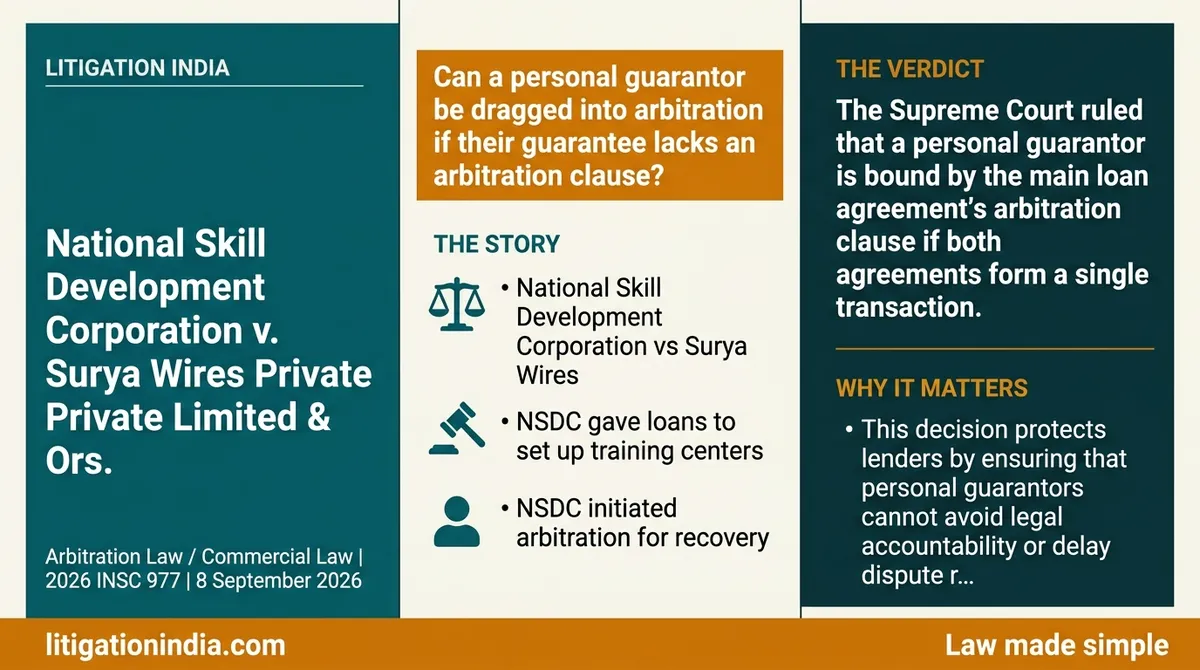
In short
This case involves the National Skill Development Corporation (NSDC), a government-backed agency that funds skill training centers, and Surya Wires Private Limited. NSDC gave loans to Surya Wires to set up training centers. As a mandatory condition before receiving the money, the Managing Director of the company (Respondent No. 2) signed personal guarantees promising to repay the loan if the company failed to do so. When the company defaulted on the loans, NSDC demanded the money back and initiated arbitration—a private dispute resolution process—against both the company and its directors, including Respondent No. 2. However, Respondent No. 2 argued that the personal guarantees he signed did not contain an arbitration clause. He argued that he should be removed from the arbitration case because he only signed the main loan agreement as a company representative, not in his personal capacity. The Arbitrator and the Delhi High Court agreed with him and removed him from the case. NSDC appealed to the Supreme Court. The Supreme Court looked closely at the loan documents and the personal guarantee documents. It found that the loan agreements explicitly stated that all facility agreements, including the personal guarantees, were an inseparable part of the main loan deal. They were signed at the same time and were part of one single commercial transaction. Therefore, under Section 7(5) of the Arbitration Act, the arbitration clause from the loan agreement was automatically active in the personal guarantee as well. The Supreme Court set aside the lower orders and ruled that Respondent No. 2 must join the arbitration proceedings. This judgment confirms that when multiple business documents are deeply interconnected, a guarantor cannot escape arbitration just because their specific guarantee paper does not repeat the arbitration clause.
Background
National Skill Development Corporation (NSDC) provided loans to Surya Wires Private Limited to set up training centers. The company's Managing Director gave personal guarantees to secure these loans. When the company defaulted on repayment, NSDC initiated arbitration, but the Managing Director claimed he could not be part of it because his personal guarantees did not contain an arbitration clause.
The Decision
The Supreme Court ruled that the personal guarantees were an integral part of the main loan agreements, forming a single transaction. Therefore, the arbitration clause in the loan agreements automatically applied to the personal guarantor, and he must participate in the arbitration.
Why it matters for you
This decision protects lenders by ensuring that personal guarantors cannot avoid legal accountability or delay dispute resolution on technical grounds. It simplifies recovery processes by keeping interconnected commercial disputes within a single arbitration instead of multiple court battles.
Relevant Legal Provisions
Key Acts and sections cited or relied upon in this judgment
“Allows an arbitration clause written in one document to become part of another contract if there is a clear reference to it.”
“Gives the arbitrator the authority to decide if they have the power to rule on a particular dispute.”
“Deals with the process of filing an appeal against certain orders passed by an arbitrator or a court.”
AI-assisted summary, reviewed and verified by our editorial team.
In the Court's words
“The Personal Guarantees do not, therefore, stand apart from the Loan Agreements, and are woven into their very fabric.”
“The intention of the parties to incorporate the Personal Guarantees into the Loan Agreements is, in these circumstances, explicit, rather than a matter of inference.”
Need help with your case?
Facing a similar legal challenge in the Supreme Court or High Court? Connect with our pro bono volunteer advocates today.
Related Supreme Court services