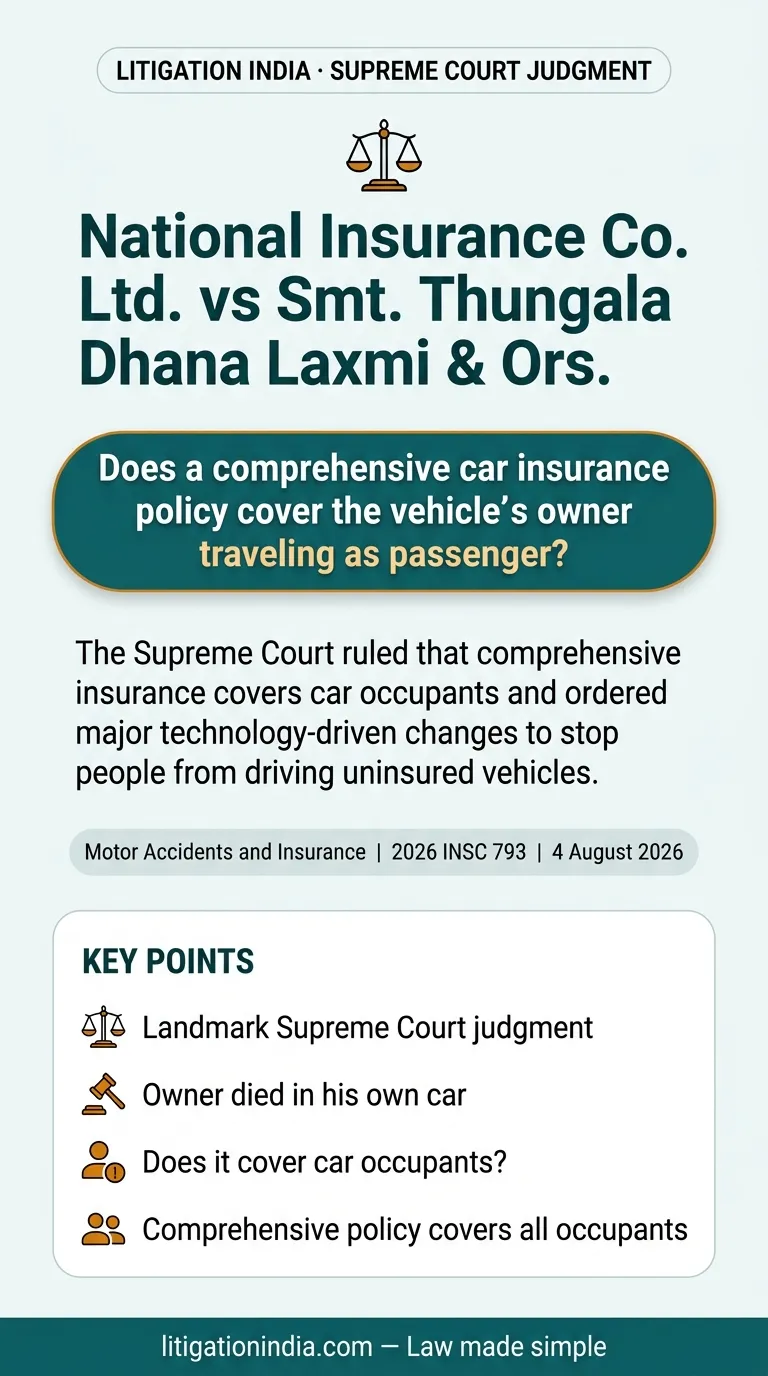
National Insurance Co. Ltd. vs Smt. Thungala Dhana Laxmi & Ors.
The big legal question
Does a comprehensive car insurance policy cover the vehicle's owner traveling as passenger?
“The Supreme Court ruled that comprehensive insurance covers car occupants and ordered major technology-driven changes to stop people from driving uninsured vehicles.”
Story Slides
In short
This case started when a car owner, Mr. T. Ramu, died in a road accident in 1996. He was traveling in his own car, which was hit by an unknown speeding lorry. His family asked for compensation from National Insurance Company, with whom the car had a comprehensive policy (a package policy that covers extra damages beyond basic third-party insurance). The Insurance Tribunal rejected the claim, saying no extra premium was paid for the owner's personal risk. However, the High Court and later the Supreme Court ruled that a comprehensive policy naturally covers all occupants, including the owner traveling as a passenger. The court rejected the insurance company's appeal and confirmed the compensation of Rs. 10.05 lakh. Moving beyond this specific case, the Supreme Court expressed shock that over 56 percent of vehicles on Indian roads are uninsured. To solve this major public safety issue, the court issued historic directions. It ordered the integration of highway cameras with government databases to send automatic fines to uninsured vehicles. It also introduced a simple four-layer policy form so buyers can easily choose add-on covers. Furthermore, the court increased the mandatory third-party insurance period for new cars to four years and two-wheelers to six years, and suggested a pilot project where petrol pumps can refuse fuel to uninsured vehicles.
Background
In 1996, a car owner died when his Maruti 800 was hit by an unknown lorry. His family sought compensation under a comprehensive insurance policy, but the insurer refused, claiming no extra premium was paid for the owner's risk.
The Decision
The Supreme Court dismissed the insurer's appeal, ruling that a comprehensive policy covers all vehicle occupants. To tackle the huge number of uninsured vehicles on roads, the court also ordered strict tech-based tracking, compulsory customer choice forms, and extended insurance durations.
Why it matters for you
This judgment ensures that families of accident victims get fair compensation easily if the vehicle has a comprehensive policy. It also makes roads safer by using technology to identify and penalize uninsured vehicles, ensuring everyone is protected.
AI-assisted summary, reviewed and verified by our editorial team.
Need help with your case?
Need help securing compensation under the Motor Vehicles Act? Our accident claims advocates can guide you.
Related Supreme Court services