Updates
Service Law / Employment
0 views

Nakhat Singh vs Union of India and Others

The big legal question

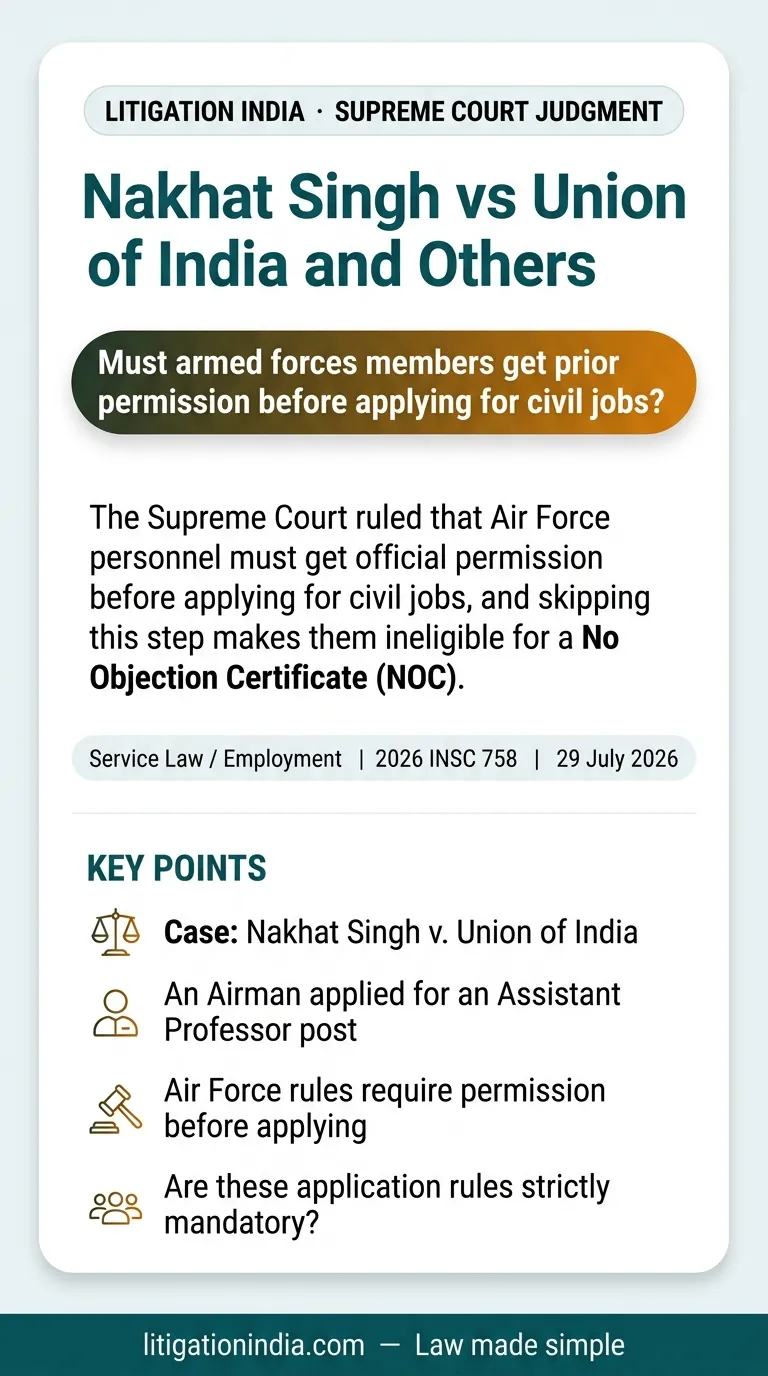
Must armed forces members get prior permission before applying for civil jobs?

“The Supreme Court ruled that Air Force personnel must get official permission before applying for civil jobs, and skipping this step makes them ineligible for a No Objection Certificate (NOC).”

Story Slides
1 / 6

Rules for Leaving the Air Force

  • Case: Nakhat Singh v. Union of India
  • Court: Supreme Court of India
  • Focus: Rules for military personnel taking civil jobs
Nakhat Singh vs Union of India and Others29 July 2026
2 / 6

Selected for a New Job

  • An Airman applied for an Assistant Professor post
  • He passed the exam and was selected
  • The Air Force refused to release him
Nakhat Singh vs Union of India and Others29 July 2026
3 / 6

Why was NOC Denied?

  • Air Force rules require permission before applying
  • The Airman had no proof of prior permission
  • He argued this was just a minor technicality
Nakhat Singh vs Union of India and Others29 July 2026
4 / 6

Is Prior Permission Mandatory?

  • Are these application rules strictly mandatory?
  • Can a successful selection excuse skipping the rules?
  • Do military members have a right to leave?
Nakhat Singh vs Union of India and Others29 July 2026
5 / 6

Supreme Court's Verdict

  • The rule to seek permission is fully mandatory
  • Skipping steps and demanding NOC is not allowed
  • Military preparedness cannot be compromised
Nakhat Singh vs Union of India and Others29 July 2026
6 / 6

Discipline in Armed Forces

  • Armed forces members cannot leave at will
  • National security requires structured staffing levels
  • Strict adherence to service rules is required
Nakhat Singh vs Union of India and Others29 July 2026

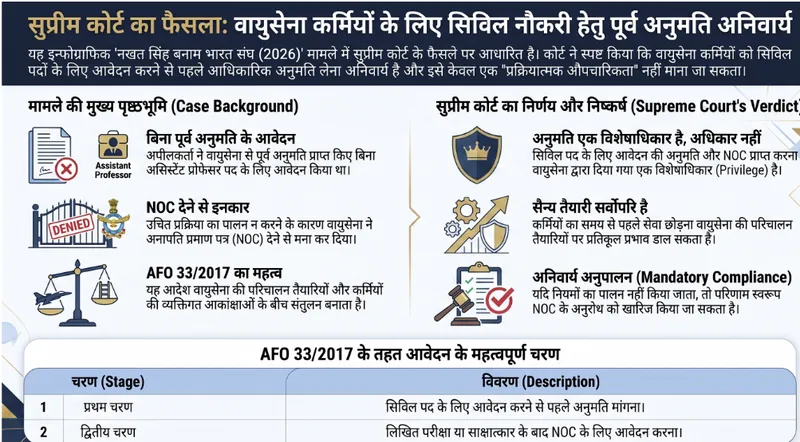
At a glance (infographic)

Nakhat Singh vs Union of India and Others — infographic summary
Download infographic

In short

The appellant, Nakhat Singh, worked as a Corporal in the Indian Air Force. After serving seven years, he applied for the post of Assistant Professor in Hindi, advertised by the Rajasthan Public Service Commission in 2020. He cleared the exams and was selected. However, when he applied for a No Objection Certificate (NOC) and discharge from the Air Force, his request was rejected. The Air Force pointed out that under Air Force Order (AFO) No. 33/2017, he was strictly required to get permission from his superiors before applying for the civil job. Nakhat Singh argued that this was a minor procedural issue that should be ignored since he was already selected. The Supreme Court rejected his argument, emphasizing that the Air Force is a highly disciplined force. Rules governing premature discharge exist to protect the country's military preparedness and cannot be bypassed at will. The Court ruled that because the guidelines clearly state that an NOC will be denied if prior permission is not taken, this requirement is mandatory, not optional. An employee cannot create a 'done deal' situation by getting selected first and then demanding an NOC. Therefore, the Supreme Court dismissed his appeal, ruling that the Air Force was right to deny him the NOC.

Background

Nakhat Singh, an Air Force Corporal, applied for a civil job as an Assistant Professor in Rajasthan and got selected. He then applied for an NOC and discharge, which the Air Force refused because he did not seek official permission before applying for the post.

The Decision

The Supreme Court dismissed the appeal, ruling that military personnel must strictly follow service rules. Since the rules clearly warn that failing to get prior permission results in NOC rejection, the requirement is mandatory and cannot be ignored.

Why it matters for you

This judgment makes it clear that members of disciplined forces like the Army, Navy, or Air Force cannot leave their service at will. They must strictly follow all procedures and obtain official clearances before seeking external jobs, as military operational readiness is of primary importance.

Photos
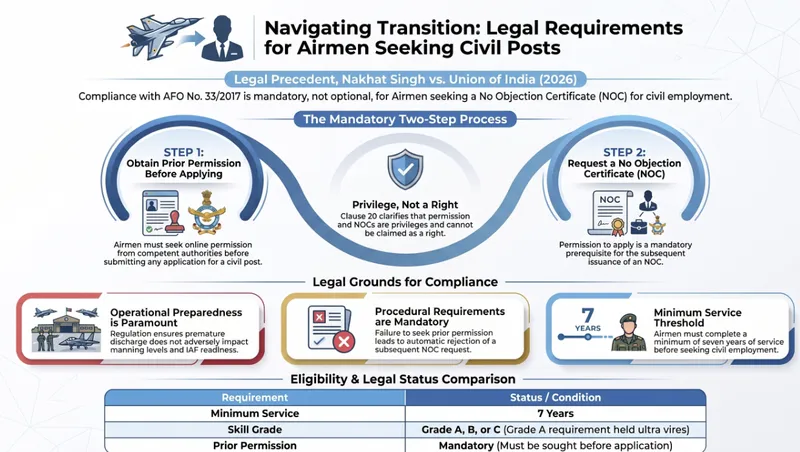
The Supreme Court dismissed the appeal of an Airman denied a No Objection Certificate (NOC) to join a civil post, holding that seeking prior permission before applying is a mandatory requirement under Air Force Order No. 33/2017 . The Court emphasized that these regulations balance personal career aspirations with the operational preparedness of the armed forces, where personnel do not have an unqualified right to resign at will .

AI-assisted summary, reviewed by our editors.

Litigation India

A public-service initiative to make justice understandable for every Indian.

contact@litigationindia.com

+91 9956486585

New Delhi, India

Quick Links

Our Mission

To make every important Supreme Court of India judgment understandable to ordinary citizens in simple English and Hindi, and to connect litigants and junior lawyers with experienced Supreme Court advocates — so that no one suffers injustice merely for lack of correct guidance.

Disclaimer: Summaries are for general public understanding only and are not legal advice. Always consult a qualified lawyer for your specific case.

© 2026 Litigation India. All rights reserved.