M/s. Saudi Arabian Airlines vs Union of India & Ors.
The big legal question
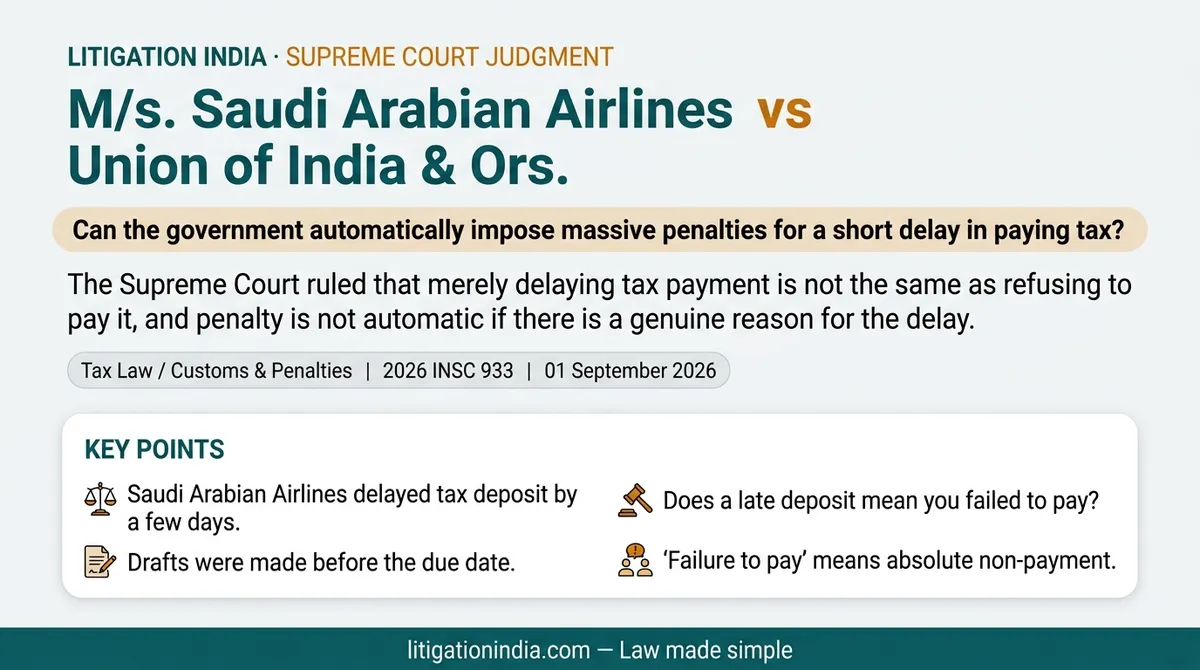
Can the government automatically impose massive penalties for a short delay in paying tax?
“The Supreme Court ruled that merely delaying tax payment is not the same as refusing to pay it, and penalty is not automatic if there is a genuine reason for the delay.”
Story Slides
In short
Saudi Arabian Airlines collects Foreign Travel Tax (FTT) from international passengers and deposits it into the government treasury. In six instances, there were minor delays (ranging from 1 day to 11 days, and one of 63 days) in depositing this tax. For five of these, demand drafts had been bought before the due date but couldn't be deposited on time due to tight airport security, while in the remaining instance, the employee concerned was on emergency leave. The customs department initially imposed a small penalty of Rs 12,000. When the airline appealed against this, the higher authority sent the matter back for reconsideration. In the fresh round, the customs officer raised the penalty to a staggering Rs 71.29 Lakhs. The airline challenged this, but the Bombay High Court upheld the huge penalty, ruling that delay is the same as non-payment, and the penalty is automatic. The Supreme Court reversed this decision. It held that 'delayed payment' is entirely different from 'non-payment'. If a taxpayer pays the tax before a formal warning (show-cause notice) is issued, it cannot be treated as a refusal to pay. The Court also emphasized that penalties are not automatic; customs officials have the power and discretion to forgive genuine delays. Finally, using the rule of 'no reformatio in peius' (no change for the worse), the Court held that appealing a decision should never result in making the litigant's situation worse. Thus, the penalty was quashed, and the government was ordered to refund any paid penalty with 9% interest.
Background
Saudi Arabian Airlines delayed depositing travel tax on 6 occasions due to bank holidays, security issues, or employee emergency leave, though they had prepared the drafts in time. The customs department initially fined them Rs 12,000, but when the airline appealed, the penalty was shockingly increased to over Rs 71 Lakhs.
The Decision
The Supreme Court quashed the massive penalty and ordered the government to refund any money paid by the airline with 9% annual interest. The Court clarified that delay is not the same as tax evasion, and a person's situation cannot be made worse just because they filed an appeal.
Why it matters for you
This judgment protects common taxpayers from automatic, harsh penalties when they have genuine, minor delays. It also secures the right to appeal by confirming that courts or authorities cannot punish you with higher fines just because you dared to challenge their original order.
AI-assisted summary, reviewed and verified by our editorial team.
In the Court's words
“‘Failure to pay’ would mean ‘non-payment’. ‘Failure to pay’ would not mean and cannot be equated with ‘delay in making payment’.”
“It cannot be said as a thumb rule that the moment there is a breach of the timeline, imposition of penalty is automatic.”
“No reformatio in peius... is a part of fair procedure and, thus, by extension can also be construed as part of natural justice. It is not only a procedural guarantee but is also a principle of equity.”
Need help with your case?
Facing a similar legal challenge in the Supreme Court or High Court? Connect with our pro bono volunteer advocates today.
Related Supreme Court services