
Updates
Arbitration Law / Enforcement and Execution of Arbitral Awards
Summarized by Adv. Om Narayan Pandey|Verified by Adv. Om Narayan Pandey, Supreme Court of India 2 views

Can a Supreme Court judgment on a certified legal question be reopened for factual clarification?

Supreme Court Limits Scope of Clarification in Arbitral Award Execution, Refers Enforcement Framework to Law Commission

Case: M/S Royal Construction Company Pvt. Ltd. vs M/S National Projects Construction CorporationCitation: 2026 INSC 1167Decided on: October 28, 2026

What this case means

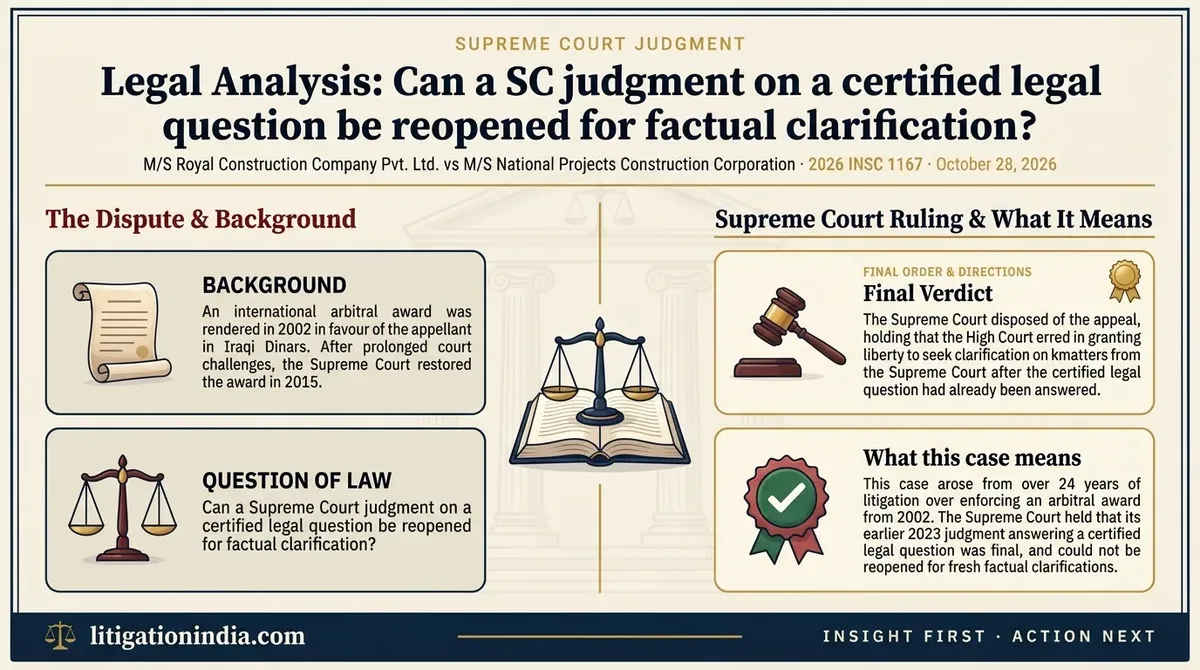
This case arose from over 24 years of litigation over enforcing an arbitral award from 2002. The Supreme Court held that its earlier 2023 judgment answering a certified legal question was final, and could not be reopened for fresh factual clarifications. The Court also referred the broader issue of delays in executing arbitral awards to the Law Commission of India.

“The Supreme Court held that its earlier certified-question judgment could not be reopened for clarification on factual matters, and referred the systemic delays in executing arbitral awards to the Law Commission of India.”

Share:

Story Slides

Case at a glance1 / 6

Supreme Court of India

Arbitral Award Enforcement: Court Sets Limits on Clarification Jurisdiction

M/S Royal Construction Company Pvt. Ltd. vs M/S National Projects Construction Corporation | 2026 INSC 1167

Court: Supreme Court of India, Civil Appellate JurisdictionDate of decision: October 28, 2026Bench: Justice Vikram Nath, Justice Sandeep Mehta, Justice Aparesh Kumar SinghArea of law: Arbitration Law, Enforcement and Execution of Arbitral Awards
A 2002 arbitral award remained unenforced for over 24 years — prompting the Court to call for systemic reform.
M/S Royal Construction Company Pvt. Ltd. vs M/S National Projects Construction Corporation · 2026 INSC 1167October 28, 2026
The legal question2 / 6

Can a Supreme Court Certified-Question Judgment Be Reopened for Factual Clarification?

Core legal issue before the Court

  • Appellant: The High Court erred in granting liberty to reopen issues already settled by the Supreme Court's 2023 judgment.
  • Respondent: The principal amount had already been paid in Indian Rupees in 2009, a fact not placed before the Court earlier.
  • Respondent (MA): The 2023 judgment should be modified to reflect the prior payment of principal in INR.
M/S Royal Construction Company Pvt. Ltd. vs M/S National Projects Construction Corporation · 2026 INSC 1167October 28, 2026
The Court's reasoning3 / 6

Court's Reasoning: From Certified Question to Final Order

Step-by-step legal reasoning

  1. 1Step 1: High Court certified a substantial question of law under Articles 134-A and 133(1)(a) of the Constitution.
  2. 2Step 2: Supreme Court's appellate jurisdiction was strictly confined to answering only that certified question.
  3. 3Step 3: By 2023 judgment, Court answered: no conversion date needed; payment to be in foreign currency.
  4. 4Step 4: That answer exhausted the scope of the earlier appellate proceedings — it cannot be expanded.
  5. 5Step 5: Factual disputes about deposited/withdrawn amounts must be resolved before the executing court, not the Supreme Court.
M/S Royal Construction Company Pvt. Ltd. vs M/S National Projects Construction Corporation · 2026 INSC 1167October 28, 2026
Statutory comparison4 / 6

Arbitral Award Enforcement: What the Law Provides vs What This Case Reveals

Key statutory provisions and their practical gaps

ProvisionWhat the Law ProvidesWhat This Case Reveals
Section 36, Arbitration and Conciliation Act, 1996Arbitral award enforced as a court decree under CPC, 1908Over 24 years since award; enforcement still incomplete
Sections 34 & 37, Arbitration and Conciliation Act, 1996Grounds for challenging an award are strictly limitedDespite limited grounds, court challenges extended for decades
Articles 134-A & 133(1)(a), Constitution of IndiaCertification of substantial question of law for Supreme Court appealOnce question answered, scope of proceedings is exhausted; factual issues remain for executing court
M/S Royal Construction Company Pvt. Ltd. vs M/S National Projects Construction Corporation · 2026 INSC 1167October 28, 2026
The verdict5 / 6

The Court's Final Decision

Fact, Law, and Result

  • The Fact: A 2002 arbitral award remained unenforced for over 24 years; respondent claimed principal was paid in INR in 2009.
  • The Law: Supreme Court's jurisdiction under the certification route is confined to the certified question; once answered, proceedings are exhausted.
  • The Result: Appeal disposed; MA dismissed; factual disputes referred to executing court; Law Commission directed to study enforcement framework.
Appeal disposed; MA dismissed; Registry to forward judgment to the Law Commission of India for study on arbitral award enforcement.
M/S Royal Construction Company Pvt. Ltd. vs M/S National Projects Construction Corporation · 2026 INSC 1167October 28, 2026
Why it matters6 / 6

Why This Judgment Matters for Ordinary People

Practical significance

  • Winning an arbitration award is meaningless if enforcement takes over two decades — this case highlights the urgent need for reform.
  • Parties cannot use the 'clarification' route to reopen concluded Supreme Court rulings on factual disputes.
  • The Law Commission has been asked to recommend faster, more effective ways to enforce arbitral awards in India.
  • Factual disputes about payments made during execution must be raised before the executing court, not the Supreme Court.
Arbitration wins must translate into actual recovery — the law must ensure timely enforcement, not just timely awards.
M/S Royal Construction Company Pvt. Ltd. vs M/S National Projects Construction Corporation · 2026 INSC 1167October 28, 2026

At a glance (infographic)

M/S Royal Construction Company Pvt. Ltd. vs M/S National Projects Construction Corporation — infographic summary
Download infographic

In short

The case concerns an arbitral award dated 10th August, 2002, rendered in favour of the appellant, M/S Royal Construction Company Pvt. Ltd., with amounts denominated in Iraqi Dinars. The award-debtor, M/S National Projects Construction Corporation, challenged the award in Indian courts. By judgment dated 24th February, 2015, the Supreme Court restored the original award directions, emphasising minimal judicial intervention. In execution proceedings, the High Court in 2017 directed currency conversion at the 1982 exchange rate. On appeal, the Division Bench set aside that order and certified a substantial question of law under Articles 134-A and 133(1)(a) of the Constitution regarding the correct date for USD to INR conversion. By judgment dated 10th October, 2023, the Supreme Court answered that no occasion arose to fix a conversion date as payment was to be made in foreign currency. Thereafter, the respondent claimed the principal had already been paid in Indian Rupees in 2009. The High Court, by an interim order dated 16th February, 2026, granted liberty to seek clarification from the Supreme Court. The Supreme Court, in this appeal, dismissed the attempt to reopen the earlier judgment. It held that its jurisdiction in the previous appeal was strictly confined to answering the certified question, and could not be expanded to adjudicate factual disputes about deposited amounts. The Court also dismissed a Miscellaneous Application seeking modification of the 2023 judgment for the same reason, preserving the respondent's right to raise set-off claims before the executing court. Notably, the Court expressed serious concern about over 24 years of enforcement delays and directed the Law Commission of India to study the arbitral award execution framework and recommend improvements.

Need clarity on a similar legal issue?

Request free pro bono guidance from a Supreme Court Advocate.

Request Guidance

Background

An international arbitral award was rendered in 2002 in favour of the appellant in Iraqi Dinars. After prolonged court challenges, the Supreme Court restored the award in 2015. In 2023, the Supreme Court answered a certified substantial question of law, holding that no date for currency conversion needed to be fixed as payment was to be made in foreign currency. The respondent then claimed the principal had already been paid in Indian Rupees in 2009, prompting the High Court to seek clarification from the Supreme Court.

The Decision

The Supreme Court disposed of the appeal, holding that the High Court erred in granting liberty to seek clarification on factual matters from the Supreme Court after the certified legal question had already been answered. The Miscellaneous Application seeking modification of the 2023 judgment was dismissed, with the parties directed to raise adjustment or set-off claims before the executing court. The Court also directed the Registry to forward the judgment to the Law Commission of India for a focused study on arbitral award enforcement.

Why it matters for you

This judgment makes clear that parties cannot misuse the 'clarification' route to reopen concluded Supreme Court proceedings on factual disputes, protecting the finality of court decisions. More broadly, the Court's direction to the Law Commission highlights that winning an arbitration award means little if enforcement takes decades, and calls for systemic reform to make arbitration a truly effective alternative to litigation. Ordinary businesses and individuals seeking to enforce contracts through arbitration stand to benefit if the Law Commission recommends faster and more certain execution procedures.

Relevant Legal Provisions

Key Acts and sections cited or relied upon in this judgment

“Sections 34 and 37 set out the limited grounds for challenging an arbitral award, and Section 36 provides for enforcement of an arbitral award as a decree of the court; the Court cited these provisions to underscore the principle of minimal judicial intervention and to note that the execution framework under Section 36 warrants closer scrutiny.”
“These articles govern the certification of substantial questions of law of general importance for appeal to the Supreme Court; the High Court had certified such a question, and the Supreme Court held that its jurisdiction was confined to answering only that certified question.”
“The Code of Civil Procedure provides the ordinary machinery of execution upon which Section 36 of the Arbitration and Conciliation Act, 1996 draws for enforcement of arbitral awards; the Court noted this framework warrants scrutiny for adequacy.”
“The original arbitration in this case was invoked when the Arbitration Act, 1940 was in force, which the Court noted to highlight the extraordinary duration of the proceedings spanning both the old and new arbitration regimes.”

Full text of the judgment

Text extracted from M/S Royal Construction Company Pvt. Ltd. vs M/S National Projects Construction Corporation. For the authoritative version refer to the Supreme Court of India's official website.

2026 INSC 1167 C.A. @ SLP (C) NO. 14005 of 2026

REPORTABLE IN THE SUPREME COURT OF INDIA CIVIL APPELLATE JURISDICTION CIVIL APPEAL NO(S). OF 2026 (ARISING OUT OF SLP (C) NO. 14005 of 2026)

M/S ROYAL CONSTRUCTION COMPANY PVT. LTD.

…APPELLANT(S)

VERSUS M/S NATIONAL PROJECTS CONSTRUCTION CORPORATION …RESPONDENT(S) AND MISCELLANEOUS APPLICATION @ DIARY NO. 48152 OF 2026 IN CIVIL APPEAL NO. 1991 OF 2019

J U D G M E N T VIKRAM NATH, J. Civil Appeal @ SLP (C) No. 14005 of 2026 1. Leave granted. 2. Heard Mr. Rishabh Sancheti, learned counsel appearing for the appellant, and Mr. Vikramjit Banerjee, learned Additional Solicitor General appearing for the respondent. 3. The present appeal assails the interim order dated 16th February, 2026, passed by the High Court of Delhi at Digitally signed by SONIA BHASIN Date: 2026.10.28 16:49:47 IST Reason: Signature Not Verified

C.A. @ SLP (C) NO. 14005 of 2026

New Delhi1 in Execution First Appeal (Original Side) No. 17 of 2018, whereby the parties were granted liberty to seek clarification from this Court as to why the fact that the principal amount had already been paid in Indian Rupees in 2009, pursuant to the orders passed by the High Court, had not been brought to its notice on an earlier occasion when this Court had the opportunity to consider and answer the substantial question of law framed by the High Court under Article 134-A read with Article 133(1)(a) of the Constitution of India. 4. The brief facts relevant to the disposal of the present appeal are as follows: 4.1. The appellant is the award-holder, while the respondent is the award-debtor. Pursuant to an internationally seated arbitration, an arbitral award dated 10th August, 2002, was rendered in favour of the appellant, with the amounts awarded denominated in Iraqi Dinars. 4.2. The award was challenged before the Indian courts, culminating in proceedings before this Court. By judgment dated 24th February, 2015, this Court underscored the principle of minimal judicial intervention in arbitral awards, holding that the courts ought not to substitute their own subjective

1 Hereinafter, referred to as “High Court”.

C.A. @ SLP (C) NO. 14005 of 2026

satisfaction for that of the arbitral tribunal unless the statutory grounds for interference under Sections 34 and 37 of the Arbitration and Conciliation Act, 1996, are made out. Accordingly, this Court restored the directions contained in the award dated 10th August, 2002. 4.3. Thereafter, the appellant initiated execution proceedings before the High Court. By order dated 26th July, 2017, the High Court directed that the award-debtor could discharge its liability in Indian currency, with the conversion to be made at the exchange rate prevailing on the date of the underlying agreement, i.e., 26th September, 1982. 4.4. Aggrieved by the aforesaid order, the appellant preferred an appeal before the Division Bench of the High Court. By order dated 17th December, 2019, the Division Bench set aside the order passed by the Single Judge and certified a substantial question of law of general importance under Articles 134-A and 133(1)(a) of the Constitution of India for consideration by this Court. The question, being germane to the controversy, is reproduced hereinbelow: - “In terms of the agreement dated 29th June, 1982, between the parties and in light of the judgment dated 24th February, 2015 of the Supreme Court of India in Civil Appeal Nos. 2543-44/2015, what

C.A. @ SLP (C) NO. 14005 of 2026

should be the relevant date for conversion of awarded sum from USD to Indian rupees?” 4.5. By judgment dated 10th October, 2023, this Court answered the aforesaid question in the negative, holding that no occasion arose for determining or fixing a date for conversion of US Dollars into Indian Rupees (INR). This Court further cautioned that the terms of the agreement, the arbitral award, and the directions contained in its judgment dated 24th February, 2015, ought not to be disturbed. 4.6. Thereafter, the appellant continued to pursue the execution proceedings before the High Court. While those proceedings were pending, the respondent contended that the principal amount had already been paid in 2009 pursuant to the orders passed by the High Court. By an interim order dated 16th February, 2026, the High Court granted liberty to the parties to seek clarification from this Court in that regard. 5. Hence, the appellant is before us. 6. We have perused the material on record and considered the submissions advanced on behalf of the parties. 7. In our considered opinion, the Division Bench has fallen into error in appreciating the scope of the controversy previously adjudicated by this Court. A perusal of the judgment dated 10th October, 2023,

C.A. @ SLP (C) NO. 14005 of 2026

makes it evident that this Court, while exercising appellate jurisdiction, was called upon to answer the substantial question of law of general importance certified by the High Court. The scope of consideration was, therefore, confined to answering the question so referred, without undertaking an examination of factual matters beyond its ambit. 8. Having held that no occasion arose for determining or fixing a date for conversion of the amount into Indian Rupees and that payment was to be made in foreign currency, this Court had no occasion to issue any further clarification on factual questions concerning the amounts deposited or their subsequent withdrawal. 9. The order of the executing court was assailed before the Division Bench of the High Court, which, upon certifying a substantial question of law of general importance under Articles 134-A and 133(1)(a) of the Constitution, referred the question to this Court. The jurisdiction exercised by this Court was confined to answering that question. This Court cannot be called upon, in the guise of seeking clarification, to assume a supervisory role over the continuing execution proceedings or to adjudicate upon every issue that may arise therein. It is for the competent court seized of the execution proceedings, and the appellate court exercising jurisdiction over its orders, to determine the questions arising in accordance with law.

C.A. @ SLP (C) NO. 14005 of 2026

10. Once the substantial question of law referred to this Court stood answered, the scope of the earlier appellate proceedings stood exhausted. It would be impermissible to enlarge the scope of that adjudication by seeking answers to questions that are distinct from, and unconnected with, the lis previously decided. Epilogue: 11. Before parting, we deem it appropriate to express our concern at the protracted course which the present proceedings have taken. The arbitration in the present case was invoked when the Arbitration Act, 1940 held the field. We are now approaching three decades under the Arbitration and Conciliation Act, 1996, enacted, inter alia, in furtherance of the UNCITRAL Model Law and with the objective of facilitating the expeditious resolution of disputes through minimal judicial intervention. However, more than twenty-four years after the arbitral award was rendered, the parties continue to litigate over its enforcement. Such a state of affairs strikes at the very rationale underlying the adoption of arbitration as an effective alternative to conventional civil litigation. 12. The efficacy of an arbitral regime cannot be measured merely by the expedition with which an award is rendered or the circumscribed grounds upon which it may be challenged. It must equally be assessed by the

C.A. @ SLP (C) NO. 14005 of 2026

ability of the successful party to realise the fruits of the award within a reasonable time. The promise of arbitration remains unfulfilled if a party, having traversed the arbitral process, is compelled to embark upon another protracted course of litigation to secure the benefit of the award. 13. While the statutory framework governing arbitration has sought to address delays in arbitral proceedings, challenges to awards and the grant of stays on their enforcement, the process of actual execution warrants equally serious consideration. Section 36 of the Arbitration and Conciliation Act, 1996 provides for enforcement of an arbitral award in the same manner as a decree of the Court, thereby drawing upon the ordinary machinery of execution under the Code of Civil Procedure, 1908. The experience of cases such as the present one calls for a closer examination of whether this framework adequately serves the objectives of arbitration. In particular, the identification and disclosure of the award-debtor’s assets, the coordination of different modes of execution, the disposal of repetitive or dilatory objections, and the time taken to conclude execution proceedings merit focused scrutiny. Comparative legal systems may offer useful insights into more effective and coordinated enforcement mechanisms, while preserving the

C.A. @ SLP (C) NO. 14005 of 2026

legitimate procedural safeguards available to judgment-debtors. 14. In these circumstances, we request the Law Commission of India to undertake a focused study of the statutory and procedural framework governing the enforcement and execution of arbitral awards. The study may identify the practical impediments to timely recovery, examine the experience of other jurisdictions, and consider whether domestic and foreign arbitral awards warrant distinct enforcement procedures or a common framework with appropriate safeguards. The Commission may, upon such examination, make such legislative or procedural recommendations as it considers necessary to strengthen the execution regime and ensure that the enforcement of arbitral awards is commensurate with the objectives of the Arbitration and Conciliation Act, 1996 and India’s commitment to establishing itself as an arbitration-friendly jurisdiction. 15. The appeal is disposed of in the above terms. 16. The Registry shall forward a copy of this judgment to the Hon’ble Chairman of the Law Commission of India. 17. All pending application(s), if any, stand disposed of.

C.A. @ SLP (C) NO. 14005 of 2026

M.A. @ Diary No. 48152 of 2026 in Civil Appeal No. 1991 of 2019

18. M.A @ Dairy No. 48152 of 2026 is taken on board. 19. The present Miscellaneous Application has been filed by the appellant in the disposed of civil appeal, seeking modification of the judgment dated 10th October, 2023, on the ground that the amounts deposited by it, in its capacity as the award-debtor, in Indian rupees pursuant to the order of the High Court had already been withdrawn by the respondent, the award-holder, in 2009. 20. As already observed, the lis in the earlier appeal was confined to the interpretation of the substantial question of law of general importance. This Court was, therefore, not called upon to adjudicate upon factual questions concerning the amounts so deposited or their subsequent withdrawal. 21. In view of the above, the Miscellaneous Application is dismissed. 22. Needless to state, the applicant shall be at liberty to raise all objections and contentions concerning the

C.A. @ SLP (C) NO. 14005 of 2026

adjustment or set-off of the aforesaid amounts before the executing court, in accordance with law.

……………………………………J. [VIKRAM NATH]

……………………………………J. [SANDEEP MEHTA]

……………………………………J. [APARESH KUMAR SINGH] NEW DELHI; OCTOBER 28, 2026

AI-assisted summary, reviewed and verified by our editorial team.

In the Court's words

“This Court cannot be called upon, in the guise of seeking clarification, to assume a supervisory role over the continuing execution proceedings or to adjudicate upon every issue that may arise therein.”
“Once the substantial question of law referred to this Court stood answered, the scope of the earlier appellate proceedings stood exhausted.”
“The promise of arbitration remains unfulfilled if a party, having traversed the arbitral process, is compelled to embark upon another protracted course of litigation to secure the benefit of the award.”
“The efficacy of an arbitral regime cannot be measured merely by the expedition with which an award is rendered or the circumscribed grounds upon which it may be challenged.”

Need help with your case?

Facing a similar legal challenge in the Supreme Court or High Court? Connect with our pro bono volunteer advocates today.

Request Free Callback
Litigation India

Insight First, Action Next. A public-service initiative to make justice understandable for every Indian.

contact@litigationindia.com

+91 9956486585

New Delhi, India

Quick Links

Our Mission

To empower ordinary citizens, litigants, and junior advocates across India by translating complex Supreme Court of India judgments into editor-verified, plain-language summaries in both English and Hindi. We aim to bridge the gap between judicial proceedings and everyday citizens by delivering verified legal insights and offering free, pro bono guidance from experienced Supreme Court advocates—ensuring no individual suffers injustice merely for lack of correct guidance.

Legal Disclaimer: The information and case summaries on this website are provided for general public understanding only and do not constitute legal advice. Accessing this website or any guidance here does not create an attorney-client relationship, which is established only upon a formal engagement with a lawyer. Litigation India is an informational, public-service platform — always consult a qualified advocate before acting on any information relating to your specific matter.

© 2026 Litigation India. All rights reserved.