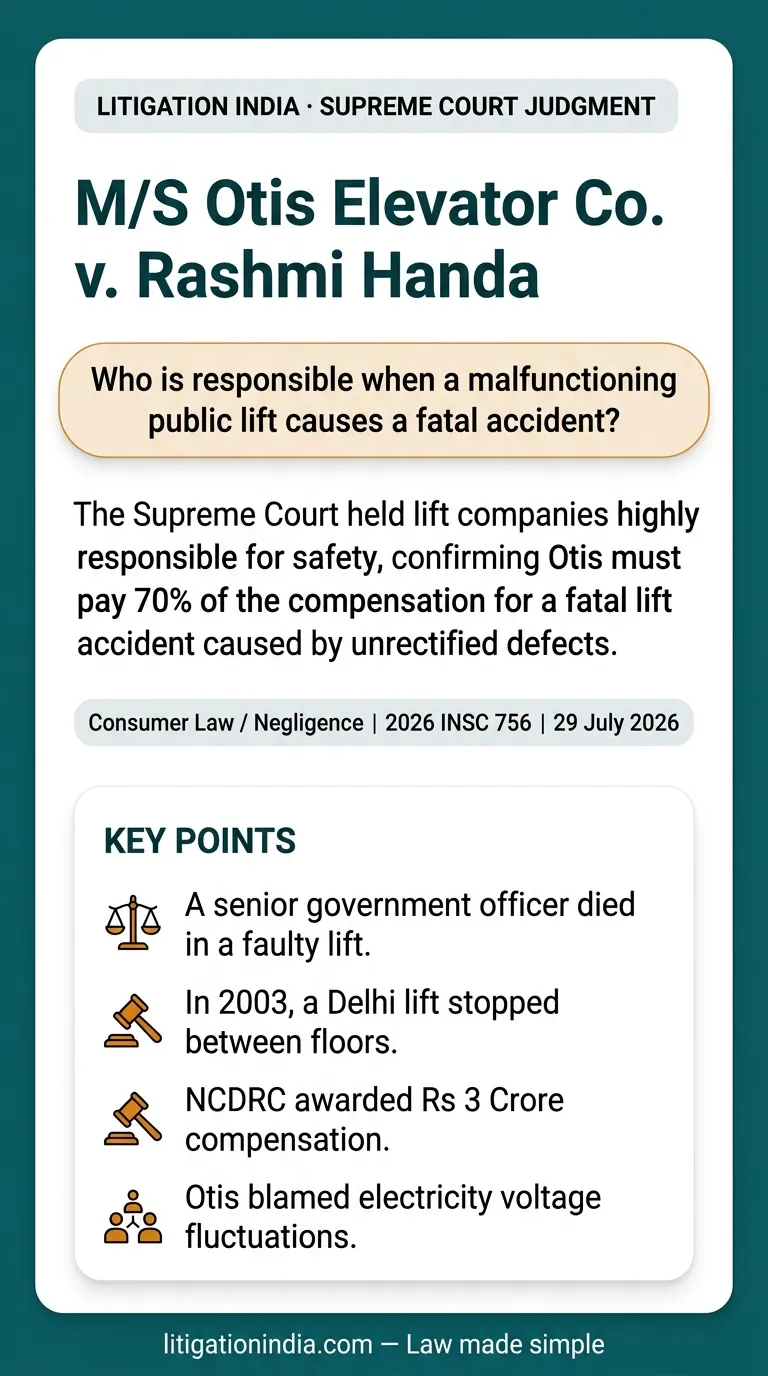
M/S Otis Elevator Co. v. Rashmi Handa
The big legal question
Who is responsible when a malfunctioning public lift causes a fatal accident?
“The Supreme Court held lift companies highly responsible for safety, confirming Otis must pay 70% of the compensation for a fatal lift accident caused by unrectified defects.”
Story Slides
In short
In this important case, the Supreme Court of India decided who is responsible when a passenger lift breaks down and causes a fatal accident. A senior officer died in 2003 when a newly installed lift in a government building stopped between floors. During a rescue attempt, the lift suddenly dropped, crushing him. The victim's family asked the National Consumer Commission (NCDRC) for compensation. The Commission blamed three parties: the lift maker and maintainer (Otis) was held 70% responsible, the maintenance department (MES) 25% responsible, and the office (RAW) 5% responsible. Otis appealed to the Supreme Court, claiming they were not at fault. They argued that the accident happened because someone else manually released the brakes. The Supreme Court rejected Otis's arguments. The Court declared that passenger lifts are like public transport, meaning the companies that make and maintain them owe a very high duty of safety to the public. Otis knew about frequent voltage problems and breakdowns for months but did not fix them, did not stop the lift from being used, and failed to train the building staff on safe rescues. Therefore, the Supreme Court dismissed Otis's appeal, upheld the 70% liability on Otis, and ordered that the victim's family receive their full compensation of over Rs. 3 crore with interest.
Background
In March 2003, a newly installed Otis lift in a government building in New Delhi stopped working between floors with 13 people inside. While a senior officer was being rescued, the lift suddenly fell, crushing and killing him. The family sued for compensation, blaming the lift company, the maintenance team, and the office department.
The Decision
The Supreme Court dismissed Otis's appeal and upheld the Consumer Commission's order. It ruled that Otis is 70% responsible for the tragedy because they ignored repeated breakdowns and failed to provide safety training, and ordered the execution of the compensation decree to proceed immediately.
Why it matters for you
This judgment is a shield for common people using lifts in high-rise buildings and offices. It establishes that lift manufacturing and maintenance companies cannot escape liability by blaming local staff for rescue errors if the lift itself had chronic unfixed defects.
AI-assisted summary, reviewed and verified by our editorial team.
Need help with your case?
Facing a similar legal challenge in the Supreme Court or High Court? Connect with our pro bono volunteer advocates today.
Related Supreme Court services