
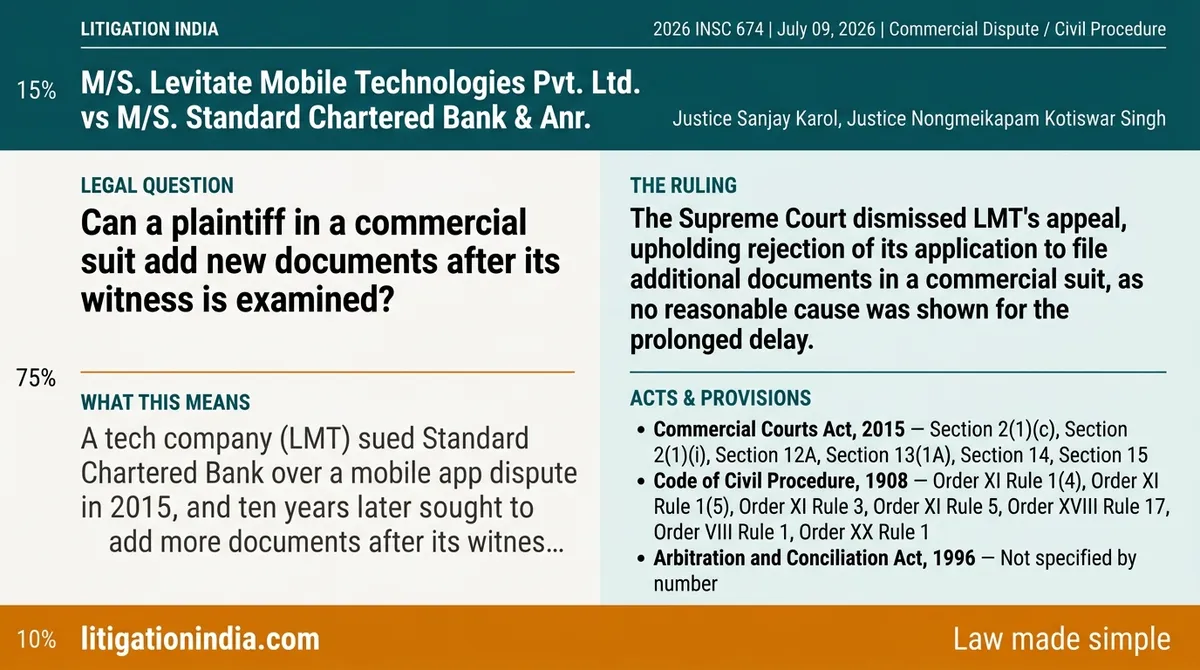
Can a plaintiff in a commercial suit add new documents after its witness is examined?
Court Rejects Belated Plea to File Additional Documents in Commercial Suit
Case: M/S. Levitate Mobile Technologies Pvt. Ltd. vs M/S. Standard Chartered Bank & Anr.Citation: 2026 INSC 674Decided on: July 09, 2026
What this case means
A tech company (LMT) sued Standard Chartered Bank over a mobile app dispute in 2015, and ten years later sought to add more documents after its witness was already examined. The Supreme Court dismissed the appeal, upholding the High Court's rejection of the application. The ruling reinforces that commercial courts must strictly enforce timelines to ensure speedy resolution of business disputes.
“The Supreme Court dismissed LMT's appeal, upholding rejection of its application to file additional documents in a commercial suit, as no reasonable cause was shown for the prolonged delay.”
Story Slides
In short
M/S. Levitate Mobile Technologies Pvt. Ltd. (LMT) had entered into an IT Professional Services Agreement with Standard Chartered Bank (SCB) on 19th February 2013 to develop and manage a mobile app. After the app was launched and then taken down at SCB's instruction, LMT alleged losses under a revenue sharing clause and filed Civil Suit No.1705 of 2015 before the Delhi High Court, claiming Rs. 4,46,50,000 with 18% interest. The suit was renumbered as CS(Comm.) 169 of 2018 under the Commercial Courts Act, 2015. Issues were framed in 2016 and examination of LMT's first witness (PW-1) was completed in May 2023. LMT then filed IA No. 24359 of 2023 seeking to place additional documents on record — emails, vendor agreements, and backend server data — and to recall PW-1. The Delhi High Court's Single Judge rejected this application in February 2025, finding no reasonable cause for the delay and holding that allowing it would be contrary to the objectives of the Commercial Courts Act, 2015. LMT appealed to the Supreme Court. The Supreme Court dismissed the appeal. It held that even applying the lower 'reasonable cause' standard (rather than 'sufficient cause'), LMT showed no justification for the delay. The Court emphasised that all documents sought were already in LMT's possession at the time of filing the plaint and during the earlier additional evidence application. It found that allowing a second round of additional documents would endorse a piecemeal approach incompatible with the CCA's mandate for expeditious resolution of commercial disputes. The Court also rejected LMT's argument that CCA's strict procedures did not apply to its pending suit, holding that Section 15 CCA expressly applies to transferred pending suits. The suit was directed to be decided as expeditiously as possible.
Need clarity on a similar legal issue?
Request free pro bono guidance from a Supreme Court Advocate.
Background
LMT and SCB entered into an IT Professional Services Agreement in February 2013 for developing a mobile app, which was later taken down by SCB. LMT claimed losses under a revenue sharing clause and filed a civil suit in 2015 before the Delhi High Court seeking Rs. 4,46,50,000. After the suit was renumbered as a commercial suit in 2018 and PW-1's evidence was completed in May 2023, LMT filed an application seeking to place additional documents on record and recall PW-1.
The Decision
The Supreme Court dismissed LMT's appeal and agreed entirely with the Delhi High Court's rejection of the application to file additional documents. It held that no reasonable cause was made out for the delay, that all documents were already in LMT's possession, and that allowing a second round of additional documents would endorse a piecemeal approach contrary to the Commercial Courts Act, 2015. The Court directed that the suit be decided as expeditiously as possible.
Why it matters for you
This ruling makes clear that parties in commercial suits cannot keep adding documents in a piecemeal manner after evidence has begun; they must produce all relevant documents upfront or within the strict timelines set by the Commercial Courts Act. For businesses, this means thorough preparation before filing suits is essential. The judgment reinforces India's commitment to speedy resolution of commercial disputes to improve the ease of doing business.
Relevant Legal Provisions
Key Acts and sections cited or relied upon in this judgment
“This Act establishes commercial courts for speedy resolution of commercial disputes; Section 15 was applied to hold that CCA procedures apply to all pending suits transferred to commercial courts, and the Court used the Act's strict timelines to reject LMT's belated application for additional documents.”
“Order XI Rule 1(4) as amended by the Commercial Courts Act requires a plaintiff to file additional documents within thirty days of filing the suit with leave of court and reasonable cause; the Court found LMT failed to meet this standard, justifying rejection of its application.”
“Cited in the context of State of Maharashtra v. Borse Bros. to discuss the meaning of 'sufficient cause' and the shared objective of speedy dispute resolution under both the Arbitration Act and the Commercial Courts Act.”
AI-assisted summary, reviewed and verified by our editorial team.
In the Court's words
“What cannot be countenanced is a stop and go or a piecemeal approach. Voluminous evidence too, is entirely an uninspiring ground.”
“Evidence, however voluminous, cannot water down the statutory intent and rigours of the statute.”
“We may say that even a snail may question the speed at which this trial is proceeding.”
“The whole object of the law is clear as daylight. Disputes of a commercial hue, must be extinguished with the highest level of expedition.”
Need help with your case?
Facing a similar legal challenge in the Supreme Court or High Court? Connect with our pro bono volunteer advocates today.
Related Supreme Court services